The rise of artificial intelligence raises questions about investments, public debt, and financial markets. For Arthur Hayes, chief investment officer at Maelstrom, the bursting of this bubbl
The rise of artificial intelligence raises questions about investments, public debt, and financial markets. For Arthur Hayes, chief investment officer at Maelstrom, the bursting of this bubble could benefit bitcoin. According to him, the bailout plans for the affected companies would increase the money supply and favor safe-haven assets. However, this bullish outlook faces several obstacles, including risks linked to quantum computers and capital outflows from US spot ETFs.
In Brief
- Arthur Hayes believes the bursting of the AI bubble could trigger financial bailouts favorable to bitcoin.
- An increase in the money supply and inflation could strengthen the appeal of safe-haven assets.
- Fidelity notes a record correlation of 0.6 between bitcoin and the yields of 10-year US bonds in 2026.
- Quantum threat and $228 million outflows from US Bitcoin ETFs limit the bullish outlook.
Arthur Hayes Anticipates a Bitcoin Rebound After the AI Bubble
In a recent interview with Luke Martin, Arthur Hayes explained why the bursting of the artificial intelligence bubble could support bitcoin. The Maelstrom executive believes that the spending in this sector raises questions about its profitability. He also believes financial difficulties among large companies could lead Washington to intervene.
Hayes specifically cites Anthropic, OpenAI, and SpaceX, which would benefit from US government support. According to him, these companies do not yet generate sufficient profits to justify their situation. He anticipates support measures if their difficulties worsen. Such interventions could alter financial conditions and enhance the appeal of cryptocurrencies.
In this scenario, the authorities would inject more money to limit the consequences of a crisis. This increase in the money supply could then fuel inflation and reduce purchasing power. Investors would then seek to protect their wealth with assets like gold and bitcoin. Hayes associates this mechanism with monetary devaluation, which can favor assets perceived as stores of value.
The market already offers a point of comparison. This week, the bitcoin price defended the $80,000 level despite massive sell-offs hitting chip makers and tech stocks. These sales would have been two to five times greater than those observed for bitcoin. This resistance illustrates a price evolution but does not alone confirm the scenario envisaged by Hayes.
Your 1st cryptos with BitpandaThis link uses an affiliate program.
US Debt and Bond Yields Strengthen Bullish Expectations
Arthur Hayes is not alone in mentioning a favorable environment for cryptocurrencies. Ceteris Paribus, research director at Delphi Research, also highlights the importance of financial flows on the internet. According to him, monetary depreciation linked to debt and a possible bailout of the AI sector could feed capital inflows into bitcoin.
Financial flows on the internet are very positive. The depreciation due to the current debt situation and the bailout by a Ponzi-like pyramid scheme of AI generate significant BTC flows.
Ceteris Paribus, Research Director at Delphi, source: AMBCRYPTO.
US public debt has reached $40.3 trillion and continues to grow, regardless of which party is in power. A support plan for artificial intelligence companies could further increase this burden. Consequently, investors might monitor federal spending and its effects on the currency value more closely.
Fidelity also notes a growing link between bond yields and bitcoin. According to the asset manager, their correlation with 10-year US Treasury bonds reached 0.6 in 2026. In the last two months, yields increased by 10%, and BTC saw a 30% gain. These parallel developments support the hypothesis of potential market support.
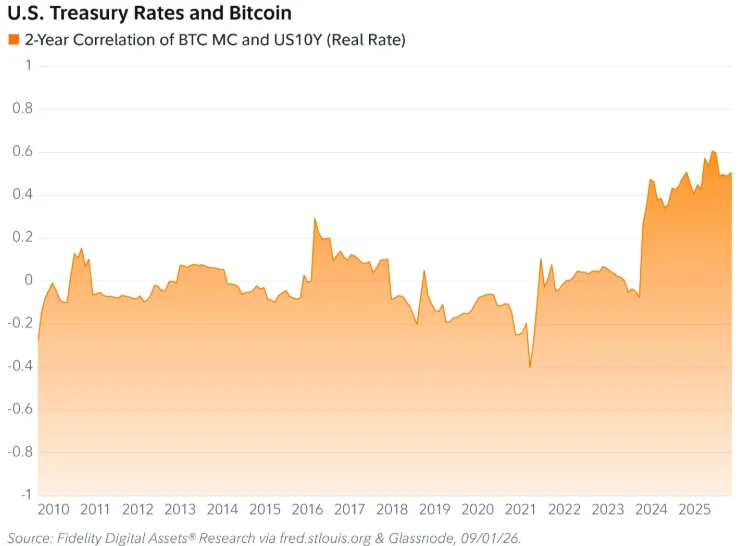 The correlation between bitcoin and yields of 10-year US bonds reaches 0.6 in 2025, according to Fidelity.
If this relationship holds, rising yields could accompany a new rise in bitcoin. Fidelity points out a broader budgetary issue: interest on the debt could soon become the largest federal expense. In this context, investors might place greater importance on alternative stores of value, although this evolution does not guarantee a sustained price increase.
Quantum Threat and ETF Outflows Limit the Prospects
Despite these arguments, several risks could slow bitcoin’s progress. Ceteris Paribus notably believes that advances in artificial intelligence and Google’s progress in quantum computing increase concerns. Eventually, this technology could weaken certain cryptographic protections and weigh on investor confidence.
The researcher nevertheless considers that monetary depreciation will remain a favorable factor. However, he believes BTC will no longer be the only store of value sought by investors. According to this analysis, the quantum threat could limit expected gains, even if debt tensions support demand.
Exchange-traded fund flows also provide a mixed signal. US spot Bitcoin ETFs recorded an additional $228 million in outflows this week. This marks their second consecutive week of withdrawals in October, indicating less favorable institutional demand in the short term.
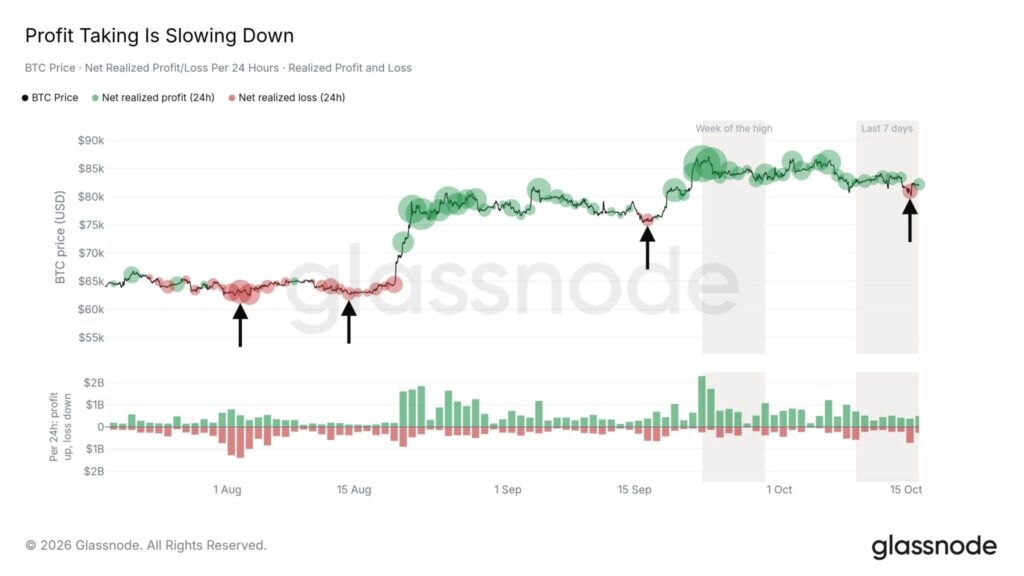 The slowdown in profit-taking could signal a floor around $80,000, according to Glassnode.
However, Glassnode observes a slowdown in profit-taking after this weekly capitulation phase. This development could signal the formation of a floor around $80,000. However, it is not sufficient to confirm this level durably.
In the short term, bitcoin will therefore depend on the evolution of financial flows, bond yields, and technological risks. A potential bailout of the artificial intelligence sector could support safe-haven assets, but ETF outflows and the quantum threat remain cautionary factors.