This article was first published on Deythere. For years now, Bitcoin advocates have been saying that banks would eventually treat Bitcoin the same way they do government bonds, gold or blue-c
This article was first published on Deythere.
For years now, Bitcoin advocates have been saying that banks would eventually treat Bitcoin the same way they do government bonds, gold or blue-chip shares, but that moment still hasn’t arrived.
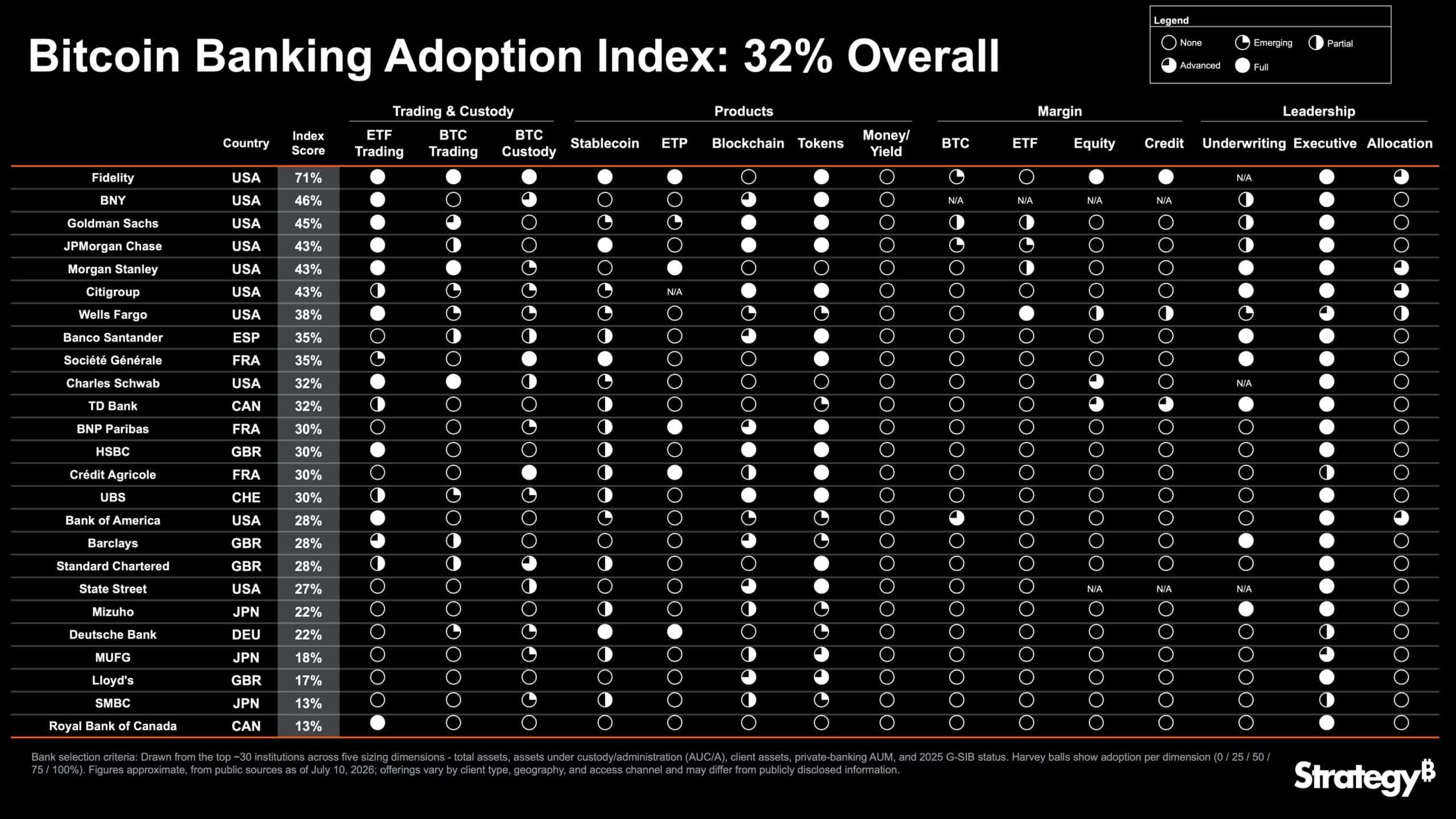
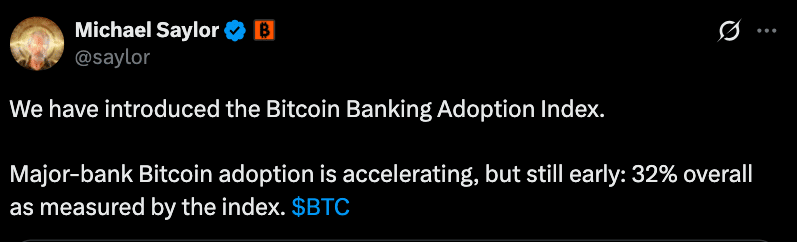
A new Bitcoin Banking Adoption index from Strategy’s Michael Saylor reveals that major financial institutions have jumped on the Bitcoin train faster than most people anticipated, yet overall adoption is still only at 32%.
The findings show both how far Bitcoin has come in terms of getting accepted in the traditional finance world and how much further it still has to go before it gets treated like a fully-fledged banking product.
The main barrier right now isn’t getting banks to look after Bitcoin or to let them get traded, it is getting them to accept it as collateral.
Fidelity Runs Ahead While Traditional Banks Struggle To Keep Up
Strategy’s new index covers a range of areas, including Bitcoin custody, ETFs, trading infrastructure, stablecoin issuance and lending products that use Bitcoin as collateral.
Fidelity came out on top with an adoption score of 71% . The asset manager got the full marks for Bitcoin custody, spot Bitcoin ETF trading and stablecoin capabilities. BNY Mellon was a close second with 46%, just ahead of Goldman Sachs on 45%.
JP Morgan, Morgan Stanley and Citigroup all followed closely behind with scores of 43%, which shows that American institutions are getting more willing to support Bitcoin-related services even if they go about it in different ways.
Outside of the US, Banco Santander, Société Générale and Standard Chartered also scored well.
Without a doubt, Bitcoin services have become an integral part of mainstream financial infrastructure.
 Bitcoin Banking Adoption
The Credit Market Still Remains Bitcoin’s Biggest Hurdle
The most revealing section of the index was credit. Banks are still reluctant to lend against actual physical Bitcoin even though the market has matured over the past few years.
What they are willing to accept as collateral is more traditional products like spot ETFs which they can easily fit into their existing systems.
BlackRock’s iShares Bitcoin Trust has become more acceptable as an example of this because it fits nicely into the structures that already exist for handling custody and compliance.
However, spot Bitcoin itself still isn’t being treated as if it is the same as say government bonds. This is because collateral is what decides whether an asset is going to become deeply embedded within the banking system.
Government bonds and gold both became seen as solid financial assets once they could be borrowed against. Bitcoin still hasn’t got to that point.
The relatively low score in the margin and lending categories shows that banks still view Bitcoin as an investment product and not something that can be used to create new credit.
Strategy’s Bitcoin Banking Ambition Hits Reality Check
The company Strategy, has talked at length about becoming what Saylor calls the first ever Bitcoin bank.
The idea is simple; Strategy uses its massive Bitcoin treasury as collateral to create a new range of credit products and then partners with traditional banks to distribute them.
The company has already started issuing products like STRC, and they believe their Bitcoin holdings could support a much more extensive financial ecosystem.
The banking data at the moment is saying that a vision of a fully functional bank that deals with Bitcoin could still be years off.
 Bitcoin Banking
If banks are still hesitant to lend out against Bitcoin at market value, then building a lending institution that uses Bitcoin as collateral becomes more difficult.
It’s worth noting that Strategy isn’t the only one who is having this problem.
Bitcoin treasury company Metaplanet in Japan has just announced that it is studying Credit backed by Bitcoin, digital bonds alongside JPYC and tokenization platform Progmat, meaning there’s an interest in using Bitcoin to secure loans outside of the States.
Strategy Strengthens Its Balance Sheet While Waiting
In the meantime, Strategy continues preparing for a longer timeline.
The company recently increased its cash reserve to approximately $3 billion after raising roughly $466.7 million through sales of MSTR shares. The reserve now provides approximately 20 months of coverage for preferred dividends and interest obligations.
The figure approaches, but does not yet reach, the 24 to 36 months of liquidity coverage that JPMorgan analysts previously suggested would strengthen the company’s financial position during prolonged market downturns.
However, Strategy was able to add to its cash position without having to sell off its core Bitcoin holdings.
The approach exposes the recognition that Bitcoin treasury firms need substantial liquidity buffers alongside digital asset reserves.
Conclusion
It is undisputed that Bitcoin Banking adoption has gone further than it was 5 years ago but the most important test for the industry is still to come.
Custody, trading and ETF products have entered the mainstream, yet banks remain cautious about treating spot Bitcoin as collateral for loans and credit products.
Banks need to start taking Spot Bitcoin seriously as collateral for loans and credit products before the dream of a real Bitcoin bank can become a reality.
Glossary
Bitcoin Banking Adoption: a way of measuring how deep financial institutions are integrating Bitcoin into their operations.
Spot Bitcoin ETF: an exchange-traded fund that holds the real Bitcoin itself, rather than derivative.
Collateral: the assets pledged to secure a loan or pay some debt.
STRC: A financial instrument that Strategy has created.
Custody Services: the secure storage solution that institutions use to keep their digital assets.
Frequently Asked Questions About Bitcoin Banking Adoption
What Is The Bitcoin Banking Adoption Index?
It’s a measure that looks at how well major banks are integrating Bitcoin into their operations in places like custody, trading, ETFs and lending.
Which Institution Scored Highest?
Fidelity led the rankings with an adoption score of 71%.
Why Do Banks Prefer Bitcoin ETFs Over Spot BTC?
ETFs fit more easily within existing compliance, custody and risk-management frameworks.
Is Strategy Still Trying To Make Its Bitcoin Bank Plan Work?
Yes, but it all depends on how soon banks start to take Bitcoin seriously as collateral.
References
Bitcoin Foundation
NewsBitcoin
Newsbitcoin
Ambcrypto