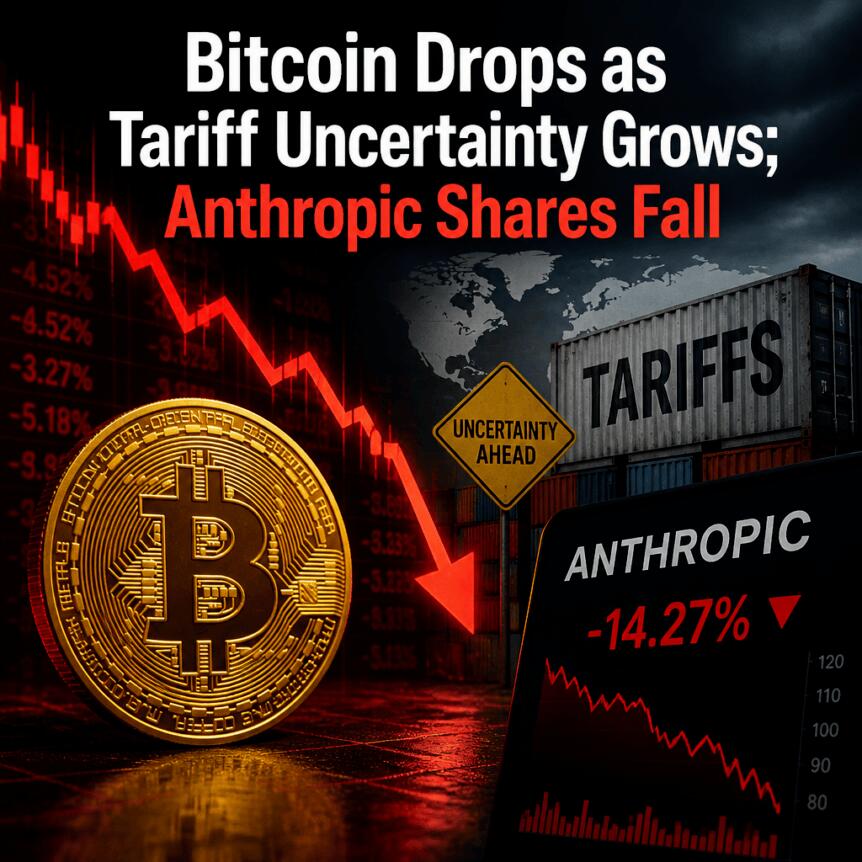
Bitcoin struggled to hold the $60,000 mark in early US trading on Tuesday, sliding to roughly the $59,500 area on Bitstamp as broader risk assets weakened. The move came amid renewed headline
Bitcoin struggled to hold the $60,000 mark in early US trading on Tuesday, sliding to roughly the $59,500 area on Bitstamp as broader risk assets weakened. The move came amid renewed headlines about potential US tariff increases and fresh pressure on high-beta equities.
Crypto’s drawdown mirrored declines in US markets: the S&P 500 opened down 0.7% and the Nasdaq Composite fell about 2%, with investors responding to reports that the US could raise tariffs on China and other economies. In parallel, shares of AI-focused firm Anthropic dropped sharply after trading below its IPO reference level.
Key takeaways
- Bitcoin fell to around $59,500 on Bitstamp as tariff-related concerns drove a broader risk-off session.
- BTC/USD was down about 2.2% on the day, reversing gains after Monday’s near $64,500 peak, according to TradingView data cited in the report.
- US equity weakness aligned with tariff headlines, with the S&P 500 down 0.7% and the Nasdaq off roughly 2% at the open.
- Anthropic shares slid to about $75.85—roughly 14% below the $83 IPO price—reflecting heavy sell pressure in some growth stocks.
- Economist Robin Brooks pointed to ongoing market worry that Federal Reserve tightening could keep weighing on risk assets.
Tariff headlines tilt markets lower
According to the report, TradingView data showed BTC/USD trading down around 2.2% during the day, having fallen nearly 8% from Monday’s $64,500 high. The correlation to traditional markets was reinforced as US stocks opened lower across indices.
The Wall Street Journal reported, citing people familiar with the matter, that US Trade Representative Jamieson Greer could announce the results of an investigation into foreign industrial subsidies “as soon as this week.” The report also said partners that signed trade pacts with the US—such as the European Union, Japan, and South Korea—could face maximum levies of 15%, based on those sources.
For crypto traders, the practical takeaway is that tariff-driven macro uncertainty appears to be continuing to trigger quick shifts in risk appetite. The report noted that risk assets have shown heightened sensitivity to tariff headlines since President Donald Trump unveiled sweeping tariff plans in April 2025, while the US Supreme Court struck down some emergency economic power tariff measures in February 2026.
High-growth stocks amplify the risk-off tone
Market jitters were not limited to macro indicators. The report highlighted that Anthropic shares sank on Tuesday, moving below its IPO price of $83. At the time of writing, the stock was trading near a record low of $75.85, down roughly 14% on the day.
The drop underscores how periods of rising rates expectations and policy uncertainty can pressure equities—especially businesses valued on future growth. Even though the report mentioned relief tied to Nvidia’s CEO returning to duties, it emphasized that underlying stress across markets still dominated sentiment.
Fed tightening concerns stay in focus
Economist Robin Brooks, in a Monday analysis referenced by the report, argued that worries about further Federal Reserve interest-rate hikes are contributing to downside pressure for risk assets. In a quoted comment shared through his Substack, Brooks said markets may be taking comfort in the near-term while broader system stress tied to the Fed’s focus on hikes continues to build.
Recent policy expectations appear to be holding firm. The report cited CME Group’s FedWatch Tool as continuing to show “overwhelming” odds of a 25 basis point rate hike at the Federal Open Market Committee’s Dec. 8–9 meeting.
That view also aligns with messaging from Federal Reserve leadership. The report referenced a New York Fed speech on Monday in which President John Williams said inflation is expected to ease to “just above” the central bank’s 2% target next year, before returning to that level in 2028. Williams also warned that the Fed must continue taking actions to ensure inflation is brought back to target “in a timely manner and on a sustained basis,” according to the speech text linked in the report.
Oil softness and inflation expectations don’t remove the tightening risk
While some economic signals pointed toward easing pressures, the report noted that crude oil has fallen to multi-month lows—WTI was cited at $79.07 per barrel, a level last seen on Aug. 10. Even with oil weakness and inflation prints broadly in line with expectations, the report said Fed officials have used increasingly hawkish language in recent weeks.
For traders, that combination matters: falling energy prices can help reduce inflation pressure, but it does not automatically change the market’s view of how aggressively the Fed will tighten. With CME data still pointing to a high probability of a December hike, risk assets—including bitcoin—can remain vulnerable to selloffs even when one part of the macro picture looks less intense.
Next, investors will likely watch whether tariff developments escalate or fade in headlines, and whether Fed communication further shifts rate expectations at upcoming meetings. Bitcoin’s sensitivity to traditional risk appetite—highlighted by Tuesday’s move—suggests that macro catalysts could continue to dominate short-term trading rather than crypto-specific narratives.
This article was originally published as Bitcoin Drops as Tariff Uncertainty Grows; Anthropic Shares Fall on Crypto Breaking News – your trusted source for crypto news, Bitcoin news, and blockchain updates.