Bitcoin Drops: Straight Of Hormuz Now Controls More Than Oil One headline. One denial. And then the market fell apart. Bitcoin drops have happened before, but the speed of today’s one was dif
Bitcoin Drops: Straight Of Hormuz Now Controls More Than Oil
One headline. One denial. And then the market fell apart. Bitcoin drops have happened before, but the speed of today’s one was different. Within 60 minutes of President Trump denying reports of a deal to reopen the Strait of Hormuz, over $270 million in crypto positions were wiped out. That is not a normal dip. That is a market that was sitting on a powder keg.
How the Trump Hormuz Denial Triggered a Bitcoin Price Crash
The trigger was geopolitical, not technical. On May 27, 2026, reports emerged of US military strikes on Iranian drone operations near the Strait of Hormuz. Then Trump publicly denied any deal to restore traffic through that waterway. Risk assets sold off immediately.
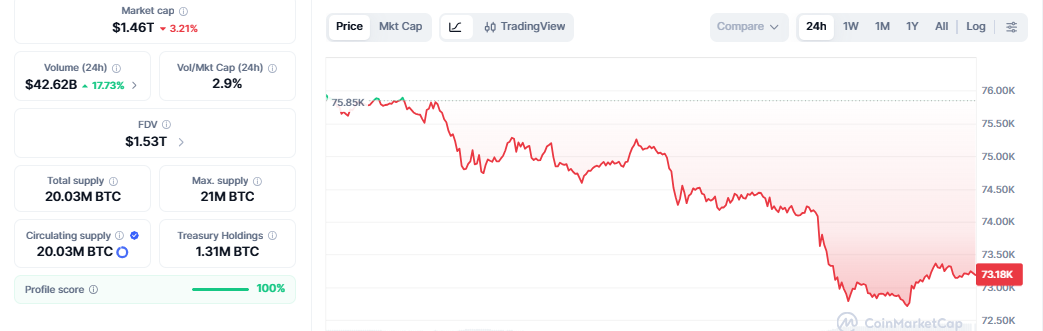
Source: CoinMarketCap Official
Bitcoin fell to $73,281.93, a 3.35% drop in 24 hours. The price briefly broke below $73,500, then below $74,000, as the selling accelerated. This was not panic from retail traders alone. Institutions moved first.
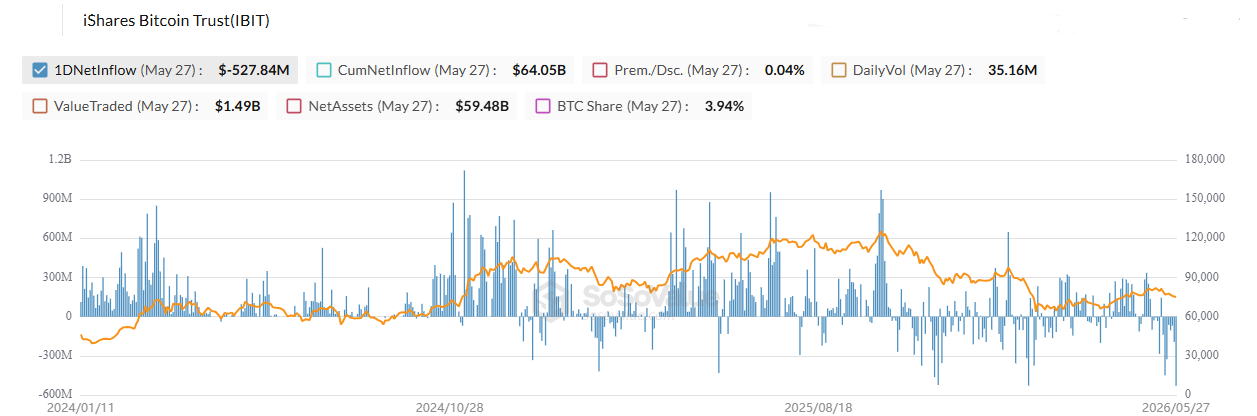
As per SoSo Value, BlackRock's IBIT Bitcoin ETF recorded a $527.84 million net outflow, its second-largest single-day withdrawal ever. When the world's largest asset manager pulls that much capital in one day, the spot market feels it immediately.
The Strait of Hormuz Controls More Than Oil: Now Crypto Too
The Strait of Hormuz carries roughly 20% of the world's oil supply. Any disruption to that route spikes oil prices.
Spiking oil prices raise inflation fears. Raised inflation fears push central banks toward keeping interest rates higher for longer. And higher rates drain liquidity from risk assets, including crypto.
That chain reaction is exactly what played out on May 28, 2026. Bitcoin showed an 83.6% correlation with gold ($4,390, down 1.50%) during the selloff, meaning both assets moved together in response to the same macro fear.
It is now a pattern that has been building as institutional money entered BTC through ETFs. The more institutions treat Bitcoin like a macro asset, the more it behaves like one.
The US-Iran conflict has created this feedback loop before. Each time a headline lands about Hormuz, oil responds, and now BTC responds right alongside it.
BTC Long Liquidations: $264 Million in Longs Got Wiped in One Hour
The derivatives data tells the real story of what happened inside the market. Of the $270 million liquidated within the first hour, nearly $264 million came from long positions. Traders who had bet on BTC going up got forced out of their trades automatically.
Over the full 24-hour period, total Bitcoin liquidations reached $296.62 million. Long positions made up $283.23 million of that, roughly 95% of the total, according toCoinMarketCap data. The short side barely got touched.
Funding rates had been negative, meaning long traders were paying a premium just to hold their positions, for two straight days before the crash. The market was stretched. The Hormuz headline did not cause the damage alone. It just lit the fuse.
Bitcoin $70,000: Where Support Sits and What the Chart Is Saying
Technically, Bitcoin has now broken below its 20-day, 50-day, and 100-day moving averages simultaneously. That is a bearish signal. The RSI dropped to 30.71, a level that historically suggests the asset is oversold and a short-term bounce is possible.
The key support level to watch is $72,650, the most recent swing low before this drop. If that level holds on hourly closes, a relief move toward $74,332 (the 50% Fibonacci retracement level) is possible.
If it breaks, the next major test is $70,000, a psychological level that will attract significant attention from both buyers and sellers.
The deciding factor will not be a chart pattern. It will be ETF flow data. If inflows gain, that signals institutions are buying the dip. If outflows continue, the pressure will remain.
Crypto Market Selloff Pattern: Geopolitical Drops History
Every major geopolitical shock of the past three years has produced a sharp Bitcoin drop followed by a recovery that exceeded the previous high, but only after the fear cycle ran its full course.
Whales addresses holding between 10 and 10,000 BTC, added over 61,000 BTC in the month before this drop, according to Santiment data. That is accumulation behavior. Long-term holders do not panic-sell during geopolitical noise. They wait. And when retail fear peaks, they buy.
The story unfolding right now is a short-term macro shock sitting on top of a long-term institutional adoption trend. The question is not whether Bitcoin recovers. The question is how long the geopolitical noise lasts.
Note: This article is for information purposes only. All the information and facts are based on market present data. The article itself does not claim anything.