Key Takeaways 218 net institutional entities exited Bitcoin ETF positions in Q1. Advisor holdings grew 24.9K BTC year-on-year through the full cycle. Citi disclosed its first ever Bitcoin ETF
Key Takeaways
- 218 net institutional entities exited Bitcoin ETF positions in Q1.
- Advisor holdings grew 24.9K BTC year-on-year through the full cycle.
- Citi disclosed its first ever Bitcoin ETF position in Q1 2026.
- Hedge funds and brokerages together shed 50.2K BTC in one quarter.
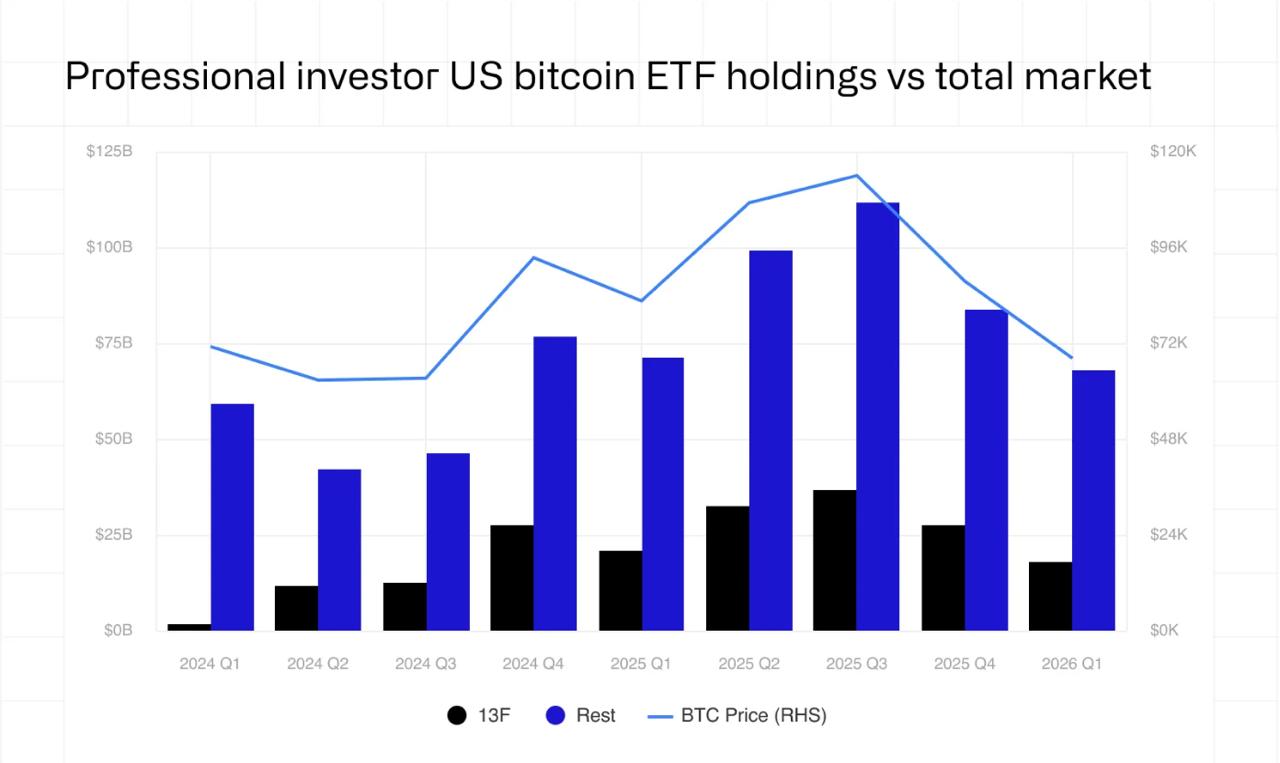
Professional Bitcoin ownership through US spot ETFs entered Q1 2026 having never faced a sustained price drawdown since the products launched in January 2024. From near zero at launch, 13F filings tracked by CoinShares showed consistent institutional accumulation through each quarter as Bitcoin climbed toward its $126,000 cycle high. Q1 2026 delivered the first genuine test of that conviction.
Bitcoin retraced from approximately $120,000 at the start of Q1 to around $72,000 by quarter close, a drawdown of roughly 40% within the measurement window. Against that backdrop, CoinShares analyst Matthew Kimmel’s 13F analysis confirms total professional holdings contracted from 313K BTC to 260.8K BTC, a 17% quarterly reduction representing 52.6K BTC in net selling across 1,813 reporting entities.
The aggregate figure, however, obscures a more precise story about which institutional categories held conviction and which did not.
Hedge Funds and Brokerages: 95% of the Selling
Hedge fund managers reduced their Bitcoin ETF exposure by 39% quarter-on-quarter, cutting holdings from approximately 80K BTC to 48.6K BTC, a reduction of 31.4K BTC. Brokerages moved faster and harder, shedding 53% of their position, reducing from approximately 36K BTC to 17.0K BTC, a contraction of 18.8K BTC. Combined, those two categories account for 50.2K BTC of the 52.6K total reduction, or approximately 95% of all professional selling in the quarter.
Institution TypeQ1 26QOQ ΔYOY Δ# Holders Q1 26# New# Exited
Investment advisor150.3K-9.4K24.9K1,510159321
Hedge fund manager48.6K-31.4K-34.6K130836
Brokerage17.0K-18.8K-8.6K3737
Bank15.2K+7.7K11.7K69815
Holding company9.7K0.0K2.5K1112
Government8.3K+1.1K3.3K1––
Private equity6.5K+1.3K3.6K11–3
Endowment2.0K-1.3K1.9K3–1
Family office/trust1.1K+0.2K0.8K191–
Insurance company0.9K+0.1K0.7K8–7
Trust0.5K0.0K0.1K5–4
Unclassified0.2K-2.0K0.2K3–1
Corporation0.2K0.0K0.2K3–1
Pension fund0.1K0.0K0.0K1––
Venture capital0.1K+0.1K0.1K2––
Total260.8K-52.6K6.8K
1,813180398 Source: Bloomberg, CoinShares, data available as of close 19 May 2026 • Compiled by the Coindoo Editorial Team
The concentration of exits within hedge funds and brokerages reflects the structural difference between those participants and longer-duration institutional holders. Hedge funds operate with shorter investment horizons, performance pressure relative to quarterly benchmarks, and risk management mandates that respond to drawdown thresholds. A 40% price decline within a quarter triggers stop-loss protocols and risk limit adjustments that produce exactly this kind of concentrated, rapid position reduction. Brokerages face similar dynamics through client-driven redemptions and margin exposure.
Notably, only 8 new hedge funds initiated positions in Q1 while 36 exited entirely, and only 3 new brokerages entered while 7 exited, confirming the reduction reflected departures rather than existing holders simply trimming.
Investment Advisors: Largest Category, Held Relatively Steady
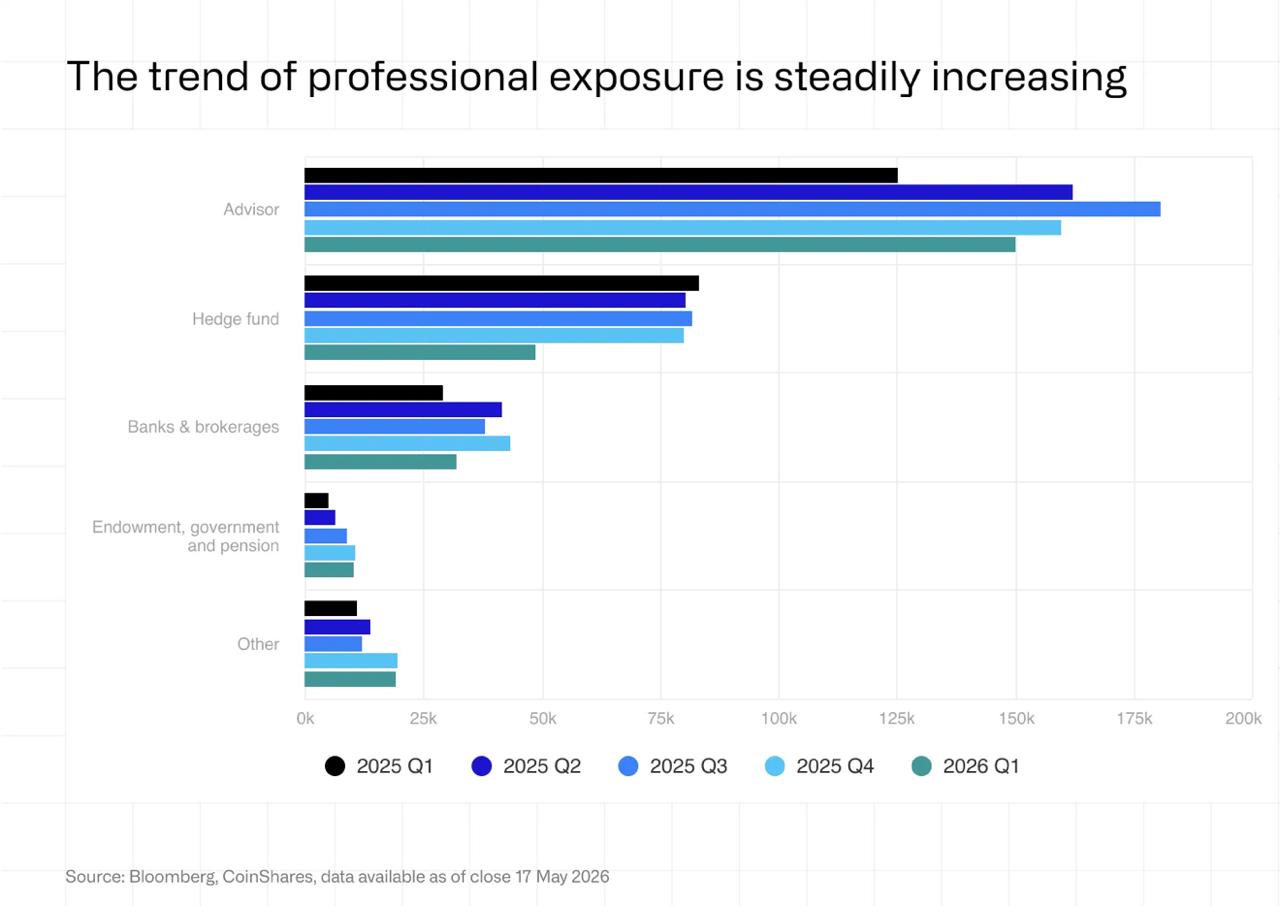
Investment advisors remain the dominant institutional holder category by a wide margin, holding 150.3K BTC in Q1 2026, more than three times the hedge fund total. The quarterly reduction of 9.4K BTC is modest relative to the category’s total exposure and sits against a year-on-year increase of 24.9K BTC, confirming that advisors have grown their aggregate position through the full cycle and treated Q1’s price weakness as a trim rather than an exit.
The trend chart from Bloomberg and CoinShares confirms the advisor category has expanded consistently from 2025 Q1 through 2026 Q1 across every measurement period, making it the most structurally stable institutional cohort in the dataset. With 1,510 holders, 159 new entrants, and 321 exits in Q1, the churn within the category is higher than it appears from the net figure alone, but the aggregate position held.
The Category Adding Exposure Into the Drawdown
The most structurally significant data point in the Q1 report is not the hedge fund reduction, it is the bank category moving in the opposite direction. Banks added 7.7K BTC quarter-on-quarter, bringing total bank holdings to 15.2K BTC, up 11.7K year-on-year. JPMorgan and Wells Fargo increased existing positions while Citi disclosed its first Bitcoin ETF position, marking the first time the institution appeared in 13F filings as a Bitcoin holder.
Banks operate under regulatory capital frameworks, fiduciary obligations, and investment committee governance structures that make position initiation and expansion significantly slower and more deliberate than hedge funds or advisors. A bank adding Bitcoin ETF exposure into a 40% price drawdown is not a tactical trade, it is a strategic allocation decision that has passed multiple layers of internal review. The fact that 8 new bank entities entered in Q1 while only 15 exited confirms the category is in net expansion mode regardless of price direction.
READ MORE:
 Stablecoins Shouldn’t Pay Yield, Says House Committee Member
What the Data Signals About Institutional Conviction
The Q1 2026 13F data describes two distinct institutional responses to Bitcoin’s first ETF-era bear market test. The first, concentrated in hedge funds and brokerages, reflects performance-driven selling under drawdown pressure, a mechanical response to price decline rather than a fundamental reassessment of Bitcoin’s role in a portfolio. The second, visible in banks and sustained in advisors, reflects the kind of longer-duration conviction that does not respond to quarterly price movements.
The net exit of 218 institutional entities in a single quarter, 398 departures against 180 new entrants, is the headline number that will draw attention. The more analytically useful signal is that the categories most likely to re-enter when price stabilizes, hedge funds responding to performance recovery, and the categories least likely to exit regardless of price, banks and advisors building strategic allocations, are both present in the data and pointing in different directions simultaneously.
The information provided in this article is for educational purposes only and does not constitute financial, investment, or trading advice. Coindoo.com does not endorse or recommend any specific investment strategy or cryptocurrency. Always conduct your own research and consult with a licensed financial advisor before making any investment decisions.
The post Bitcoin ETF 13F Report: Who Bought and Sold the Q1 Dip appeared first on Coindoo.