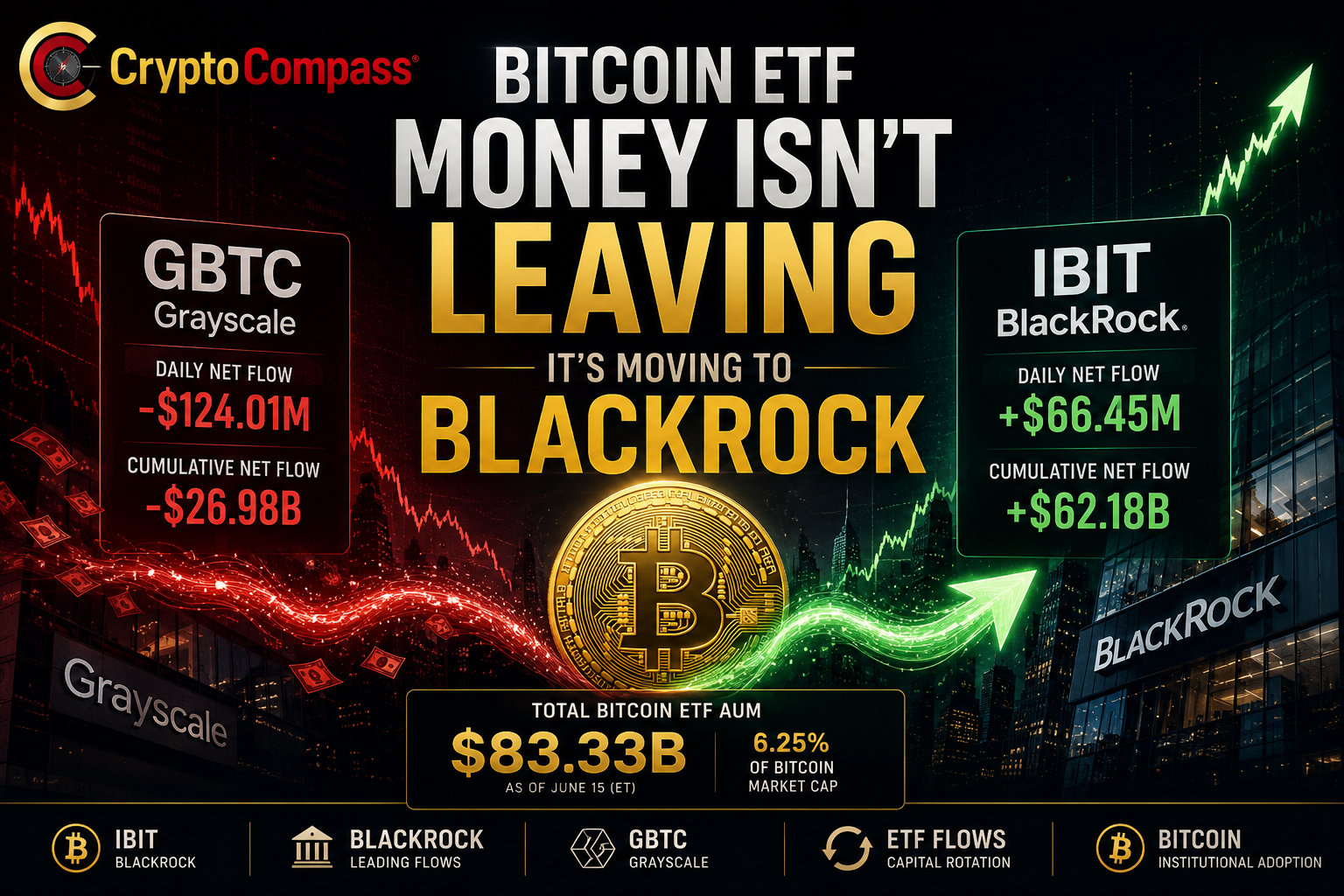
Bitcoin ETFs recorded another day of net outflows, but the headline number hides a much bigger story. Capital is not leaving Bitcoin. It is rotating aggressively toward BlackRock and away from Grayscale.
The Headline Is Misleading
At first glance, the latest Bitcoin ETF data appears bearish.
The U.S. spot Bitcoin ETF market recorded approximately:
-$64.09 Million
in net outflows during the latest trading session.
Many investors immediately interpreted the number as a sign of weakening institutional demand.
But the underlying data tells a very different story.
The real story is not capital leaving Bitcoin.
The real story is capital changing vehicles.
BlackRock Keeps Winning
Among all Bitcoin ETFs, one fund continues to dominate institutional flows:
IBIT (BlackRock)
Latest Daily Flow:
+$66.45 Million
Total Historical Net Inflows:
$62.18 Billion
These numbers are extraordinary.
BlackRock has become the preferred gateway for institutional Bitcoin exposure.
Despite short-term market uncertainty, investors continue allocating fresh capital into IBIT.
This trend has persisted for months.
And it shows little sign of slowing.
Grayscale Keeps Losing Assets
On the opposite side of the ledger sits Grayscale.
GBTC
Latest Daily Flow:
-$124.01 Million
Cumulative Net Outflows:
-$26.98 Billion
The contrast is striking.
While BlackRock attracts capital, Grayscale continues experiencing persistent withdrawals.
The phenomenon has become one of the defining stories of the ETF era.
Investors are not abandoning Bitcoin.
They are abandoning higher-cost products.
The Great ETF Rotation
Many investors still analyze ETF flows as a simple inflow-versus-outflow calculation.
That approach misses an important reality.
Institutional investors frequently rotate between products.
Reasons include:
Lower fees
Better liquidity
Operational efficiency
Portfolio restructuring
Risk management
In many cases, capital exiting GBTC eventually reappears inside IBIT.
This creates the illusion of weakness when the actual story is migration.
Why BlackRock Has Become The Default Choice
Several factors explain IBIT's success.
Scale
BlackRock is the largest asset manager in the world.
Institutional investors already have existing relationships with the firm.
Liquidity
Deep liquidity matters for large allocations.
The ability to enter and exit positions efficiently remains a major advantage.
Trust
For many traditional investors, BlackRock represents familiarity.
Bitcoin remains new.
BlackRock is not.
That combination has proven powerful.
Bitcoin ETFs Now Control A Massive Share Of Supply
The ETF market has reached a scale that would have seemed unimaginable only a few years ago.
Combined Spot Bitcoin ETF Assets:
$83.33 Billion
Percentage of Bitcoin Market Cap:
6.25%
This figure continues to grow.
The implications are significant.
Bitcoin is increasingly becoming integrated into traditional financial infrastructure.
The asset is no longer operating solely within the crypto ecosystem.
Wall Street now owns a meaningful portion of the network's economic exposure.
What Institutions Are Really Saying
The latest flow data reveals several important conclusions.
1. Institutions Still Want Bitcoin
If demand were truly collapsing, IBIT would not continue attracting capital.
2. Product Selection Matters
Investors are becoming more sophisticated.
They care about fees, liquidity, and execution quality.
3. Bitcoin Has Matured
ETF flows increasingly resemble behavior seen in traditional asset classes.
Competition among issuers is becoming just as important as competition among assets.
Why This Matters For The Next Bull Market
Many previous crypto cycles depended heavily on retail participation.
The ETF era changes that dynamic.
Institutional capital tends to move differently.
It is:
Larger
Slower
More strategic
More persistent
This means future Bitcoin rallies may increasingly depend on allocation decisions made inside pension funds, wealth managers, and investment committees rather than retail speculation alone.
A Hidden Signal Most Investors Ignore
One of the most important indicators is not daily ETF flow.
It is cumulative ownership.
Every week that ETFs continue accumulating Bitcoin, more supply moves into long-term institutional hands.
That supply becomes less sensitive to short-term market volatility.
Over time, this can influence:
Liquidity
Volatility
Market structure
Price discovery
The ETF market is not merely tracking Bitcoin.
It is gradually reshaping Bitcoin itself.
Looking Ahead
The latest ETF data should not be interpreted as a simple bearish signal.
Yes, the market recorded net outflows.
But beneath the surface, institutions continue allocating capital.
The evidence suggests investors are becoming increasingly selective about where they gain Bitcoin exposure.
BlackRock continues winning.
Grayscale continues losing.
Bitcoin remains the battleground.
CryptoCompass View
Headline numbers often tell only part of the story.
The ETF market's latest data reveals something important:
Capital is not necessarily leaving Bitcoin.
It is concentrating.
And right now, much of that concentration is flowing toward BlackRock.
In the ETF era, understanding where money moves may be more important than understanding where prices move.
Follow capital.
The rest usually follows.
Navigate Markets. Discover Opportunities.