US spot bitcoin ETFs recorded more than $3.4 billion in net outflows in November: $3.47 billion through Thursday, November 19, according to data from Farside Investors. BlackRock's IBIT, the
US spot bitcoin ETFs recorded more than $3.4 billion in net outflows in November: $3.47 billion through Thursday, November 19, according to data from Farside Investors. BlackRock's IBIT, the largest fund, lost $541.1 million that Thursday, its biggest one-day withdrawal since launch. Outflows came on 13 of 15 trading days. For Friday, November 20, Farside shows outflows of $124.5 million, a provisional figure published on Saturday at 12:20 UTC without BlackRock's IBIT. Including that provisional figure, the month's total reaches $3.59 billion, more than in February 2025 ($3.56 billion), which would make November the second-worst month since the funds launched in January 2024, behind June 2026 ($4.51 billion). The final ranking depends on IBIT's figure for Friday.
The withdrawals coincide with bitcoin's slide below $60,000 on Friday for the first time since July, as our report on bitcoin below $60,000 shows.
Bitcoin ETF outflows: the November numbers
Session
All ETFs
of which IBIT (BlackRock)
Nov. 13, 2026
−185.4 $m
−143.5 $m
Nov. 16, 2026
7.9 $m
76.5 $m
Nov. 17, 2026
−239.9 $m
−209.5 $m
Nov. 18, 2026
−306.5 $m
−148.7 $m
Nov. 19, 2026
−582.3 $m
−541.1 $m
Nov. 20, 2026 (provisional)
−124.5 $m
not published
November through Nov. 19 (final)
−3,467.8 $m
November through Nov. 20 (provisional)
−3,592.3 $m
−2,940.7 $m (excluding Nov. 20)
June 2026 (record)
−4,509.7 $m
February 2025
−3,560.4 $m
November 2025
−3,466.7 $m
Cumulative since January 2024
+53,456 $m
+63,370 $m
Net flows in millions of dollars. Source: Farside Investors, read on Nov. 21, 2026; monthly totals: own calculation from daily totals.
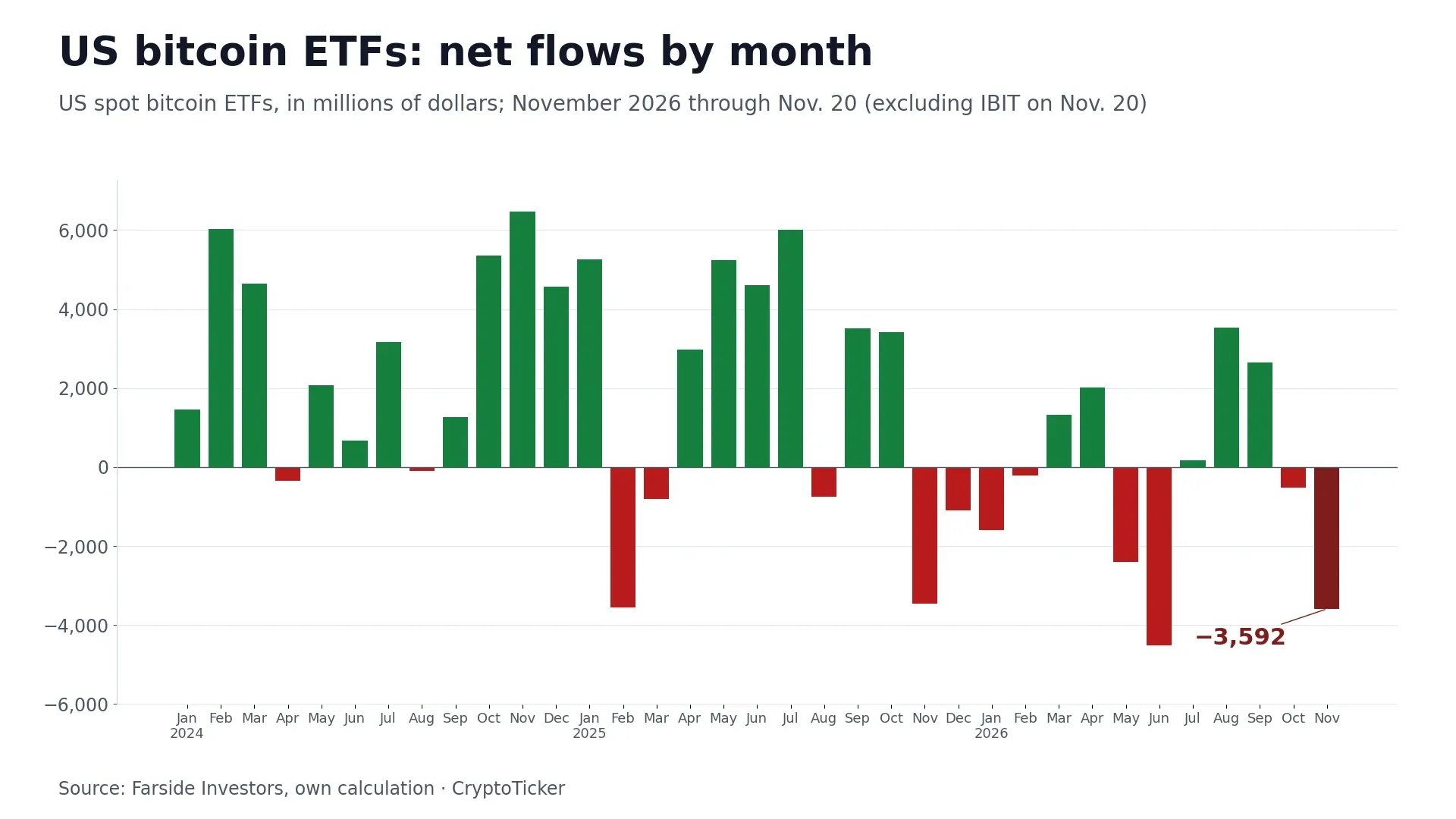
Monthly net flows of US spot bitcoin ETFs since launch. Data: Farside Investors, own calculation
Despite the outflows, the overall balance remains clearly positive: since January 2024, the ETFs have attracted about $53.46 billion in net inflows. According to The Block, citing SoSoValue, they held $76.6 billion in assets on Thursday, equal to 6.1% of bitcoin's market value.
Why investors are pulling money out
The outflows follow the sell-off in technology stocks. On Friday, the Nasdaq fell 5.3% and wiped out its entire 2026 gain, as our report on the AI bubble shows. Bitcoin is trading like a tech stock rather than a safe haven: gold also fell more than 4%, a sign that investors above all need cash.
Rates add to the pressure. Markets expect the Federal Reserve to raise rates by a quarter point at its meeting on December 8 and 9, and UBS expects two hikes, in December and March. Higher rates make non-yielding assets such as bitcoin less attractive. Not every issuer is losing money, though: according to The Block, Morgan Stanley's MSBT took in $49.6 million on November 19, and Hong Kong's bitcoin ETFs have seen small inflows since the start of November.

Illustrative image, AI-generated
Earlier waves of outflows
Bitcoin ETFs have been through several months of heavy withdrawals before. In February 2025 they lost $3.56 billion, in November 2025 $3.47 billion and in June 2026 $4.51 billion, the record so far. After February 2025, flows turned positive again in April; after November 2025, it took until March 2026; after June 2026, July was slightly positive and August brought $3.54 billion in inflows, according to Farside data. These episodes say nothing about what comes next, but they show that heavy outflows have not so far marked the end of investor interest.
What analysts say
In a note on Friday, UBS said the risk-reward in equities had become more balanced, while remaining cautious about rates. David Kelly, chief global strategist at JPMorgan Asset Management, told CNN he expects the correction to pass within a week or two, like a mild cold. Others see more risk: James Reilly of Capital Economics expects stocks to fall further, according to the CNBC live blog.

Illustrative image, AI-generated
What comes next
- IBIT figure: Farside has yet to publish the flow of BlackRock's fund for Friday; it will complete the November tally.
- Federal Reserve: the next rate decision is due on December 9.
- Next week: ETF flows from Monday to Wednesday come ahead of the Thanksgiving holiday, with a shortened session on Friday, November 27.
- Weekend: ETFs do not trade, bitcoin does; the moves minute by minute are in our Bitcoin crash live blog.
Trading the crash: long and short
If you want to trade the move, you can bet on rising prices (long) or falling prices (short). Leverage multiplies every price change in both directions: at 10x, a 10 percent move changes the position by 100 percent; at 100x, about 1 percent is enough for liquidation. A stop-loss and a small position size limit the risk. The basics are explained in our guide to long and short positions.
- Bitget: futures with long and short, plus copy trading.
- OKX: spot and futures with long and short.
- Kraken: spot trading and futures, in the market since 2011.
- XTB: CFDs on crypto, long and short, quick account opening. 78% of retail investor accounts lose money when trading CFDs with this provider.
Risk warning: trading with leverage can lead to the loss of your entire stake. This section explains options and is not investment advice. These are partner links; if you open an account through them, cryptoticker.io earns a commission at no cost to you.
More providers with fees and regulation are listed in our crypto exchange comparison and our crypto broker comparison.