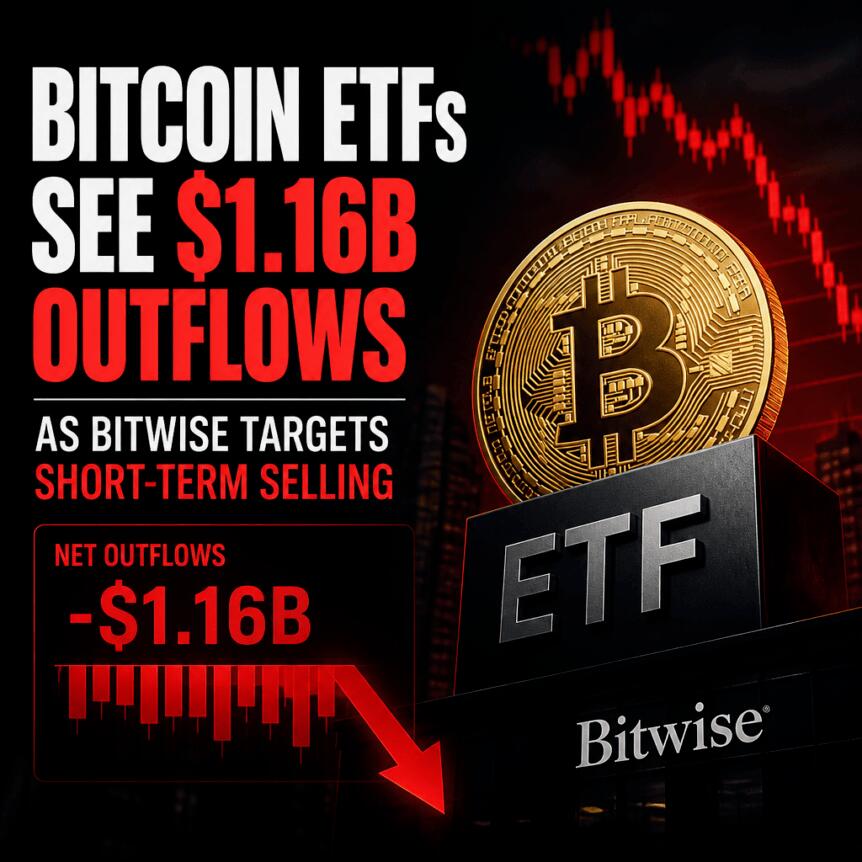
US spot Bitcoin exchange-traded funds (ETFs) saw net outflows of more than $1 billion over three trading days, according to SoSoValue data, but Bitwise argues the movement is more consistent
US spot Bitcoin exchange-traded funds (ETFs) saw net outflows of more than $1 billion over three trading days, according to SoSoValue data, but Bitwise argues the movement is more consistent with a short-term risk-off reaction than a durable shift in institutional demand.
Another $116 million left the funds on Tuesday, taking net outflows since Friday to $1.16 billion, SoSoValue data shows. Bitwise’s head of research, André Dragosch, told Cointelegraph that the withdrawals appear tied to weaker sentiment rather than any widespread institutional concern about whether ETF holdings are safe.
Key takeaways
- SoSoValue reports Tuesday’s $116 million withdrawal brings three-day net outflows to $1.16 billion.
- Bitwise says the pattern aligns with a short-term risk-off mood, not a structural retreat by institutional investors.
- Dragosch links the ETF flow weakness to broader market sentiment that worsened after Binance’s $6.3 billion hack was reported.
- Outflows appear to be moderating as Bitcoin sentiment improves and the Crypto Fear & Greed Index rises within the “Fear” zone.
Flows weaken, but Bitwise sees no lasting institutional break
Bitwise frames ETF flows as a blend of long-term adoption and shorter-term sentiment swings. Dragosch said the latest withdrawals reflect changes in how investors feel about risk during volatile periods rather than a fundamental reassessment of Bitcoin ETFs’ role for institutions.
To support that view, Bitwise pointed to a survey of 15 institutions in which none reported reducing their Bitcoin ETF exposure during the bear market. Dragosch also referenced US regulatory filings indicating that most institutional investor categories—excluding hedge funds—largely held their positions.
At the same time, Dragosch emphasized that retail investors still account for the majority of Bitcoin ETF holdings. Retail participation tends to respond more sharply to day-to-day market volatility, which can amplify flow swings when sentiment deteriorates.
Tuesday’s outflows slow as sentiment ticks up
Tuesday’s $116 million net outflow marked a slowdown compared with earlier sessions. Cointelegraph previously reported Monday saw $399 million in outflows and Friday $643 million, extending the withdrawal streak to three trading days.
Despite the outflows, sentiment signs have been less pessimistic than earlier in the week. The Crypto Fear & Greed Index rose to 34 from 26 on Monday, though it remained in the “Fear” category. Over the same period, Bitcoin gained about 1.6% over 24 hours to trade near $78,000 at the time of publication, according to CoinGecko.
On Bitwise’s framing, this combination—still-negative sentiment but improving price action—helps explain why withdrawals have continued while potentially losing momentum.
After Binance hack, custody questions resurface—Bitwise draws a line
The sharp turn in flows followed the report of Binance’s $6.3 billion hack on Thursday. The incident reignited worries among some observers about crypto ETF custody, especially given the industry practice of relying on a limited number of custodians.
Dragosch said the market’s reaction appears more focused on immediate confidence than on systemic ETF custody risk. He explained that the Binance hack impacted “hot wallets,” which are connected to the internet, rather than cold wallets. In his view, this distinction matters because it more closely resembles a different threat model than the arrangements used by institutional fund custodians.
“In contrast, institutional funds held at Coinbase custody are custodied in cold storage which, by definition, are not connected to the internet,” Dragosch said, making the case that exchange incidents and institutional custody infrastructure are not directly interchangeable.
The broader point for investors is that ETF flow volatility can be driven by headlines and confidence shocks, even when the underlying custody mechanics differ. Still, the industry debate highlights a gap: even if cold-storage custody reduces certain risks, incidents that involve large exchanges can quickly influence investor behavior—at least in the short term.
What to watch next for Bitcoin ETF demand
For now, Bitwise’s message is that institutional exposure looks resilient, while retail-driven sensitivity continues to amplify short-lived drawdowns. Investors will likely watch whether outflows persist after sentiment stabilizes and whether any further custody-related narratives emerge that could extend the risk-off cycle rather than letting ETF demand normalize.
This article was originally published as Bitcoin ETFs See $1.16B Outflows as Bitwise Targets Short-Term Selling on Crypto Breaking News – your trusted source for crypto news, Bitcoin news, and blockchain updates.