What Do Falling Bitcoin Exchange Reserves Mean for the Market? Bitcoin is sliding, yet coins keep leaving trading platforms. That's an odd pairing. Rising balances on exchanges often mean hol
What Do Falling Bitcoin Exchange Reserves Mean for the Market?
Bitcoin is sliding, yet coins keep leaving trading platforms. That's an odd pairing. Rising balances on exchanges often mean holders are getting ready to sell, so a drop during a sell-off feels backwards. Do falling Bitcoin exchange reserves point to a bottom, or is something else going on?
How Much Bitcoin Has Left Exchanges in About a Month?
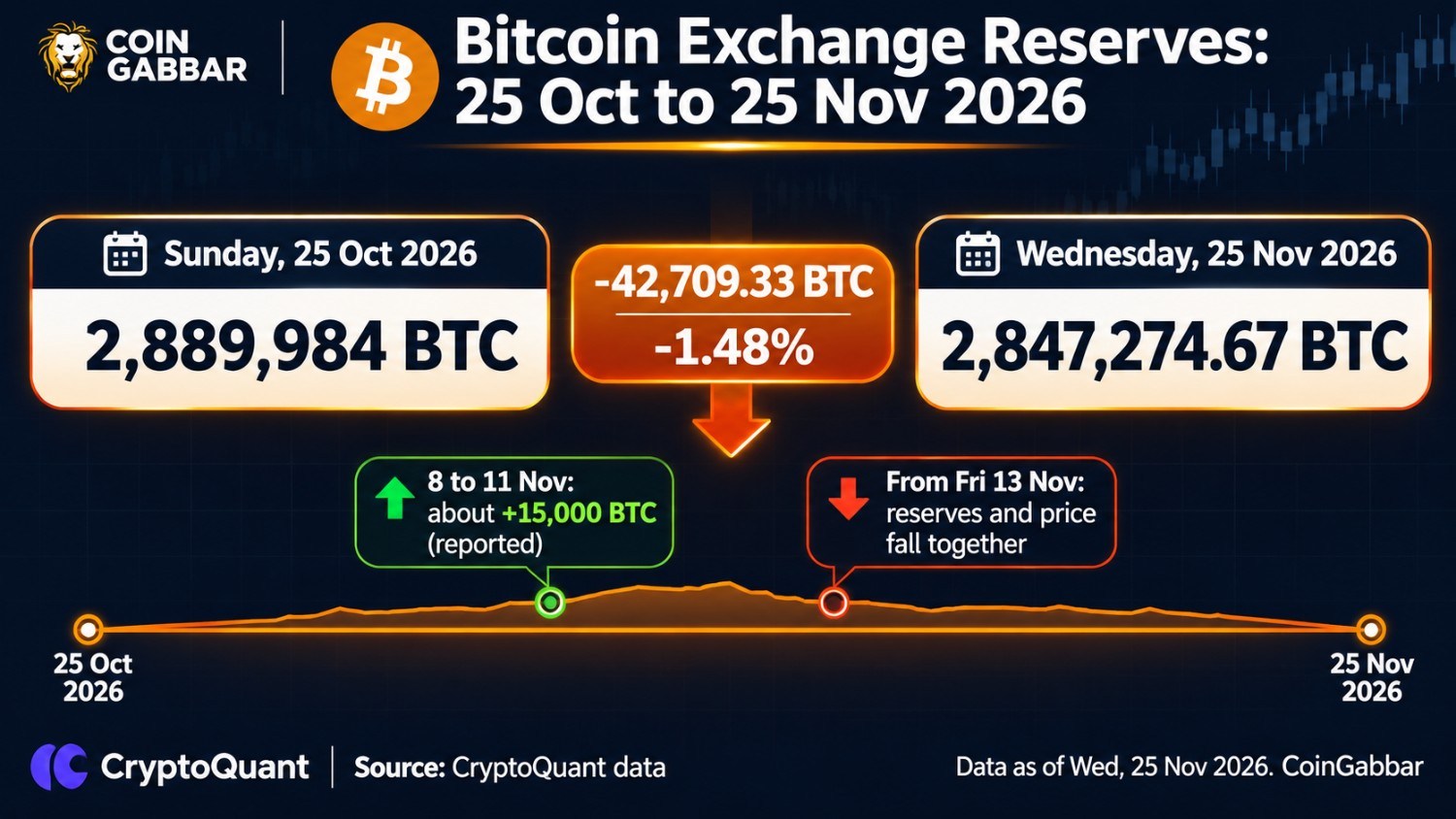
About 42,709 BTC, on a net basis. That's the change in Bitcoin exchange reserves over the period. According to CryptoQuant data, Bitcoin exchange reserves stood at 2,889,984 BTC on Sunday, 25 October 2026. On Wednesday, 25 November 2026, they were 2,847,274.67 BTC.
That's a net fall of 42,709.33 BTC, or about 1.48% of the October balance. The two dates sit 31 days apart, so "about a month" is the fair label. For scale, it's a small move, under 1.5% of the balance.
CryptoQuant's own analyst rounds the same endpoints to 2.889 million and 2.847 million BTC. That note was published on Tuesday, 24 November 2026. Rounded or exact, the direction is the same.
Why Are Bitcoin Exchange Reserves Falling During a Sell-Off?
Reserves count the BTC held in tracked exchange wallets. A fall can mean fewer coins are ready to sell on those platforms.
But a withdrawn coin doesn't have to land in a personal wallet. CryptoQuant's analyst says it may go to self-custody, ETF custodians, over-the-counter desks, or internal wallets. So the fall isn't proof of accumulation.
The month also wasn't one straight line. From Sunday, 8 November to Wednesday, 11 November 2026, reserves reportedly rose by about 15,000 BTC while Bitcoin traded near $74,000 to $75,000. After Friday, 13 November, reserves and price fell together.
Simple arithmetic adds context. If 15,000 BTC came in during that window, net outflows across the rest of the month were closer to 57,700 BTC. That's a rough CoinGabbar estimate, not a published figure.
Are Bitcoin Realized Losses Showing Capitulation?
Capitulation means holders sell at a loss, often in a hurry.Glassnode's weekly report was published on Tuesday, 24 November 2026, with a data cut-off of 16:00 UTC (21:30 IST).
It found that realized losses, measured against capital that flowed in over the past year, almost doubled in a week. The reading is the highest since the FTX collapse in November 2022. Glassnode calls it the first major capitulation event of this bear market.
Be careful with the wording here, because it's easy to overstate. The metric compares losses with prior-year inflows. It doesn't say the raw dollar value of losses is at a multi-year high.
Have Falling Reserves and Capitulation Marked a Bottom Before?
Sometimes, yes. Glassnode says loss spikes showed up near lows in early 2019, March 2020, and November 2022.
They also appeared before further declines in 2018 and 2022. So the signal has a mixed record.
The same caution applies to Bitcoin exchange reserves. Coins can leave exchanges for reasons that have nothing to do with buying and holding, such as a move between wallets. A falling balance alone can't tell you which one happened.
That's why a spike in losses works as a clue, not a promise. A bottom usually needs more than one signal. Price should stop falling, and fresh buyers should step in. Until then, traders are guessing, and a loss spike can simply mark the middle of a fall.
Are ETF Outflows Cancelling the Bullish Reserve Signal?
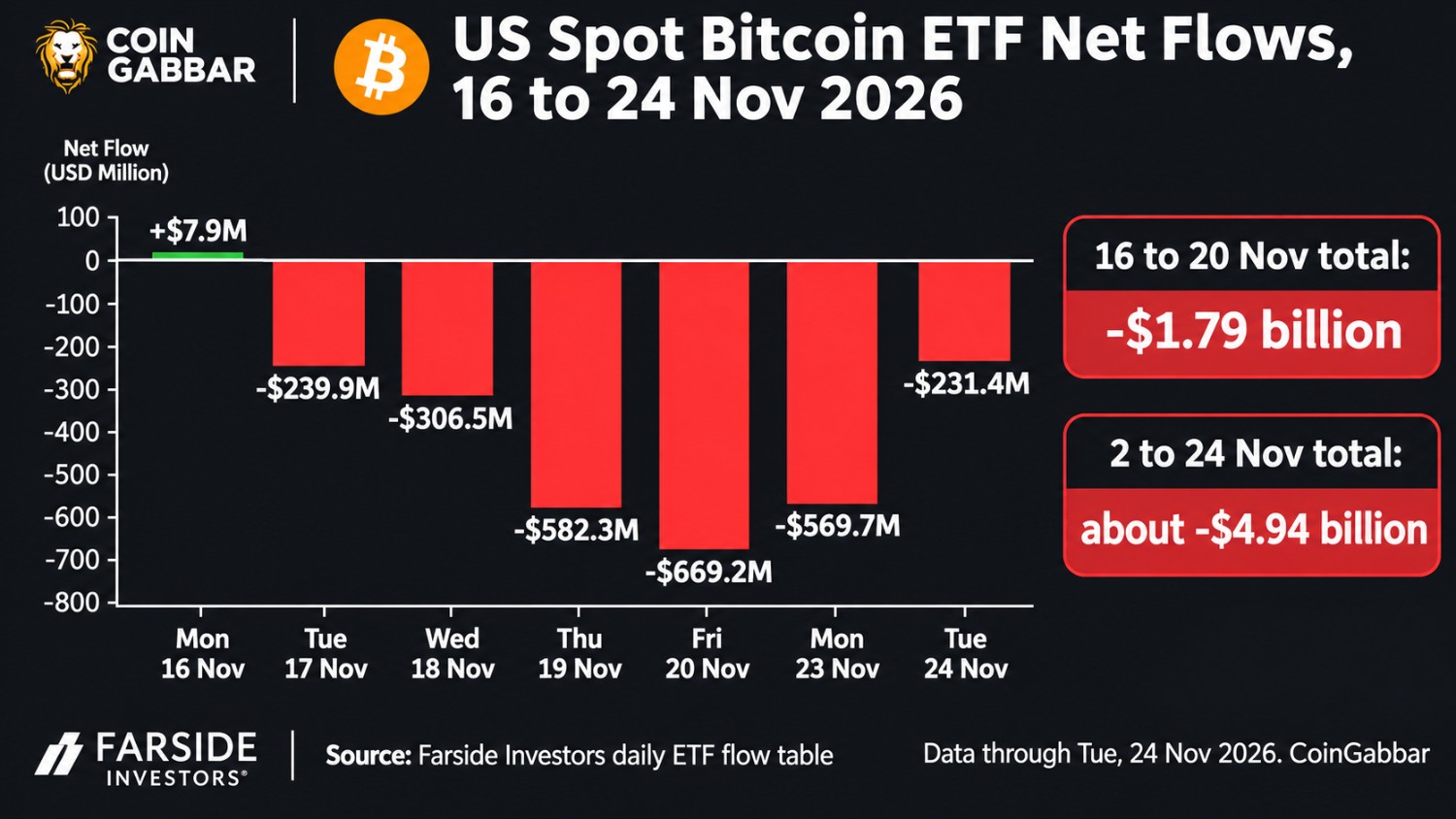
Partly, yes. Farside Investors' daily table for US spot Bitcoin ETFs shows heavy withdrawals, which weighs against the supply-side story from falling Bitcoin exchange reserves.
Day and date
Net flow
Monday, 16 Nov 2026
+$7.9 million
Tuesday, 17 Nov 2026
-$239.9 million
Wednesday, 18 Nov 2026
-$306.5 million
Thursday, 19 Nov 2026
-$582.3 million
Friday, 20 Nov 2026
-$669.2 million
Monday, 23 Nov 2026
-$569.7 million
Tuesday, 24 Nov 2026
-$231.4 million
Put the two stories side by side. Supply on exchanges is thinning, yet demand through US funds is weakening. One is a possible positive. The other is a clear negative. Neither settles the question alone.
What Could the Fed and Inflation Data Change Next?
Rates matter because Bitcoin often trades like a risk asset. Tighter policy can pull money away from it, while easier policy can help.
The next FOMC meeting runs Tuesday, 8 December, to Wednesday, 9 December 2026, per the Federal Reserve calendar. A rate hike isn't confirmed. The meeting is only the next decision point, so any forecast is just that.
One nearer event matters too. The US Bureau of Economic Analysis scheduled its October 2026 inflation report, which includes PCE, for 08:30 ET on Wednesday, 25 November 2026 (19:00 IST). Hot numbers could hurt sentiment. Cool ones could help. Either way, the result will shape how traders read Bitcoin exchange reserves and fund flows next.
Which Bitcoin Price Levels and Events Matter Next?
Binance BTC/USDT weekly candles show seven lower weekly closes in a row. They run from $83,773.10 on Monday, 12 October 2026, to $61,271.10 on Monday, 23 November 2026, each at 00:00 UTC.
That's a drop of about 26.9% over seven weeks. The latest close was 6.24% below the week before. The percentage is CoinGabbar's own calculation.
Glassnode flags $60,000 and the June low at $58,500. A convincing break under both could open a path toward its realized price estimate of $53,200. That's about 13% under the 23 November close.
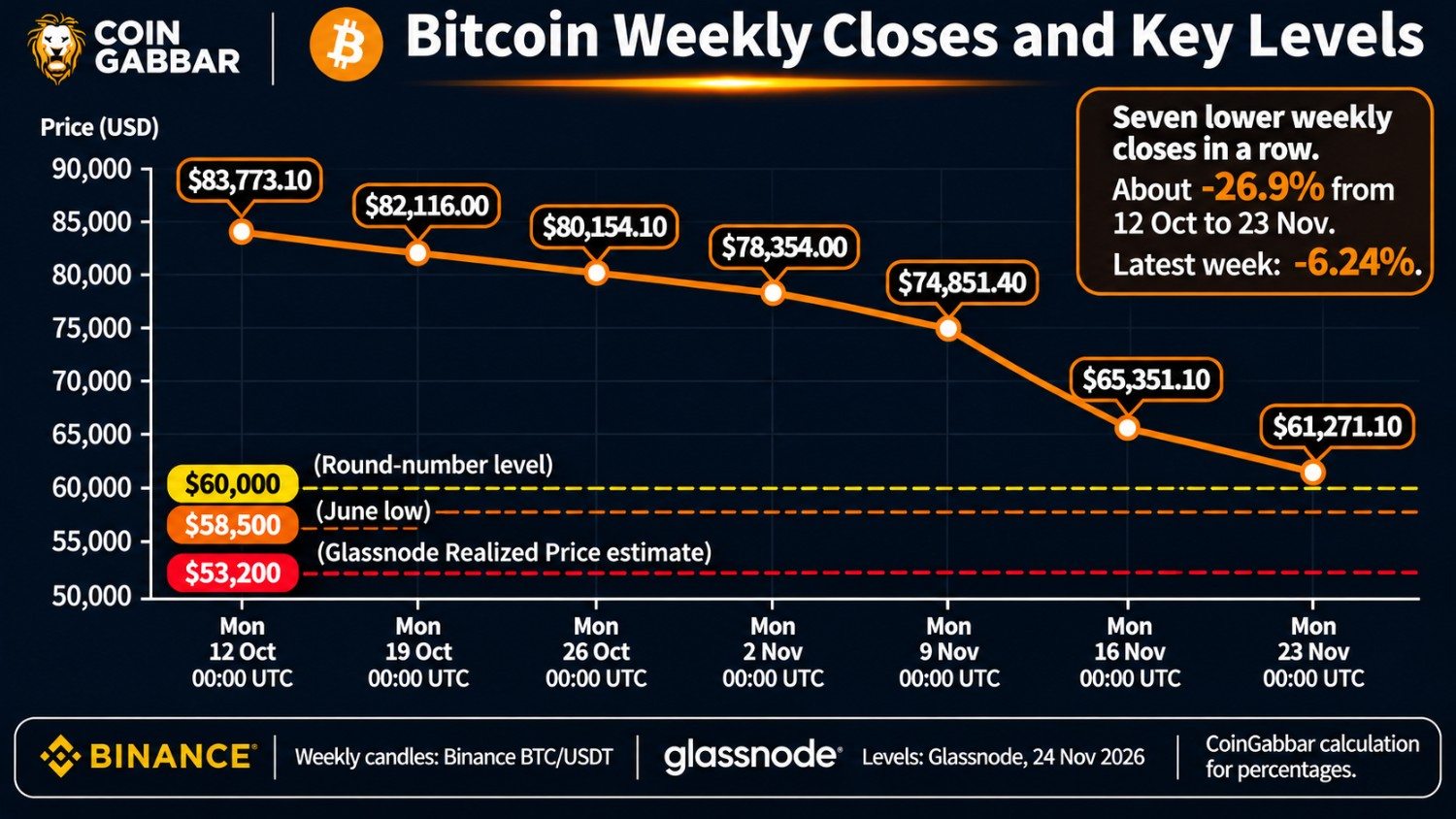
These are analysis levels, not guaranteed floors or targets. Watch whether price holds, whether ETF flows turn, and whether Bitcoin exchange reserves keep falling as price steadies. That last pairing is the one bulls need.
Expert Opinion: What Should Bitcoin Holders Take Away?
CoinGabbar analysis suggests falling Bitcoin exchange reserves are a supply-side clue, not proof of a bottom. The drop is small at 1.48%, and nobody can say for sure where the coins went.
A stronger case would need three things together. Price should stabilize, spot demand should return, and ETF flows should improve while reserves keep falling. Until those line up, readers can treat the reserve drop as one item on a checklist, not a trade signal.
This analysis considers market trends, token supply changes, adoption signals, and historical price behavior.
Disclaimer: This article is for information only. It isn't financial or investment advice. Crypto prices are volatile, and you can lose money. Data can change after publication. Past signals don't guarantee future results, and nothing here promises an outcome.