Bitcoin tried to limit further downside on Friday as traders digested new reports tied to alleged thefts affecting Ledger hardware wallets. Despite the security headlines, spot demand appeare
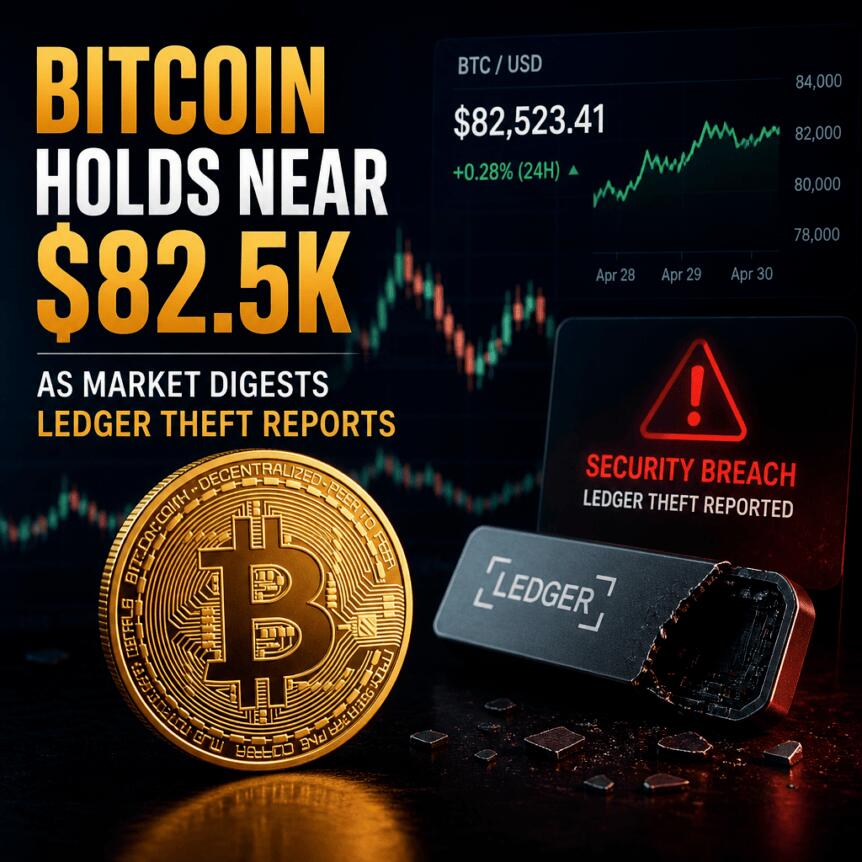
Bitcoin tried to limit further downside on Friday as traders digested new reports tied to alleged thefts affecting Ledger hardware wallets. Despite the security headlines, spot demand appeared to step in after BTC fell to a fresh local low, helping the market recover into the US session.
By the Wall Street open, BTC/USD had climbed back toward the low-$83,000 area after earlier trading near $80,350. At the same time, traders monitored broader liquidation flows and looked ahead to the weekly close for confirmation of whether this bounce can extend.
Key takeaways
- BTC/USD rebounded from $80,350 to reclaim around $83,000 by the Wall Street open.
- Crypto liquidations reportedly moved past $1 billion in the 24 hours preceding the recovery, suggesting heavy leverage unwinds.
- Ledger addressed claims about stolen funds by pointing to a reseller, and advised users to move assets to a new signer.
- Traders framed $82,500 as an important level, with prior support and potential chart-structure implications.
- Bitfinex Alpha expected range-bound conditions into the Oct. 14 US CPI release, with consolidation likely between $81,300 and $86,500.
BTC steadies above $82,500 as liquidation pressure eases
According to TradingView, BTC/USD hovered close to the $82,500 support area on Friday. After dropping to $80,350 the prior day, the market found buyers that helped pull prices away from the local lows.
CoinGlass data cited in the report indicated that rolling 24-hour crypto liquidations surpassed $1 billion around the time BTC began to recover. In addition, the CoinGlass liquidation heatmap suggested spot price movement cutting through ask-side liquidity on exchange order books, with thicker liquidity clustered around the $84,000 region.
This matters for traders because liquidity pockets can influence how far price can travel before a new balance forms. If $84,000 continues to hold as the next liquidity magnet, rallies may stall there unless spot bids broaden.
Ledger theft claims: company links issue to a reseller
While price action stabilized, attention shifted to wallet security. Crypto markets appeared to avoid sustained sell-side pressure after reports circulated about funds allegedly being stolen from Ledger hardware wallet users.
In a post on X, Ledger acknowledged the claims and attributed them to CryptoBillis, a reseller based in Southeast Asia. The company advised users who had set up their Ledger device to consider moving assets to a new Ledger signer using a new seed.
For users, this is a practical takeaway: even when broader market participants respond calmly, wallet-related incidents can change best practices around how and where devices are sourced, initialized, and verified.
It also comes against a backdrop of heightened scrutiny for cold-storage providers. Cointelegraph previously covered security concerns after Coldcard suffered a multi-phase hack in July and August, reinforcing how quickly hardware wallet narratives can evolve during periods of increased attention from attackers and scammers.
Macro and the weekly close in focus
As markets turned to the US open, crypto traders also tracked cross-asset risk sentiment. US stocks reportedly opened higher on Friday, including a rebound in technology shares. CNBC had described pressure on parts of the tech complex earlier in the week, tied to weaker-than-expected earnings projections from OpenAI, and included commentary from Adam Crisafulli of Vital Knowledge about how positioning imbalances were still unwinding.
For Bitcoin, this matters because volatility in equity indices can spill into crypto—especially when leverage is elevated and liquidation cascades can amplify moves in either direction.
Within crypto, traders increasingly focused on the upcoming weekly candle close. Earlier coverage from Cointelegraph highlighted $82,500 as a key battleground for bulls to reclaim. The same level has reportedly served as support since mid-September, and it has also been referenced as part of a possible inverse head-and-shoulders reversal structure that resembled a pattern seen in 2023.
Whether that technical setup plays out depends on whether BTC can hold above $82,500 on a closing basis and then build acceptance higher toward the next resistance/liquidity areas.
Range expectations into Oct. 14 US CPI
Even with the Ledger-related security story in the headlines, some analysts expected BTC to trade within a defined band rather than trend sharply. Bitfinex Alpha—the research arm of Bitfinex—forecast range-bound conditions continuing until Oct. 14, when US inflation data is due for release.
In a blog post published by Bitfinex Alpha, the research team said its primary outlook anticipates consolidation between $81,300 and $86,500 heading into the Oct. 14 US CPI data, with repeated retests of $84,000. The implication is that, absent a catalyst strong enough to break the range, volatility may express itself as multiple rotations around liquidity levels rather than a clean directional move.
Traders often watch for how price behaves near the edges of such ranges—whether dips are bought quickly near the lower bound or whether rallies fade aggressively before the upper boundary—because that can signal whether the market is accumulating positions or distributing them.
Going forward, investors and active traders should watch whether Bitcoin can hold $82,500 through the weekly close and whether liquidity around $84,000 continues to cap upside or becomes a springboard. On the security front, Ledger users should pay attention to the company’s guidance on moving to a new signer, while the market will likely look for further clarification on how the reseller-related claims could affect other devices and future supply-chain assumptions.
This article was originally published as Bitcoin Holds Near $82.5K as Market Digests Ledger Theft Reports on Crypto Breaking News – your trusted source for crypto news, Bitcoin news, and blockchain updates.