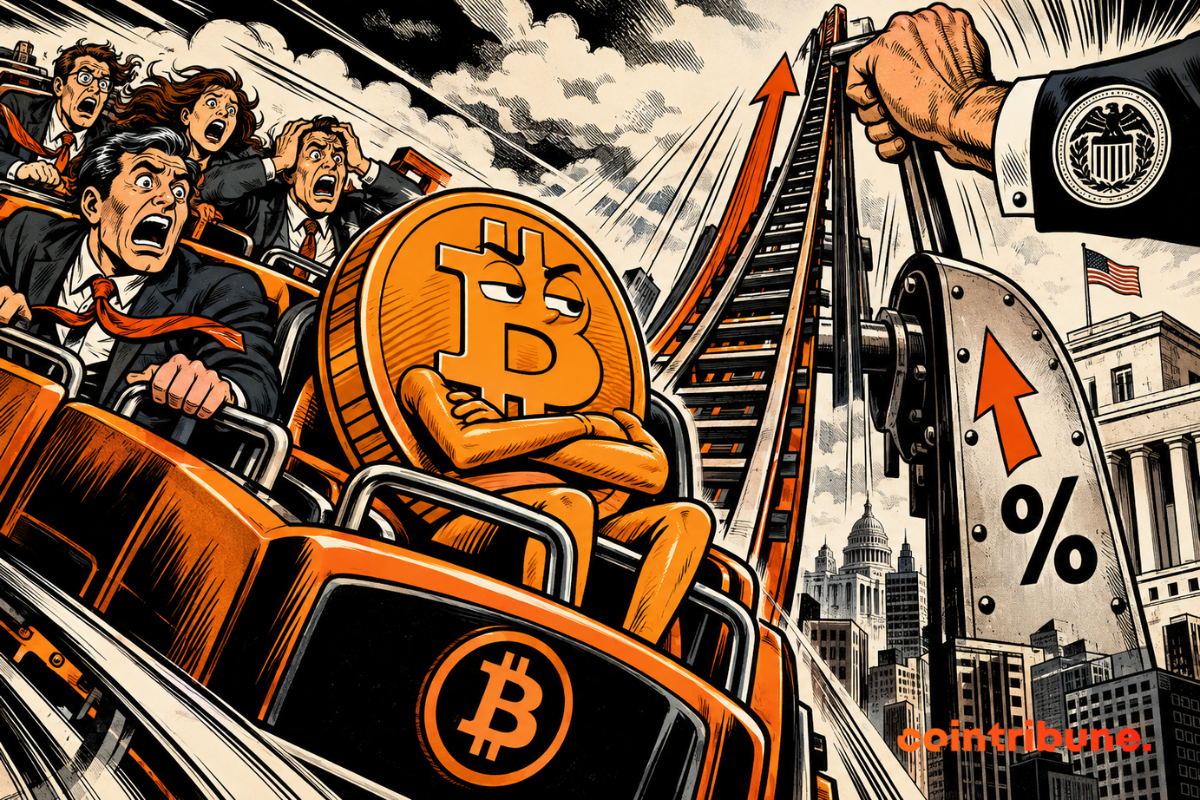
The cryptocurrency market is going through a particular moment as the US Federal Reserve has just raised its rates. This decision, the first since 2023, triggered only a limited reaction on b
The cryptocurrency market is going through a particular moment as the US Federal Reserve has just raised its rates. This decision, the first since 2023, triggered only a limited reaction on bitcoin. On Thursday, investors are watching the next steps of US monetary policy and their potential effect on risky assets. Between bond yields, the dollar, and inflation, the context remains tense. Yet, crypto prices show relative stability, while some altcoins display more marked movements.
In brief
- The Fed raises its rates by 25 basis points, with a range now between 3.75% and 4%.
- Bitcoin remains stable around 76,300 dollars despite the return of monetary tightening.
- Zcash jumps 23% and posts growth well above that of the main cryptocurrencies.
- The crypto market reaches 2.63 trillion dollars, while the fear and greed index returns to neutral zone.
Bitcoin remains stable after an expected rate hike
The Federal Reserve raised its key rate by 25 basis points, bringing its range to 3.75 to 4%. The twelve members of the Federal Open Market Committee unanimously approved this decision. Before the announcement, CME’s FedWatch tool indicated a 93% probability for this increase. This anticipation partly explains why the crypto market reacted little in the first hours.
On Thursday, the bitcoin price was around $76,300, oscillating around $78,112 at the time of writing. It showed limited variation after the decision. The contrast appears clearly when observing the main US indices. The Dow Jones lost about 1.2%, while the S&P 500 declined by 0.4% to 0.5% on Wednesday.
Higher rates also change the balance between different financial assets. Treasury bonds and cash become more attractive compared to assets that do not generate yield, such as cryptocurrencies and gold. A more restrictive monetary policy can also support the dollar, creating additional pressure on risky assets. For crypto markets, this combination remains an important factor to monitor.
Bond markets calm part of the tensions
The financial context had already started to tighten before the Fed’s decision. The US ten-year Treasury yield had exceeded 5% earlier in the week. It reached its highest level since 2007. At the same time, oil crossed $100 a barrel amid an Israeli-Iranian conflict context.
However, part of this tension eased on Thursday morning. Long-term US bond yields fell about two basis points. Stock futures were rising. The message from Fed Chair Kevin Warsh on the fight against inflation also reassured bond markets.
This lull helps explain bitcoin’s stability after the rate hike. Investors had already positioned their portfolios before the decision. They then observed yield developments. The situation remains dependent on forthcoming indications concerning US rates.
Start your crypto adventure safely with KrakenThis link uses an affiliate program.
Zcash stands out clearly among cryptocurrencies
While bitcoin remains relatively stable, Zcash shows much stronger growth. ZEC gained 23%, reaching nearly $1,425, a multi-year high. This rise follows the revelation by Matt Huang, co-founder of Paradigm, that the company held ZEC. Paradigm also invested in the Zcash Open Development Lab.
Matt Huang presented Zcash as a privacy-focused complement to this asset. He defended the funding of the project’s development fund. This fund continues to be fed by inflation. According to him, this support remains important against cyber threats linked to artificial intelligence and advances in quantum computing.
The movement fits into a dynamic already visible before. In May, Zcash had risen 37% after Tushar Jain, from Multicoin Capital, revealed a position built since February. Over the last month, ZEC gained about 160%, compared to 18.2% for bitcoin. Over twelve months, its rise reaches nearly 3,000%, placing it among the top-performing assets of the top ten cryptocurrencies by market cap this week.
Other major cryptos advance more modestly
The main cryptocurrencies show more measured movements. BNB was trading near $724, with a 2% rise, while Solana held slightly above $100, up 3.3%. XRP advanced by 2% to $1.29 but remained down over 6% on the week. Its weekly decline follows the failure of the Clarity Act on cryptocurrencies during the Senate closing vote.
This bill would have legalized most cryptocurrency-related activities in the US. It would also have brought more clarity to altcoins like Solana and XRP than to bitcoin. The evolution of the US regulatory framework thus remains another factor followed by market players.
Price movements were also accompanied by significant liquidations. The market liquidated about $373 million of crypto positions in 24 hours. A majority involved short positions. The total crypto market capitalization was also $2.63 trillion, while the fear and greed index showed 50, a neutral zone.
The next step will notably depend on Federal Reserve indications on its monetary path. In this context, bitcoin remains sensitive to rates, bond yields, and the dollar. Investors now await upcoming US monetary data.
According to its median projections, the federal funds rate should reach 4.1% by the end of 2026, leaving an additional quarter-point margin. The next Fed meeting is scheduled for October 27 and 28. Until then, BTC could continue to move under the influence of yields, the dollar, and rate expectations.