Bitcoin was trading at $76,947 shortly before 6 a.m. on Wednesday morning, equivalent to 68,416 euros, according to CoinGecko. That means the cryptocurrency has recovered half of its US elect
Bitcoin was trading at $76,947 shortly before 6 a.m. on Wednesday morning, equivalent to 68,416 euros, according to CoinGecko. That means the cryptocurrency has recovered half of its US election-night slide: from Tuesday evening's high of $77,966 at 10:45 p.m., the price fell to $75,740 by 4:10 a.m. Five minutes later, CBS News called the House of Representatives for the Democrats, and the Senate followed shortly after 5:30 a.m. Since the low, Bitcoin has regained just over $1,200.
For the day ahead, the election-night low of $75,740 is the level that will show whether the market has digested the result. Above it sits the 100-day moving average at $76,663, which Bitcoin had already dropped to on Tuesday morning. This article puts the night into context, sets out the levels and where they come from, and explains two checks that investors in Germany can carry out now: the holding period for purchases made in November 2025 and the distance of leveraged positions from liquidation.
Bitcoin price on Wednesday morning: the night in five numbers
- Price: $76,947, or 68,416 euros, as of 5:48 a.m. German time.
- Overnight range: $77,966 on Tuesday at 10:45 p.m., $75,740 on Wednesday at 4:10 a.m., a fall of 2.9 percent from high to low.
- Recovery: up $1,207, or 1.6 percent, since the low.
- Congress: the House and the Senate pass to the Democrats from January 2027, according to projections by CBS News and NBC News.
- Distance from the high: the twelve-month high of $105,951 on November 11, 2025, is 27.4 percent above today's price.
Election night in five-minute steps: when Bitcoin lost $2,200
Until midnight, the election was a non-event for Bitcoin. On Tuesday afternoon the price swung between $77,200 and $77,700, and late in the evening it climbed to the day's high. The decline began as counting got under way in the first states. Between 12:35 a.m. and 2:00 a.m., Bitcoin shed around $1,000, after which the price moved sideways for an hour.
The second leg came in the half hour before the House was decided. Between 3:40 a.m. and 4:10 a.m., Bitcoin fell from around $76,500 to $75,740. CBS News called the Democratic majority at 10:15 p.m. Eastern Time, which was 4:15 a.m. in Germany. The low therefore came five minutes before the call, not after it. From that moment the price turned higher, and the Senate call shortly after 5:30 a.m. brought no fresh setback.
Markets have a name for a pattern like this: sell the rumour, buy the news. Traders sell ahead of an expected announcement and buy back once it is confirmed. The numbers fit. On the prediction market Polymarket, the odds of a Democratic win in both chambers rose from around 75 percent at midnight to 99 percent before the House had been called, as our Wednesday morning report on the House notes. Anyone who wanted to sell on the election had already done so by 4:15 a.m.
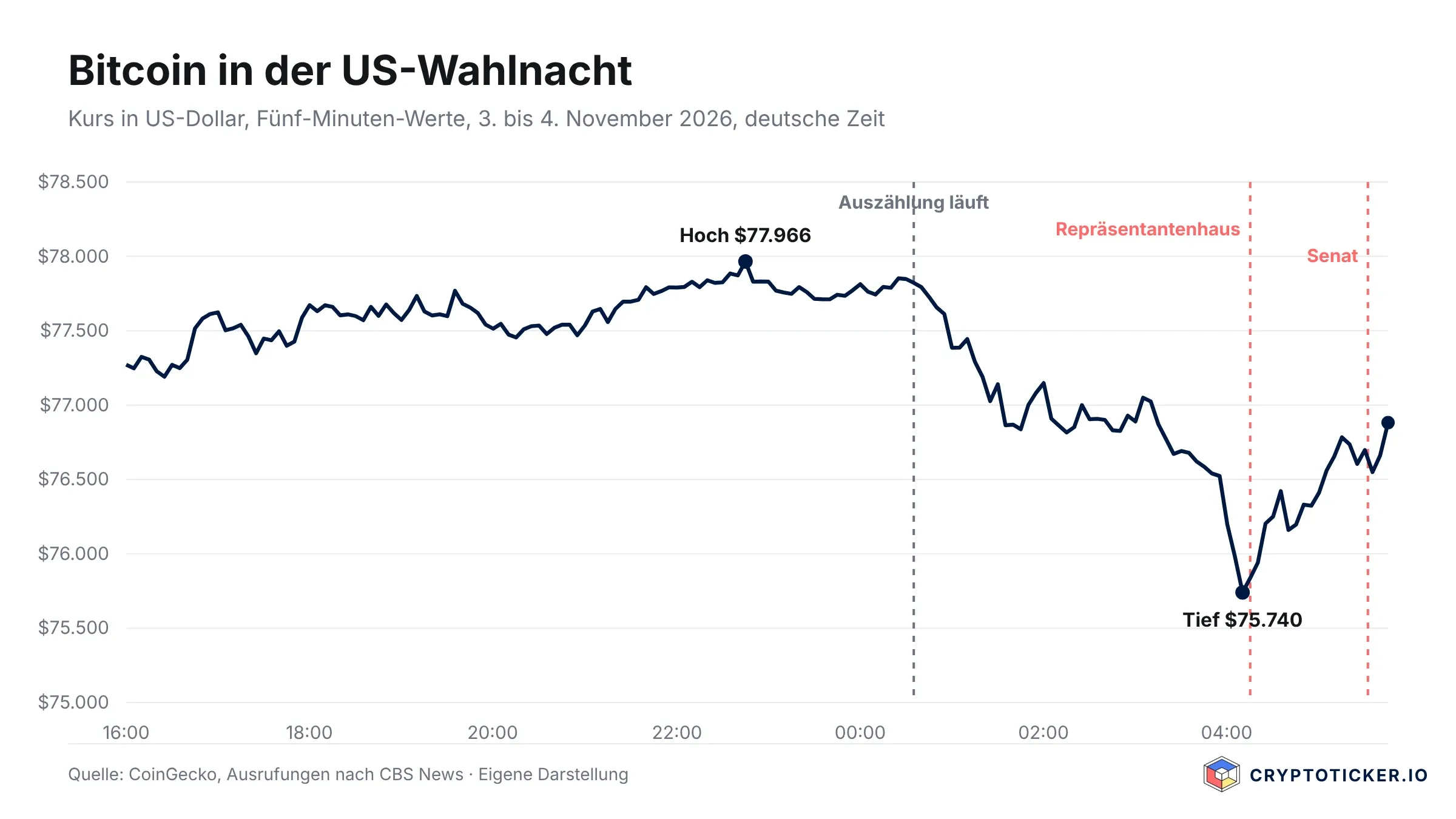
The night's low came at 4:10 a.m., five minutes before CBS News called the House for the Democrats.
Why Bitcoin fell with tech futures on election night
There are two reasons why a change of power in Congress moves the Bitcoin price, and only one of them has to do with crypto. The first is the link to the stock market. Large funds trade Bitcoin like a risky technology investment, and those are the assets they sell first when uncertainty rises. Nasdaq-100 futures fell around 2 percent over the evening and S&P 500 futures around 1.1 percent, CNBC reported, as cited in our Wednesday morning report on the House. Bitcoin moved with that shift, not against it.
The second reason is regulation. The CLARITY Act, the market structure bill for crypto assets, failed in the Senate on September 15 by 49 votes to 50. It lapses on January 3, 2027, unless the Senate acts before then. Jaret Seiberg, Washington analyst at the investment bank TD Cowen, expects a Democratic sweep of both chambers to bring investigations into Trump's crypto businesses and no passage of the bill over the next two years, Bitcoin Magazine reported on election day. For the market, a Democratic Congress therefore mainly means that rules are more likely to come from the SEC and CFTC regulators than from new legislation.
Scale matters for context. A fall of 2.9 percent in one night is nothing unusual for Bitcoin. The price range of the past twelve months runs from $58,566 on July 1, 2026, to $105,951 on November 11, 2025. The election moved the price, but it did not knock it out of its range of recent weeks.
Bitcoin at the 100-day moving average: what has changed since Tuesday
On Tuesday morning Bitcoin stood at $76,887, and our election day price report described how the price had dropped to the 100-day moving average. The 100-day moving average is the average of daily closing prices over the past 100 days; it shows the medium-term trend and is seen by many traders as support. Just over 24 hours later, at $76,947, the price is practically in the same place, $60 higher.
The similar price masks what happened in between. Overnight, Bitcoin slid to $75,740, 1.2 percent below the average, which by our calculation from CoinGecko's daily closing prices stands at $76,663 today. By 5:48 a.m. the price had reclaimed it and was 0.4 percent above. A support level that breaks briefly and is regained the same morning is what chart analysts call a false breakdown. It says nothing yet about the direction of the coming days, but it shows that buyers were waiting below $76,000.
The political situation is also new compared with Tuesday. On Tuesday the election was a risk with an open outcome; today it is a known result. Some Senate races are still open, including Maine and Michigan, which CBS News last listed as too close to call. According to the projections, the majority no longer depends on them.
The levels for the Bitcoin price: $75,740, $76,663 and $77,966
Three levels follow directly from the night and from the moving averages. Each has its own origin, and so they carry different weight.
Downside: $75,740 and $73,163
The election-night low of $75,740 is the first level. Buyers stepped in there during the night of greatest news pressure. If Bitcoin falls below it without fresh news, the morning's recovery was a pause rather than a floor. The next verifiable level below is the 200-day moving average at $73,163, 4.9 percent below the current price. It is the slowest of the usual trend lines and shows the long-term trend.
Upside: $77,966 and $81,911
Tuesday evening's high of $77,966 is the pre-election level. If Bitcoin gets back there, the night's swing will have been fully recovered. Considerably further away is the 50-day moving average at $81,911, 6.1 percent above the price. As long as Bitcoin trades below this line, the short-term trend points down, and election night has not changed that.
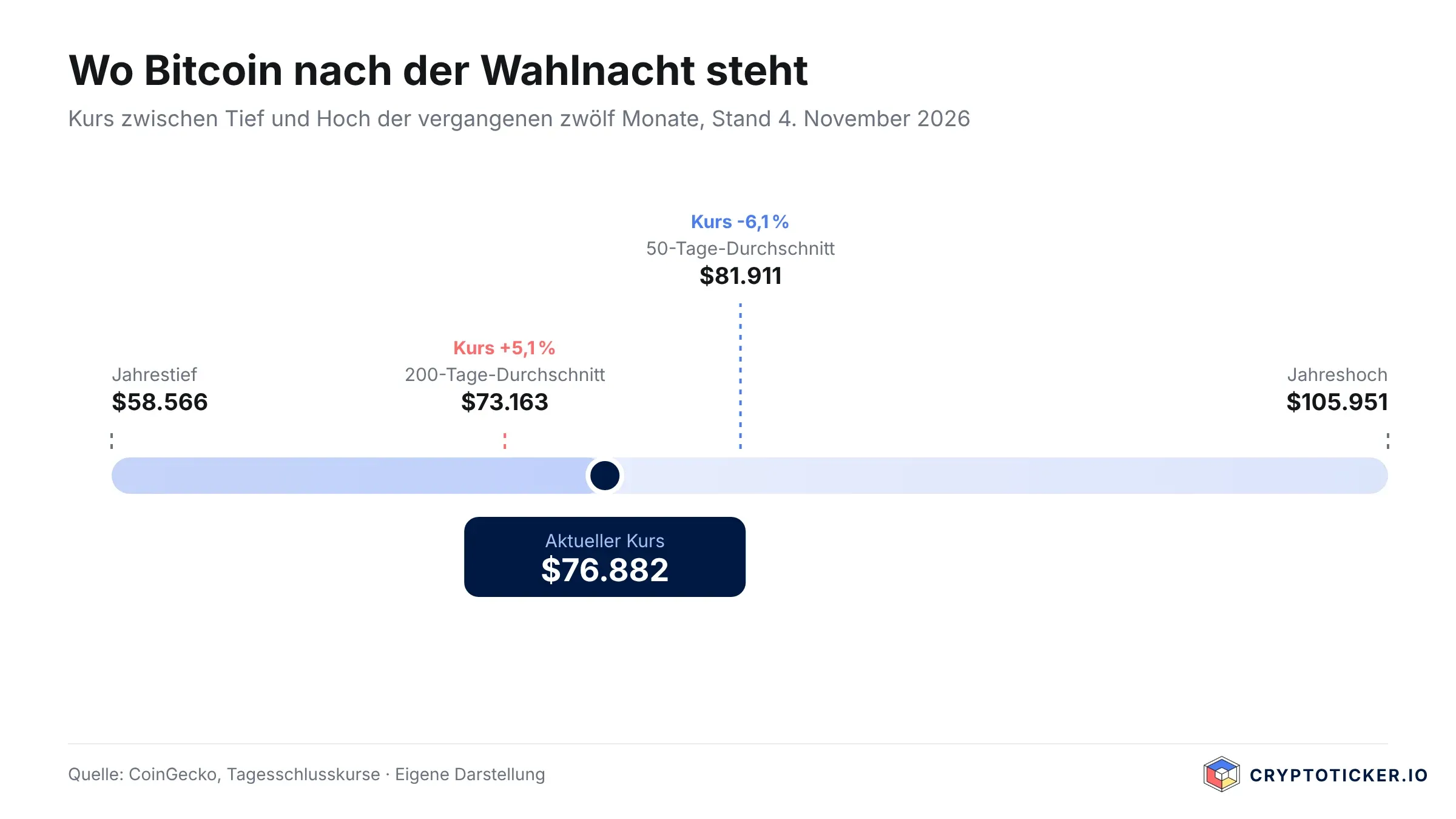
Bitcoin sits between the 200-day and the 50-day moving averages, in the lower third of its twelve-month range.
Bitcoin in euros: 68,416 euros and the role of the exchange rate
For investors in Germany, what ultimately counts is the euro price, because you buy in euros and the tax office calculates in euros. At 5:48 a.m., 68,416 euros corresponded to an exchange rate of about $1.125 per euro. If the dollar moves, the euro value of your Bitcoin changes even when Bitcoin's dollar price stays the same. A weaker dollar lowers the euro value of a Bitcoin position; a stronger one raises it.
In practice this means that if you place a buy or sell order in euros, you should convert the levels above into euros rather than copy the dollar figures. At the current exchange rate, the election-night low is about 67,340 euros and the 200-day moving average about 65,050 euros. Where you can buy Bitcoin in euros under EU supervision, and what fees apply, is shown in our crypto exchange comparison.
Bitcoin holding period in Germany: November 2025 purchases turn tax-free at a loss
For investors in Germany, this week brings a tax quirk that has nothing to do with the election. Anyone who bought Bitcoin just over a year ago reaches the holding period these days. Under the German Income Tax Act, the sale of crypto assets is tax-free if more than one year passes between purchase and sale. Anyone who bought on November 4, 2025, can sell tax-free from November 5, 2026.
The catch: those who bought then are sitting on a loss. According to CoinGecko, the daily close on November 4, 2025, was $101,481; today it is $76,947, a loss of 24.2 percent. This is exactly where the logic of the holding period flips. A loss realised within the period can be used for tax purposes: it can be offset against gains from other private disposal transactions in the same year or carried forward into later years. Once the period has expired, the sale is tax-free, and the loss no longer counts either.
Anyone who made gains in 2026 from crypto sales within the holding period, for example on altcoins, should therefore check before the anniversary of a losing position whether selling still makes sense. The FIFO principle applies: with several purchases on the same exchange, the coins bought first are deemed to be sold first. The exemption limit for private disposal gains is 1,000 euros a year; if it is exceeded by a single euro, the entire gain becomes taxable. Whether the one-year period itself will remain is still open: the federal government wants to abolish it, but there is no cabinet decision. Our page on the crypto holding period reform keeps track of the latest status. For an assessment of your individual case, a tax adviser is the right route.
Leverage on election night: how much distance a Bitcoin position needs from liquidation
The night's range works as a worked example for anyone trading Bitcoin with leverage. A liquidation is the forced closing of a position by the exchange as soon as the posted collateral no longer covers the loss. At 35x leverage, an adverse move of around 2.9 percent equals the complete loss of collateral, before fees. That is exactly how far Bitcoin fell between 10:45 p.m. and 4:10 a.m. A long position at this leverage opened on Tuesday evening would therefore have been closed overnight, even though by morning the price was almost back where it started.
At 10x leverage, the same night would have cost around 29 percent of collateral; at 5x, around 14 percent. The calculation shows the core point: what decides a leveraged position is not the direction but the volatility along the way. Ahead of events with an uncertain outcome, it helps to keep the distance to the liquidation price at least as wide as the range of a turbulent night. If you want to trade leveraged products through a regulated broker, you will find the providers in our crypto broker comparison.
Dates for the Bitcoin price: Senate races, jobs report and Bundesrat
With the election over, other dates move to the fore. The list shows what matters for the price in the coming weeks.
- Wednesday and Thursday: counting in the open Senate races, including Maine and Michigan. According to the projections they no longer decide the majority, but they do decide the size of the lead.
- Friday, November 6: US jobs report. It is the next data point for interest rate expectations, and those move Bitcoin through the stock market more than the election did.
- November 20: session of the Bundesrat, Germany's upper house. A law abolishing the holding period needs its approval, and before the end of the year it only meets in regular session on this day and on December 18.
- Until January 3, 2027: lame-duck session of the outgoing Congress. During this period the Senate would have to decide on the CLARITY Act, or the bill lapses.
Bitcoin after the election: below $75,740, the next stop is $73,163
Election night cost Bitcoin 2.9 percent, and by morning it had given back half of the loss. The result is known, and the uncertainty of the night is over. What matters for the coming days is whether the $75,740 low holds; below it, the next verifiable support only comes at the 200-day moving average. Three steps for today:
- Set levels in euros: convert buy and sell levels at the current exchange rate and place limit orders with an EU-licensed exchange. The providers and their fees are listed in our exchange comparison.
- Check the holding period: for purchases from November 2025, check whether selling within the period makes losses usable. Tax tools such as those in our crypto tax tool comparison show the purchase date per coin using FIFO.
- Limit leverage: ahead of Friday's jobs report, choose a distance to the liquidation price wider than election night's 2.9 percent. Our broker comparison sets out the brokers' leverage terms.
(As of November 4, 2026. This article is not investment advice. Prices and fee structures change; check the terms with the provider before you buy. Crypto assets can fluctuate to the point of total loss.)