The bitcoin price fell to around $62,000 overnight into Sunday. At 01:44 UTC on November 15, 2026, bitcoin traded at $62,199 according to CoinGecko, down 8.9% in 24 hours and 16.3% over the w
The bitcoin price fell to around $62,000 overnight into Sunday. At 01:44 UTC on November 15, 2026, bitcoin traded at $62,199 according to CoinGecko, down 8.9% in 24 hours and 16.3% over the week. Based on CoinGecko's daily closes, bitcoin has not been this low since early July 2026. Whether $60,000 holds now depends on three things: rate expectations for the Federal Reserve, outflows from the spot bitcoin ETFs, and how much leveraged long exposure is still left in the market.
The sell-off is market-wide. Ether lost 10.9% to $1,718, Solana 12.4% to $67.79 and XRP 10.5% to $0.90. Total crypto market capitalization dropped 10.3% to about $2.14 trillion, per CoinGecko. Our summary of the first wave of selling on Saturday evening is in the crypto news for November 14, and the reasons behind each sell-off this year are tracked on our page why is crypto down.
Bitcoin price today: 50.7% below the all-time high
Bitcoin's all-time high is $126,080, set on October 6, 2025. At $62,199, the price is 50.7% below that level, meaning bitcoin is now worth less than half of its record. On November 5, bitcoin still closed at $80,443, so roughly 23% has been lost in ten days (cryptoticker.io calculation based on CoinGecko daily closes). The last daily close below today's level was $61,490 on July 3, 2026. The 12-month low stands at $58,566 from July 1, 2026, which was 53.5% below the record; from there, bitcoin rallied back to about $86,600 by September 22.
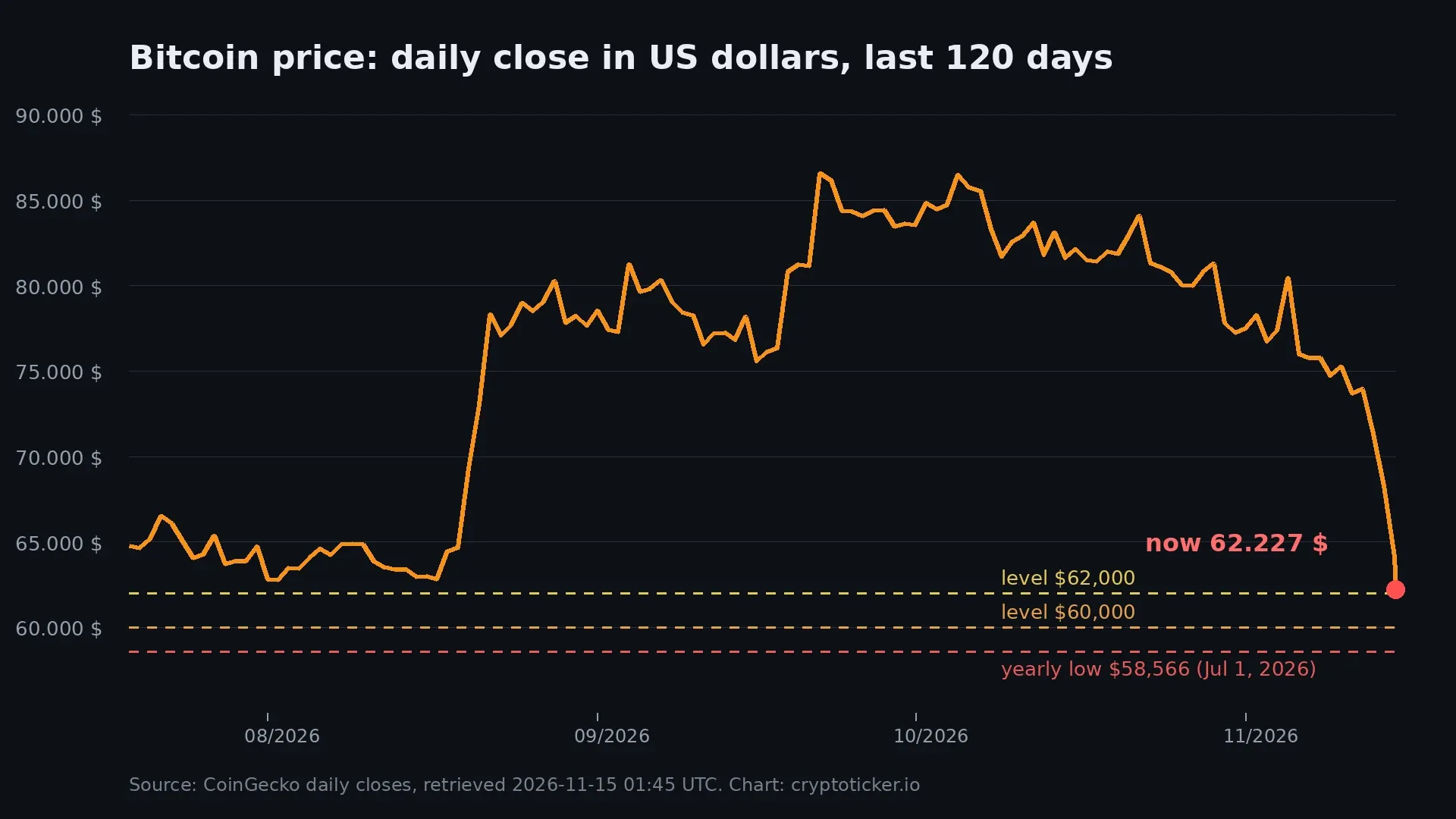
Bitcoin gives back the entire rally since August in two weeks and approaches its yearly low. CoinGecko daily closes, retrieved November 15 at 01:45 UTC.
Why the bitcoin price is falling: Fed hike odds near certainty
US rate expectations are the main driver. According to the CME FedWatch tool, cited by bitcoin.com, traders priced an 88.5% probability of a quarter-point hike in December on Saturday, and 11.5% for a half-point move. The trigger was hotter-than-expected data: October inflation of 0.4% month over month versus 0.3% expected, and 165,000 new jobs versus roughly 65,000 expected. Higher rates raise the cost of leverage and make risk assets less attractive, and bitcoin is currently reacting strongly to that shift.
Spot bitcoin ETF outflows: $1.07 billion in five trading days
A spot bitcoin ETF is an exchange-traded fund that buys and holds actual bitcoin; when investors pull money, the fund sells. According to Coinpaper, citing Farside Investors data, US spot bitcoin ETFs saw net outflows of about $1.07 billion between November 9 and November 13, while ether funds lost another $398.9 million. Coinpaper also cites Coinbase Institutional: the combined supply of USDT, USDC and DAI fell by a record $11.5 billion over 30 days. Fewer stablecoins in circulation means less cash on the sidelines to absorb selling.
Liquidations: why the bitcoin price drops so fast
A liquidation is the forced closing of a leveraged position by the exchange once the posted collateral no longer covers the loss. Every liquidated long is an automatic sell order, and that selling pushes the price into the next cluster of liquidations. When bitcoin broke below $64,000, TokenPost counted $691 million in liquidations within a single hour: $671 million in longs and $19.5 million in shorts, so about 97% hit traders betting on higher prices. According to bitcoin.com, roughly $1 billion in positions was liquidated market-wide over the preceding 24 hours, $382 million of it in bitcoin.
The Crypto Fear and Greed Index from alternative.me, which measures market sentiment on a scale from 0 to 100, reads 10 on November 15, in "extreme fear", after 13 the day before and 20 two days earlier. Among sectors worth more than $5 billion, CoinGecko showed DeFi hit hardest on Saturday night: automated market makers −14.7%, decentralized exchanges −13.5% and perpetuals −13.4%.
Will the bitcoin price fall below $60,000? The levels to watch
This article makes no forecast, but the levels traders are watching are well known. Coinpaper names $62,000 as a technical reference flagged by Coinbase Institutional before the latest decline. If bitcoin cannot stabilize above that area, $60,000 becomes the next major psychological target, followed by the yearly low of $58,566. On the upside, reclaiming the $66,000 to $68,000 zone would improve the picture, according to the same source. If rate expectations keep rising and ETF outflows continue, the lower levels come into play; if the Fed calms markets before its December meeting or ETF flows turn positive, the $66,000 zone is the first hurdle. How deep past bitcoin crashes went is documented on our bitcoin crash history page, the 200-week moving average is covered in bitcoin price breaks below the 200-week moving average, and analyst targets with names and sources are collected in our bitcoin price prediction.

When the margin is gone, the exchange closes the trade, not the trader.
Sell or hold? How traders approach a bitcoin price crash
This is not advice, only an explanation of the tools. A long position profits when the price rises; a short position profits when it keeps falling. Both are possible without leverage, by buying or selling bitcoin on the spot market, and with leverage through futures, perpetual contracts or CFDs.
Leverage magnifies results in both directions. At 10x, a 10% price move changes the position by 100%: with $1,000 of margin you control $10,000 of bitcoin, and a 5% drop costs you $500, half your margin. At 100x, a move of roughly 1% against you is enough to wipe out the entire margin. That is exactly what happened to the $671 million in long positions liquidated within one hour on Saturday.
Two tools limit the damage. A stop-loss is an order that closes a position automatically at a price set in advance. Position size determines how much is at risk; many traders risk no more than 1% to 2% of their capital on a single trade. Before trading, compare fees, order types and licensing in our crypto exchange comparison; platforms for futures and perpetuals are reviewed in our perp DEX comparison. The decision is yours. Leveraged products and CFDs can lead to the loss of your entire stake.
Bitcoin price crash: what US and UK readers should know
In the United States, the spot bitcoin ETF flows reported by Farside are the clearest daily signal of institutional demand, and the Fed's December decision is the next fixed date for markets. In the United Kingdom, check that your platform is registered with the Financial Conduct Authority before you trade. On days with sharp moves, exchanges face heavy traffic: make sure your account is accessible and that you have no forgotten leveraged positions open. Beyond crypto, many investors are also watching the planned listing of Anthropic; our guide on anthropic stock covers the details.
Bitcoin price crash: your next three steps
- Check whether you hold leveraged positions and at what price they would be liquidated; margin terms are compared in our perp DEX comparison.
- Review licensing, fees and order types of your platform in the crypto exchange comparison.
- Watch the $62,000, $60,000 and $58,566 levels and the scenarios in our bitcoin price prediction.
(As of November 15, 2026, 01:45 UTC. This article is not financial advice. Prices and fee models change; check the terms with the provider before every purchase. Trading with leverage or CFDs can result in the loss of your entire capital.)