Key Takeaways Put volume ran 1.7 times call volume. Same-distance puts cost 11% more in BTC. Puts’ volatility edge over calls reached 10 points. The $58,000 put rose 86% as Bitcoin fell. Glas
Key Takeaways
- Put volume ran 1.7 times call volume.
- Same-distance puts cost 11% more in BTC.
- Puts’ volatility edge over calls reached 10 points.
- The $58,000 put rose 86% as Bitcoin fell.
Glassnode’s Nov. 24 report put the seven-day put-to-call volume ratio at 1.7, its highest since June 2022. The same report said the put/call open interest ratio, which counts positions still held rather than contracts traded, had reached its highest level since May 2021.
Over the same stretch, the Bitcoin index fell from near $63,491 in Coindoo’s Nov. 18 sample of Deribit trades to near $59,595 on Nov. 24, a drop of roughly 6%. What that demand did to the cost of a hedge depends on what the buyer is protecting: a fixed price level, or a fixed distance below wherever Bitcoin happens to trade.
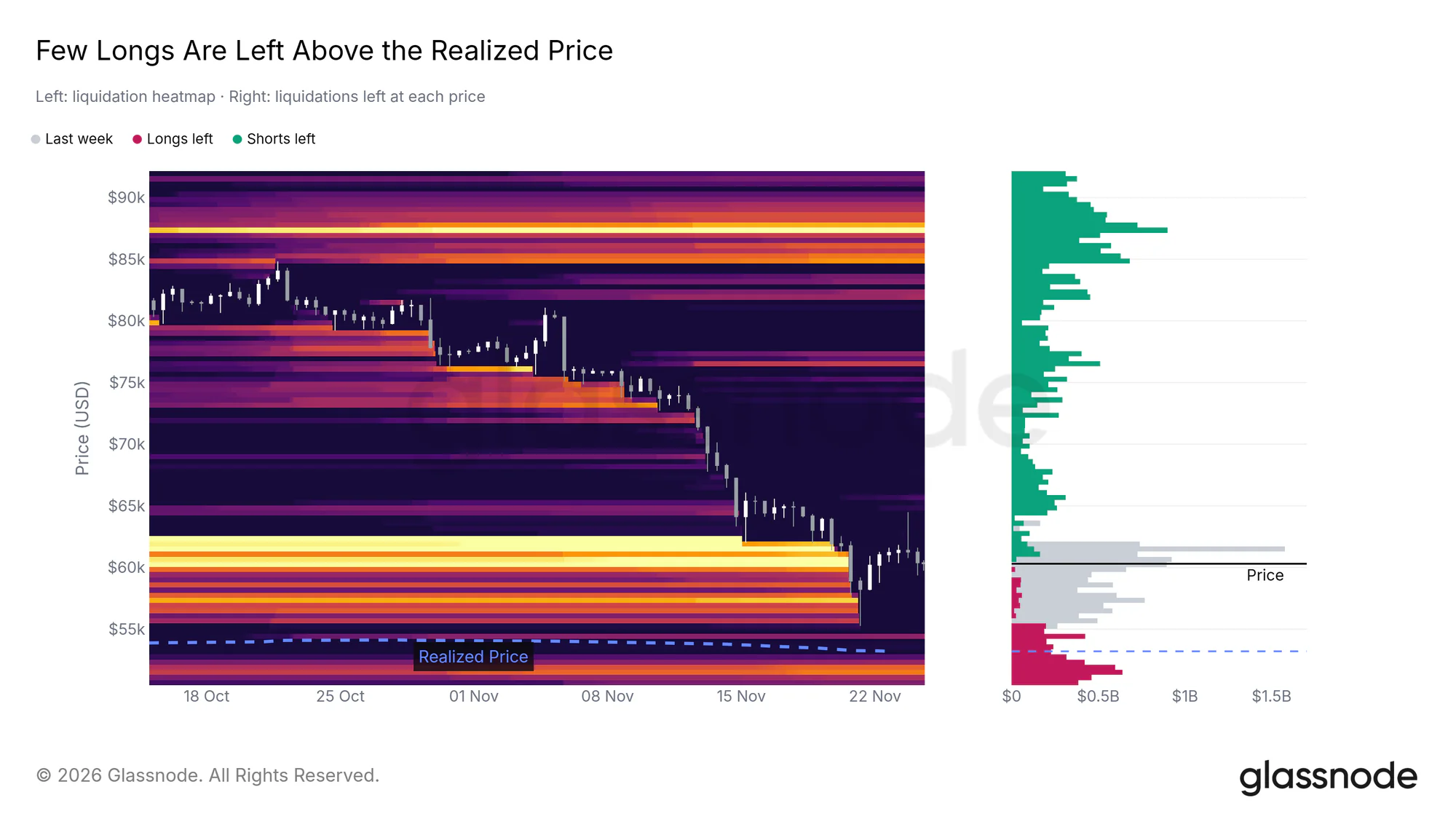
Bitcoin’s November slide cleared nearly 90% of the long positions that sat between price and Glassnode’s realized price of about $53,200. Source: Glassnode
Why the $58,000 put nearly doubled
A put with a $58,000 strike and a Dec. 25 expiry pays its holder the difference between $58,000 and Bitcoin’s settlement price if Bitcoin finishes below that level. On Deribit, both the premium and the payout are settled in BTC.
On Nov. 18, the strike sat about 8.6% below the index, and seven trades put the median premium at $1,429 per BTC covered. By Nov. 24, the same strike was only about 2.7% away. Its median premium, from two trades, was $2,652, up about 86%.
Most of that increase came from Bitcoin’s move toward the strike, not from a change in how the market priced risk. A put close to the market starts paying after a much smaller decline, so it is worth more by construction. The higher premium also lowered the break-even point. Measured in dollars at purchase and before fees, the Nov. 24 buyer needed Bitcoin to settle below about $55,348 just to recover the premium, against about $56,571 for the Nov. 18 buyer.
Same-distance protection held its dollar price
Holding the distance constant separates those two effects. Coindoo tracked December puts whose strikes sat 8.5% to 10.5% below the index at the moment each trade executed. On Nov. 18, the $58,000 put fell inside that band, so both measures start from largely the same trades.
December Bitcoin puts on DeribitMedian dollar premium per BTC covered, 15:00–16:00 UTC. Number of trades in parentheses.
Day
$58,000 strike
8.5%–10.5% below index
Wed., Nov. 18
$1,429 (7)
$1,429 (6)
Thu., Nov. 19
$1,485 (3)
$1,369 (1)
Fri., Nov. 20
$2,405 (46)
$1,461 (20)
Sat., Nov. 21
$3,008 (9)
$1,788 (2)
Sun., Nov. 22
—
$1,703 (8)
Mon., Nov. 23
$1,573 (1)
—
Tue., Nov. 24
$2,652 (2)
$1,490 (1)
In dollars, the same-distance hedge barely moved. Its Nov. 24 figure comes from a single $54,000 put with a strike about 9.4% below the index, and it sits roughly 4% above the Nov. 18 median. The band’s highest reading came on Saturday, Nov. 21, from just two weekend trades; the fixed strike’s figure that day came from nine. Activity clustered at $58,000 all week, with 46 trades in the Nov. 20 hour alone.
The dollar figures hide two things working against the buyer. Deribit prices these options in BTC, and as the index fell, the same dollar premium took more coins to pay. Converted at the index, the Nov. 18 median was about 0.0225 BTC and the Nov. 24 trade about 0.025 BTC, roughly 11% more for a holder paying out of a Bitcoin balance. The clock was also running down. The contract had about 37 days to expiry on Nov. 18 and about 31 on Nov. 24, and with less time left, an otherwise unchanged put should have been cheaper, not dearer.
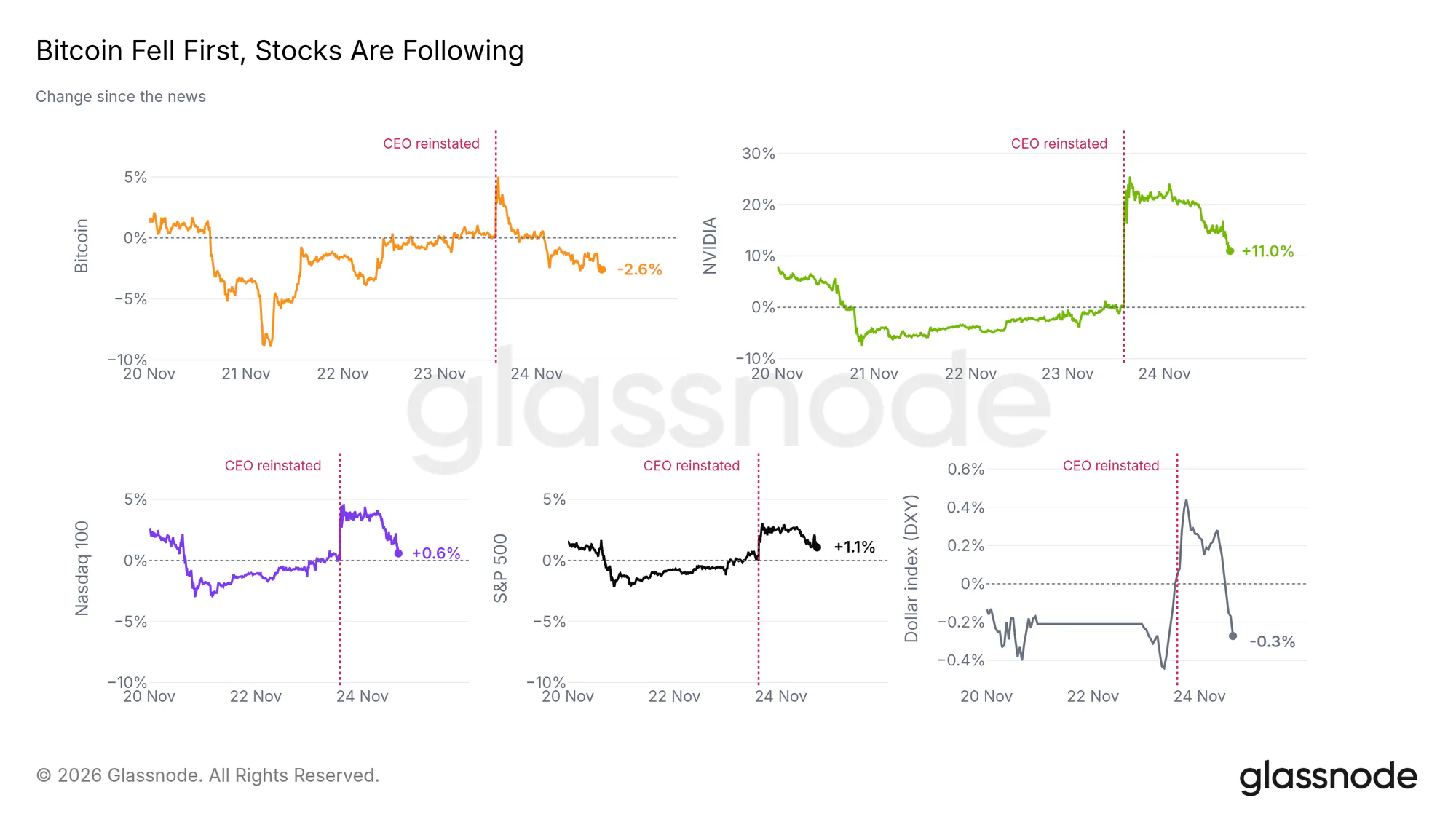
Bitcoin’s sharp Nov. 21 drop came before NVIDIA reinstated Jensen Huang as CEO. Bitcoin gained 5% in about half an hour on the news and was back where it started within six hours. Source: Glassnode
How the trades were sampled
Coindoo sampled Deribit trades from 15:00 to 16:00 UTC each day from Nov. 18 to 24, 2026, in BTC inverse options expiring Dec. 25. Each BTC premium was converted to dollars at the index price at execution. Medians are taken across individual trades and exclude fees and multi-leg strategy trades, which Deribit’s trade records flag with a combo ID. A dash means no qualifying trades in that hour.
Puts carried a wider volatility premium
Implied volatility (IV) converts an option premium into the annualised price swings that the premium implies, so contracts with different strikes and dates can be compared on one scale. The put band was matched against December calls with strikes 8.5% to 10.5% above the index. Four of the seven sampled hours had qualifying trades on both sides, and in each of them, puts carried the higher median IV.
The gap widened across the week. On Nov. 18, the medians were about 47% for puts and 40% for calls, a 7-point spread. On Nov. 24, they were about 56% and 46%, a 10-point spread, although the put side that day is one trade against five calls. Both sides repriced higher, and puts moved further.
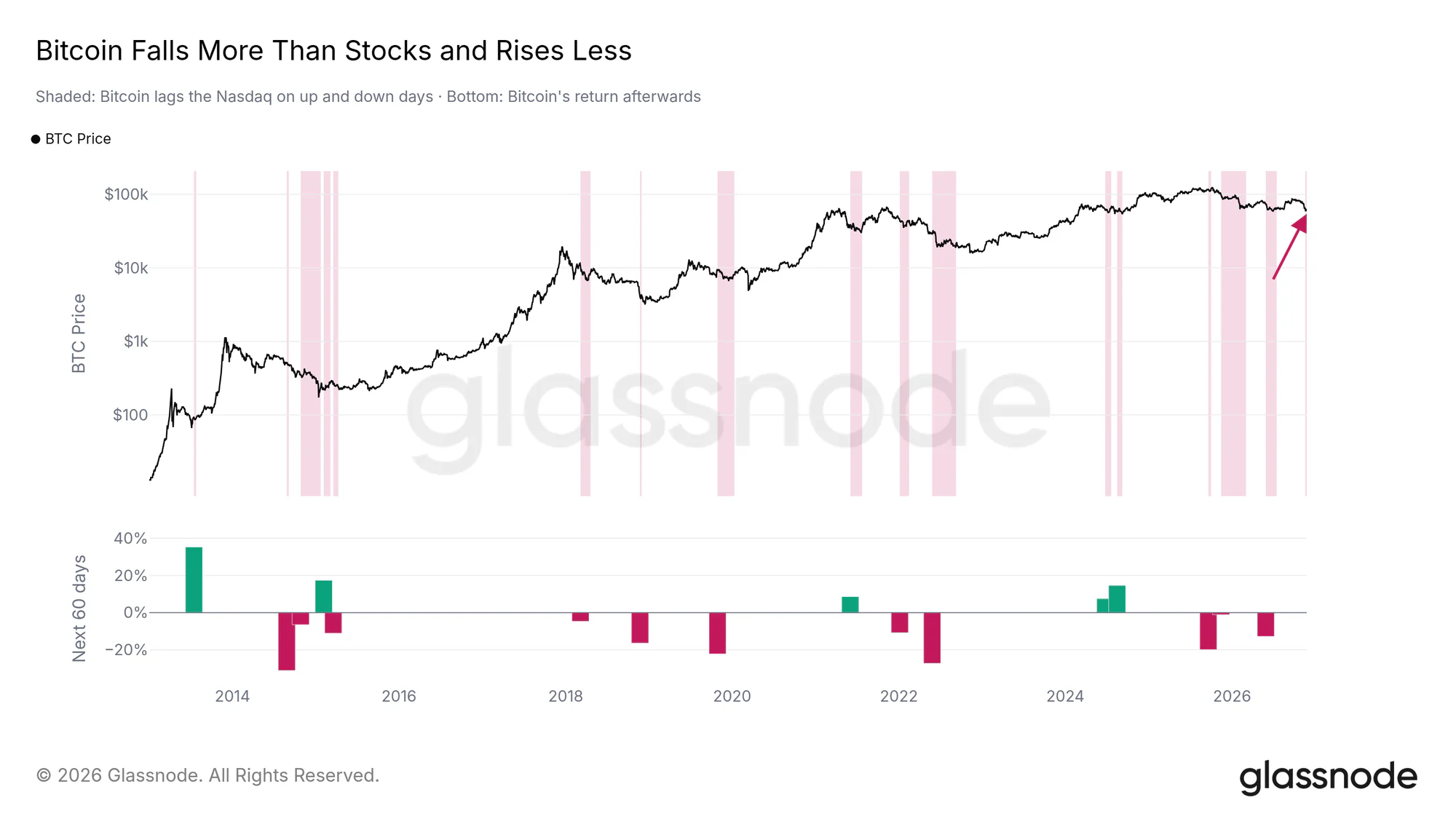
Over the past 60 trading days, Bitcoin has risen less than the Nasdaq 100 on the index’s up days and fallen more on its down days. Glassnode found Bitcoin was lower 60 days later in about two-thirds of earlier stretches like this. Source: Glassnode
These are executed trades picked by strike distance, not a constant-maturity 25-delta skew series, which is the standard gauge of the same imbalance. For the broader picture, see Coindoo’s earlier analysis of Bitcoin volatility and downside skew.
What the higher strike bought
On Nov. 24, the $58,000 and $54,000 puts traded with the index near $59,600, so their prices line up directly. Keeping the floor at $58,000 cost $1,162 more per BTC than dropping it to $54,000. In exchange, the higher strike starts paying once Bitcoin is below $58,000 rather than $54,000, and pays up to $4,000 more if Bitcoin settles at or below $54,000 on Dec. 25.
Break-even points narrow that edge. Measured the same way as above, the $58,000 put recovers its premium below about $55,348 and the $54,000 put below about $52,510, a gap of about $2,838 rather than $4,000. The extra $1,162 buys cover for the slide from about 3% to about 9% below the Nov. 24 price. Cover below that point cost about the same in dollars as it had six days earlier.
The post Bitcoin Put Demand Hits Highest Level Since 2022 appeared first on Coindoo.