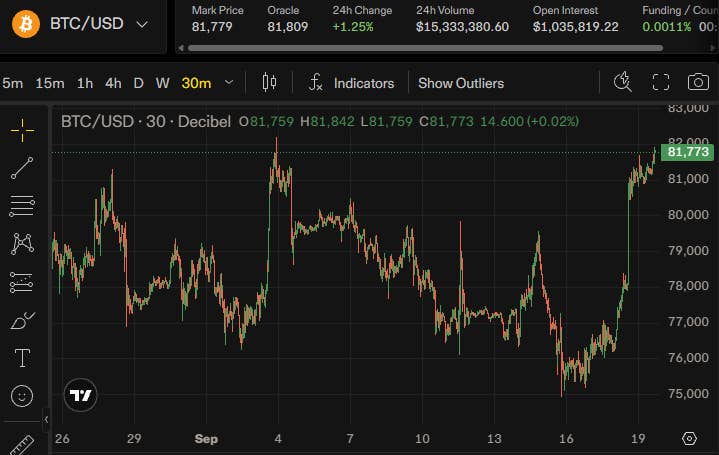
Bitcoin's latest price advance appears to have been driven largely by the forced closure of short positions in derivatives markets, according to liquidation data tracked by Coinglass. When le
Bitcoin's latest price advance appears to have been driven largely by the forced closure of short positions in derivatives markets, according to liquidation data tracked by Coinglass. When leveraged bearish traders are forced to buy back positions as prices rise against them, the resulting cascade of buy orders can accelerate a rally well beyond what spot demand alone would produce.
WHAT TO KNOW
- Market data points to short liquidations as a major catalyst in Bitcoin's recent rally.
- Liquidation-driven buying can amplify momentum without independently proving lasting demand.
How Short Liquidations Helped Fuel Bitcoin's Rally
A short liquidation occurs when a trader who has borrowed funds to bet on a price decline is automatically closed out by an exchange because the position has moved against them past a margin threshold. That forced closure requires a buy order, which pushes price higher and can trigger the next tranche of shorts in a feedback loop sometimes called a short squeeze. For related coverage, see Will Bitcoin Skyrocket When Iran War Ends? Key Signals.
Derivatives platforms including those tracked by Coinglass liquidation data record these events in real time. A concentration of liquidations on the short side during a price advance is a signal that crowded bearish positioning, rather than fresh spot buying, was a primary engine of the move. This distinction matters for assessing whether the rally reflects genuine demand or mechanical position clearing. For related coverage, see Bitcoin Surpasses $126,000, Driven by Institutional Adoption.
Bitcoin has faced repeated volatility episodes tied to leveraged positioning, where derivatives markets amplify price swings in both directions. A rally built on short liquidations tends to stall once the pool of exposed shorts has been exhausted, because the forced buying pressure disappears. For related coverage, see Bitcoin Hits $120K, Strategy's Holdings Valued at $77.4B.
What the Liquidation Data Can and Cannot Tell Traders
Large short liquidations reveal two things: that bearish positioning was crowded before the move, and that derivative exchanges added mechanical buying pressure as prices climbed. What the data does not establish is whether spot market participants are accumulating at current levels or whether the move will attract follow-through demand. For related coverage, see Bitcoin Faces Correction Risk Amid September Volatility.
Traders looking to assess durability would need to examine corroborating signals alongside liquidation figures. Spot market volume relative to derivatives volume, the direction of open interest after the move, and perpetual funding rates all carry information about whether the rally is drawing in new buyers or simply clearing a one-sided book. A rise in open interest alongside positive funding after a liquidation spike suggests fresh longs are entering; a decline in open interest suggests position compression with limited new participation.
Bitcoin's monetary properties, including its fixed supply schedule and transparent on-chain settlement, make it unusual among assets in that its network data is publicly verifiable. Exchange reserve trends tracked on platforms like CryptoQuant can supplement derivatives data by showing whether coins are flowing onto exchanges, which could indicate selling intent, or withdrawing to self-custody, which historically correlates with longer holding behavior.
Bitcoin recently surpassed $126,000 on a wave of institutional demand, a separate dynamic from short-squeeze mechanics. Distinguishing between institutional accumulation and derivatives-driven moves requires looking at both the spot and derivatives layers simultaneously.
Why Bitcoin's Next Moves May Matter More Than the Initial Squeeze
Once the pool of short positions has been liquidated, the forced buying that powered the initial move is gone. Whether Bitcoin holds the gains depends on whether organic spot demand, institutional flows, or new derivatives positioning step in to replace that mechanical pressure.
Traders and analysts typically watch two things after a liquidation-driven spike: whether price holds key support levels once the squeeze momentum fades, and whether funding rates on perpetual contracts remain elevated, which would indicate fresh leveraged longs have replaced the cleared shorts. Elevated funding without spot confirmation is itself a vulnerability to a reversal.
As with any move in leveraged Bitcoin markets, the risk of a sharp correction remains while positioning is crowded in either direction. Bitcoin's volatility is a function of its still-developing liquidity profile and the outsized role derivatives play in short-term price formation. Participants in leveraged markets carry exposure to forced liquidation in both directions, regardless of the underlying network's fundamentals.
Disclaimer: This article is for informational purposes only and does not constitute financial or investment advice. Cryptocurrency and digital asset markets carry significant risk. Always do your own research before making decisions.
Bitcoininfonews first published the article titled Bitcoin Rally Fueled by Short Liquidations, Data Suggests.