Bitcoin has recorded its weakest average weekday performance on Fridays, reflecting recurring institutional risk reduction before weekend market sessions. Derivatives expirations and lower li
- Bitcoin has recorded its weakest average weekday performance on Fridays, reflecting recurring institutional risk reduction before weekend market sessions.
- Derivatives expirations and lower liquidity amplified Friday selling pressure, increasing volatility despite Bitcoin holding above its 100-day moving average support.
- Broader macroeconomic events, ETF flows, and geopolitical developments remain stronger price drivers than historical weekday trading patterns alone.
Bitcoin has repeatedly recorded its weakest average weekday performance on Fridays, with recent market data reinforcing a trading pattern that has persisted over the past several weeks. Although the cryptocurrency market operates continuously throughout the week, the end of the traditional trading week has consistently produced stronger selling pressure than any other weekday over the measured period.
Recent market data shows Friday delivered the largest average decline in Bitcoin’s rolling two-week returns, with average losses exceeding one percent. By comparison, Tuesday generated the strongest gains, while Saturday and Sunday generally recorded positive returns, reinforcing the contrast between end-of-week weakness and stronger weekend performance.
Meanwhile, Monday and Wednesday also produced modest negative returns, although their average declines remained considerably smaller than those recorded on Fridays.
The recurring trend has gained significance because it reflects how institutional participants often adjust their portfolios before traditional financial markets close for the weekend, even though cryptocurrency trading never pauses. Consequently, many market participants approach Friday sessions with greater caution, particularly following periods of elevated volatility.
Also Read: Bitcoin Slips Below $64K as BNB and XRP Defy the Broader Crypto Market
Institutional positioning influences end-of-week trading
Many institutional investors, hedge funds, and market makers reduce risk before the weekend, especially after volatile trading sessions, prompting them to close leveraged positions or secure profits before stepping away from their trading desks. Consequently, selling pressure naturally increases as market participants seek to limit their exposure during two uninterrupted days of cryptocurrency trading.
Additionally, weekly and monthly cryptocurrency derivatives play an important role in shaping Friday price action because many futures and options contracts expire before the weekend, creating substantial order flow across major exchanges. At the same time, institutional participation gradually declines later in the trading session, reducing overall market liquidity and allowing relatively modest sell orders to trigger larger price swings than they typically would during more active trading periods.
Technical indicators reflect a balanced market
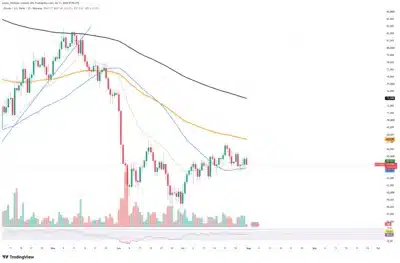
Bitcoin’s current technical structure reflects that cautious backdrop, with the cryptocurrency recently falling below its 50-day moving average near $67,400 while continuing to trade around the $64,000 level and holding above its 100-day moving average near $63,400.
Source: TradingView
However, Bitcoin remains below both its 50-day and 200-day moving averages, leaving the broader technical outlook neutral to bearish, while the Relative Strength Index continues to hover near the 50 level, indicating neither buyers nor sellers have established decisive market control.
Friday has consistently produced Bitcoin’s weakest average performance because institutional risk reduction, derivatives expirations, and declining liquidity often combine to increase selling pressure. However, macroeconomic developments, exchange-traded fund flows, geopolitical events, and liquidation activity remain the dominant drivers of Bitcoin’s broader price direction.
Also Read: Coinbase Stock Falls as Weak Trading Revenue Overshadows Stablecoin Growth
The post Bitcoin’s Friday Slump Stands Out as Historical Data Reveals Recurring Market Trend appeared first on 36Crypto.