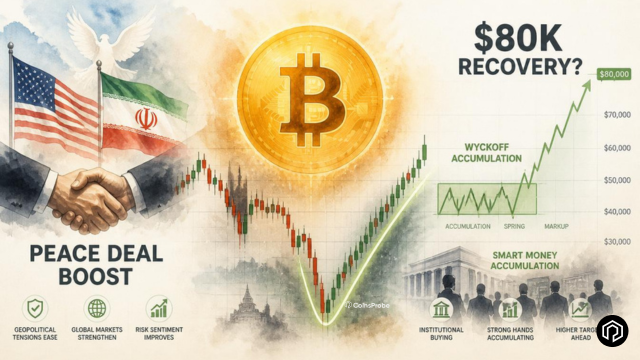
Key Highlights Bitcoin is trading at $65,805 — up +2.31% in 24 hours — after bouncing from a low of $63,634 — with a market cap of approximately $1.319 trillion. $337.89 million in total liqu
Key Highlights
- Bitcoin is trading at $65,805 — up +2.31% in 24 hours — after bouncing from a low of $63,634 — with a market cap of approximately $1.319 trillion.
- $337.89 million in total liquidations occurred in 24 hours — with $247.60 million from short positions — confirming a short squeeze driven by improving risk sentiment.
- Pakistani Prime Minister Shehbaz Sharif announced a permanent US-Iran peace deal — with a signing ceremony scheduled for June 19 in Switzerland — removing the primary geopolitical headwind that has weighed on Bitcoin throughout 2026.
- Analyst identifies Bitcoin as currently in the Secondary Test (ST) of Phase B in the classic Wyckoff Accumulation structure — projecting a recovery path toward $80,000.
Bitcoin (BTC) is currently trading at $65,805, up +2.31% in the last 24 hours after touching a low of $63,634. The market capitalization stands at approximately $1.319 trillion.
 Bitcoin (BTC) Price/Source: Coinmarketcap
Two catalysts converged on Bitcoin simultaneously today — one geopolitical and one technical — and the result was a short squeeze that wiped out $247.58 million in short positions and pushed BTC from $63,634 to $65,805 in a single session.
 Total Crypto Liquidation on 15 June 2026/Source: Coinglass
The geopolitical catalyst is the more significant of the two in the near term: a permanent US-Iran peace deal announced by Pakistan’s Prime Minister has removed the primary macro risk event that has been suppressing risk appetite since early 2026. The technical catalyst — a Wyckoff Accumulation structure that @martypartymusic identifies as currently in Phase B Secondary Test — provides the medium-term framework for where Bitcoin goes from here.
As we covered in our Bitcoin US-Iran de-escalation recovery article — geopolitical de-escalation has been one of the most reliable Bitcoin recovery catalysts of 2026. Each prior instance of Iran tension easing produced an immediate risk-on response — and today’s announcement of a permanent deal rather than a temporary ceasefire is the most significant de-escalation of the entire year.
US-Iran Peace Deal: The Geopolitical Headwind Is Gone
Pakistani Prime Minister Shehbaz Sharif announced today that a peace deal between the United States and the Islamic Republic of Iran has been reached following intensive diplomatic talks. The key terms:
- Immediate and permanent termination of military operations by both sides
- Official signing ceremony: Friday, June 19, 2026 in Switzerland
- Mediators: Pakistan, Qatar, Saudi Arabia, and Türkiye facilitating pre-implementation meetings this week
This is not a ceasefire or a temporary pause in hostilities — it is a permanent deal with a scheduled signing ceremony and named mediators. The distinction matters enormously for how markets price the risk.
As we covered across our US-Iran geopolitical Bitcoin analysis series — the US-Iran escalation sequence has been the single most consistent macro headwind for Bitcoin in 2026. Multiple Bitcoin crashes — including the $941M liquidation event, the $934M cascade, and the $72,879 decline — were each directly triggered or amplified by US-Iran tension spikes.
A permanent deal removes that risk category entirely — not just temporarily, as prior de-escalation episodes did, but structurally. Markets that have been pricing in geopolitical risk premium for months now need to unwind that premium — and for risk assets like Bitcoin, unwinding a risk discount means prices rising.
The short squeeze confirms the positioning: $247.58 million in short liquidations out of $337.82 million total shows that a significant portion of the market had been positioned for continued Bitcoin weakness — and the peace deal news forced those positions to close at a loss, accelerating the upside move.
Bitcoin Wyckoff Accumulation 2026: Currently in ST (Phase B)Technical analyst
@martypartymusic shared a detailed Wyckoff Accumulation Schematic for Bitcoin, showing that the market is currently in the Secondary Test (ST) within Phase B of the classic accumulation structure.
@martypartymusicThe chart overlays the standard Wyckoff Accumulation phases (A–E) on Bitcoin’s price action and highlights:
- Phase B is the “building cause” stage where smart money accumulates positions amid sideways or choppy price action.
- The current Secondary Test (ST) in Phase B often marks a key support area where weak hands are shaken out before the next leg higher.
- The schematic projects a recovery path toward the $80,000 resistance zone by early 2027.
- Multiple moving averages (including 200 SMA/EMA and 800 SMA/EMA) are expected to act as strong resistance as price approaches this level.
The $80,000 resistance zone is particularly significant because it is where multiple long-term moving averages — including the 200 SMA, 200 EMA, 800 SMA, and 800 EMA — are expected to converge. This cluster represents the most significant technical ceiling between current prices and Bitcoin’s prior all-time high territory.
As we covered in our Bitcoin 200 SMA bearish fractal analysis — the 200-day SMA has been the decisive technical level of the entire 2026 cycle. A recovery to $80,000 would put Bitcoin directly at that level — making the reaction there the most important technical event of the next several months.
Why Both Catalysts Together Matter
The power of today’s setup is the convergence of two independent signals pointing in the same direction:
The geopolitical catalyst removes the risk premium that has been suppressing Bitcoin since early 2026. A permanent US-Iran peace deal is not just good for one day — it changes the macro backdrop for risk assets for the foreseeable future. As we covered in our Bitcoin on-chain bottom signal analysis — 10.46 million BTC are already held at a loss, and the seller exhaustion signals have been building for weeks. The peace deal is the macro catalyst that the technical setup needed.
The Wyckoff framework provides the structural context that explains why $60,000–$65,000 has been holding as support — smart money accumulation in Phase B. If the framework is tracking accurately — the current Secondary Test near $63,634 is not a breakdown but a setup for the next phase.
What Comes Next — Two Scenarios
Bullish Scenario — $80K Recovery
The US-Iran peace deal holds and is formally signed on June 19. Risk-on sentiment returns broadly. Bitcoin completes the Phase B Wyckoff structure and moves through Phase C without a severe Spring dip — or the Spring has already occurred at the $60,061 February low we covered in our Bitcoin demand cycle low analysis. Recovery toward the $80,000 moving average cluster unfolds over the coming weeks to months — with the June 19 signing ceremony potentially acting as the next catalyst event.
Bearish Scenario — Rejection and Retest
The peace deal faces implementation challenges. Short-term relief buying fades. Bitcoin rejects at the $68,000–$70,000 resistance zone before the $80K moving average cluster is reached. A rejection there sends BTC back to retest the $60,000 Phase B support — or potentially triggers the Phase C Spring dip that the Wyckoff framework identifies as the final shakeout before the markup.
Bottom Line
Bitcoin’s move to $65,805 today is the product of the two forces that have defined 2026’s crypto market meeting simultaneously — geopolitical risk reversing and technical accumulation structure holding.
A permanent US-Iran peace deal signed by four mediating nations and scheduled for June 19 removes the macro headwind that has been the most consistent Bitcoin price suppressor of the year. A Wyckoff Phase B Secondary Test at the $63,634 low provides the technical structure that smart money accumulation frameworks have been building for months.
The target is $80,000 — where the 200 and 800 SMA/EMA moving average cluster sits. Getting there requires the peace deal to hold, the Wyckoff structure to complete on schedule, and Bitcoin to reclaim each resistance level along the way.
Watch June 19. Watch $80,000. And watch whether the short squeeze that produced $247M in liquidations today marks the beginning of the Phase D markup — or just another Phase B relief bounce.
Disclaimer: The views and analysis presented in this article are for informational purposes only and reflect the author’s perspective, not financial advice. Technical patterns and indicators discussed are subject to market volatility and may or may not yield the anticipated results. Investors are advised to exercise caution, conduct independent research, and make decisions aligned with their individual risk tolerance.