The sale of a 1.26 billion dollar IBIT block has revived questions around flows related to spot ETFs. According to NYDIG’s analysis, the transaction on BlackRock’s iShares Bitcoin Trust could
The sale of a 1.26 billion dollar IBIT block has revived questions around flows related to spot ETFs. According to NYDIG’s analysis, the transaction on BlackRock’s iShares Bitcoin Trust could come from a large investor wishing to exit their exposure quickly. The block, traded over the counter on May 26, is mainly intriguing because of its amount, discount, and the absence of clear signals on futures contracts.
In Brief
- The sale of 1.26 billion dollars of IBIT attracted the crypto market’s attention due to its unusual size.
- According to NYDIG, the transaction could come from a single large investor seeking to quickly reduce their Bitcoin exposure.
- The steep discount applied to the block suggests the seller prioritized execution speed over the best price.
- The absence of significant activity on CME futures makes the hypothesis of a classic basis trade unwind unlikely.
Bitcoin: an unusual over-the-counter sale size
In an already pressured crypto market, this transaction quickly caught analysts’ attention. The operation involved 29.21 million IBIT shares, traded at 43.16 dollars each. The price showed a discount of $1.01 compared to the market price, then at $44.17. In other words, the seller accepted a concession of 2.3%, or nearly 29.5 million dollars in execution cost.
According to NYDIG’s company analysis, this difference indicates an explicit priority: to secure a fast and certain exit. BlackRock’s vehicle thus underwent a movement that does not seem like a simple portfolio adjustment. In fact, the block size suggests a concentrated decision, led by an actor capable of ceding a major Bitcoin exposure in a single transaction.
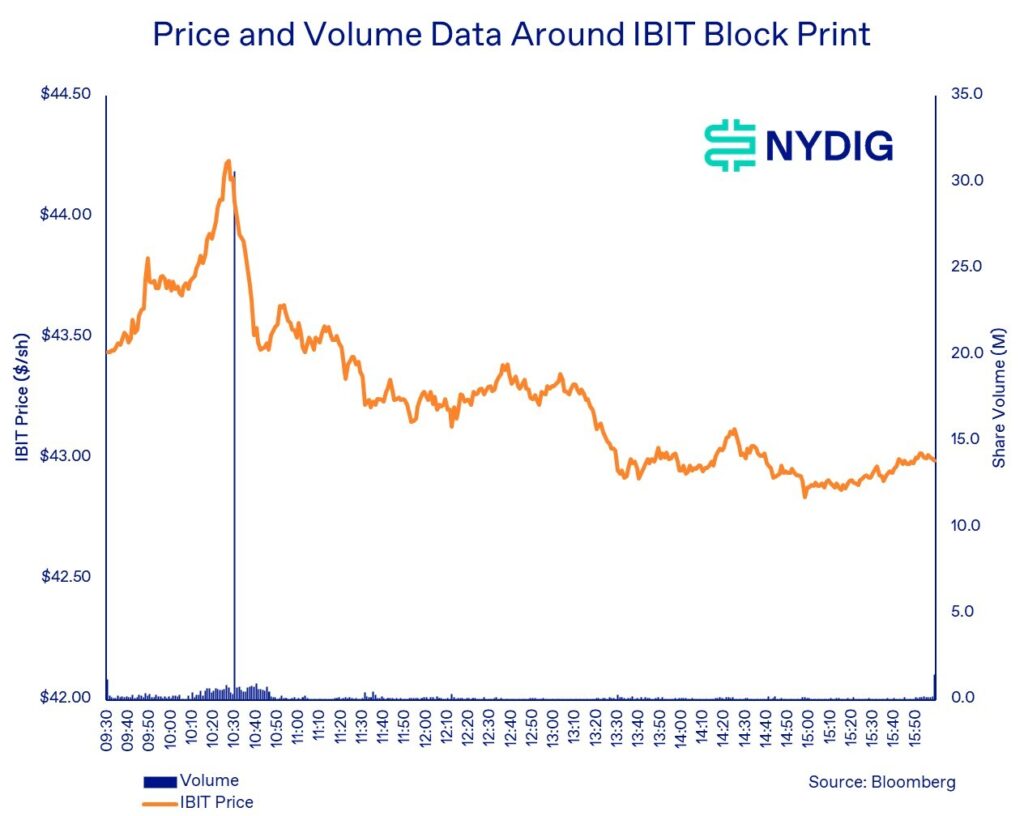 The NYDIG graph shows IBIT price and volume evolution during the block sale linked to Bitcoin and BlackRock.Secure your cryptos with LedgerThis link uses an affiliate program.
BlackRock: the hypothesis of a basis strategy discarded
Some participants initially mentioned a basis operation, a strategy combining a spot position and a short sale of futures contracts. However, NYDIG dismisses this interpretation. According to their analysis, the discount would have reduced expected returns and weakened the economic interest of such a setup.
The company also highlights the lack of notable reaction on the CME. The position linked to BlackRock’s fund corresponded to roughly 3,700 Bitcoin futures contracts. Yet, only 91 contracts changed hands during the block’s execution minute. As a result, the futures market failed to exhibit the anticipated spike.
This observation strengthens the idea of a direct disengagement. For BlackRock, the episode mainly highlights the sensitivity of large ETF blocks to liquidity needs. For NYDIG analysts, the available data does not support the hypothesis of a coordinated unwind.
Outflows complicating identification of the seller
The sale occurs amid ongoing withdrawals from American spot Bitcoin ETFs. According to SoSoValue data, these products registered net outflows every trading day from May 15 to May 29. Over the same period, the total assets in the category decreased from 107.75 to 94.17 billion dollars.
NYDIG clarifies, however, that these flows do not allow direct identification of the seller. Even though IBIT experienced roughly 720 million dollars in net redemptions between May 26 and 27, no public data links these redemptions to the block in question. The position would also exceed the holdings declared by each IBIT investor in recent 13F filings, further reducing visibility.
The exact reasons thus remain open. It may concern investment redemptions, risk management limits, or a voluntary decision to reduce Bitcoin exposure. In all cases, the movement shows that a major holder accepted a significant discount to exit a Bitcoin-related position while capital outflows continued.
In the short term, the market should watch the relationship between ETF redemptions, over-the-counter volumes, and futures activity. If outflows persist, other Bitcoin-related blocks could attract attention, especially after the BlackRock IBIT sale. However, without more precise data, BlackRock’s exact role and the seller’s identity will remain difficult to establish.