
Bitcoin1 min read
比特币ETF单日净流出403枚BTC,以太坊ETF流出1.27万枚ETH
比特币现货 ETF 单日录得净流出 403 枚 BTC,以太坊现货 ETF 同日净流出 1.27 万枚 ETH,两类产品在同一统计口径下同步出现资金外流,为机构配置层面的短期谨慎情绪提供了直接数据参考。 比特币与以太坊 ETF 单日资金流出概览 比特币现货 ETF 单日净流出 403 枚 BTC。 以太坊现货 ETF 单日净流出 1.27 万枚 ETH。 两项数据均反映同一交易日
Bitcoin hovered just under the $82,000 mark in early U.S. trading on Thursday as geopolitical headlines and a broader risk-off mood weighed on high-beta assets. The move came after fresh rema
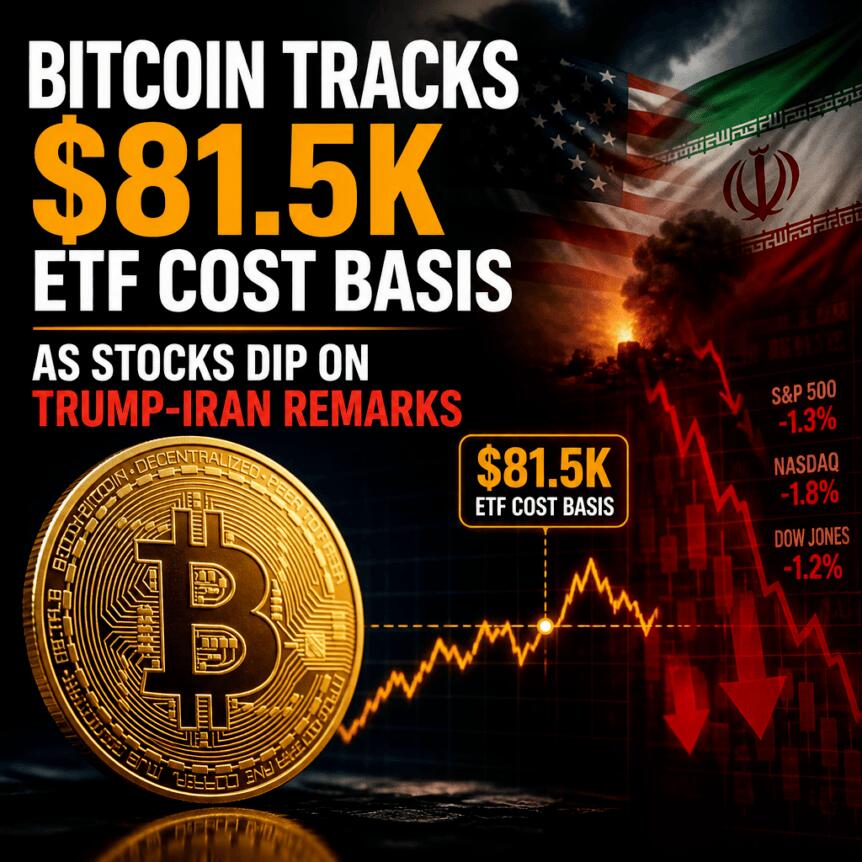
Bitcoin hovered just under the $82,000 mark in early U.S. trading on Thursday as geopolitical headlines and a broader risk-off mood weighed on high-beta assets. The move came after fresh remarks from U.S. President Donald Trump renewed concerns about the possibility of military action involving Iran.
At last checks, BTC/USD was trading around $81,256 on Bitstamp, according to TradingView—down 2.9% on the day. For traders, the next major catalyst is the Federal Reserve’s policy decision on Oct. 28, with several analysts expecting price to remain constrained in the meantime.
Markets mixed further than crypto alone, as investors digested a blend of company-specific developments and macro uncertainty. TradingView data cited in Cointelegraph coverage showed BTC/USD dipping toward $81,256 on Bitstamp, with weakness also reflecting broader pressure on risk assets.
One driver was renewed attention on U.S.-Iran relations after Trump’s comments. Speaking to reporters, he suggested the U.S. would see “something one way or the other” fairly soon, while also indicating there were no negotiations underway. He referenced the U.S. midterm elections on Nov. 3, adding that some expectations focused on the period after the election.
At the open, U.S. stocks moved lower. The S&P 500 Index was down about 1.3%, and the Nasdaq Composite fell roughly 2.3% at the time of writing, according to the same report. Bloomberg quoted Ian Lyngen of BMO Capital Markets, pointing to a renewed AI-valuation worry that pressured tech shares alongside other energy-market influences.
“Treasuries have emerged as a primary beneficiary as global risk sentiment has come under pressure.”
As equities weakened, bond markets leaned toward safety. The U.S. 10-year Treasury yield moved closer to 5% and fell to its lowest level since Sept. 23, based on chart data referenced in Cointelegraph’s write-up.
That shift matters for Bitcoin because it often signals changing expectations around growth and risk appetite. When yields fall and investors rotate toward defensives, BTC can struggle to maintain upward momentum—particularly when macro headlines keep volatility elevated.
In the short term, the combination of equity weakness and easing yields appears to have reinforced the down-drift in BTC, keeping it capped below recent levels.
Bitcoin’s trading pattern has recently been closely tied to the spot Bitcoin ETF “cost basis” zone, according to Cointelegraph’s recap. After approaching nearly $85,000 the prior day, BTC action reportedly circled around roughly $81,500—an area associated with spot ETF positioning.
Bitfinex Alpha, the research arm of exchange Bitfinex, said in a Wednesday forecast that BTC/USD should trade in a narrow range between $81,300 and $84,400 until the Federal Reserve’s next meeting on Oct. 28. Their framework emphasized the importance of ETF demand and leverage conditions.
Specifically, Bitfinex Alpha argued that sustained ETF demand alongside stable leverage metrics could pave the way for a breakout above $84,400. Conversely, a move below $81,300—paired with macro headwinds—could raise the risk of a slide toward the Oct. 15 low at $79,821.
For traders, this kind of level-based range guidance can be more actionable than broad “bull vs. bear” narratives, especially when macro catalysts are near. It also frames the likely decision points for risk managers: whether BTC can hold above the lower boundary and whether upside attempts can clear the $84,400 ceiling.
Beyond the immediate range trade, longer-horizon expectations were also tempered. The Cointelegraph report noted that traders were discounting the odds of a major recovery by mid-January 2027, referencing Kalshi markets that had trimmed the probability of Bitcoin reaching specified price targets.
In that coverage, Kalshi pricing indicated the chance of BTC/USD hitting new all-time highs had fallen to around 3%. While such market-implied probabilities do not guarantee outcomes, they can reflect how aggressively participants are willing to pay for upside tail risk at a given time.
Taken together with the short-term range outlook from Bitfinex Alpha, the picture is consistent: Bitcoin may not need to break decisively in either direction until macro uncertainty clears—especially ahead of the Oct. 28 Fed event.
With BTC still stuck below $82,000 and headlines around U.S. policy and the Iran situation continuing to shape risk sentiment, traders will likely track two signals closely: whether Bitcoin can reclaim and hold above the $84,400 range ceiling, and how interest-rate expectations react as the Fed’s Oct. 28 meeting approaches.
This article was originally published as Bitcoin tracks $81.5K ETF cost basis as stocks dip on Trump-Iran remarks on Crypto Breaking News – your trusted source for crypto news, Bitcoin news, and blockchain updates.