Corporate Bitcoin treasuries appear to be losing momentum, according to new on-chain analysis that suggests many current holders are still trading at a loss and new buying is not strong enoug
Corporate Bitcoin treasuries appear to be losing momentum, according to new on-chain analysis that suggests many current holders are still trading at a loss and new buying is not strong enough to offset that overhang. Glassnode data indicates listed companies acquired only a small fraction of the BTC they were purchasing during peak activity in mid-2025, while the group’s blended cost basis remains above current spot levels.
The result is a market where treasuries are less able to “support” price from the margin: if buyers have stopped accumulating and their positions are still underwater, the existing holdings function more like overhead supply than an active demand driver—at least for now.
Key takeaways
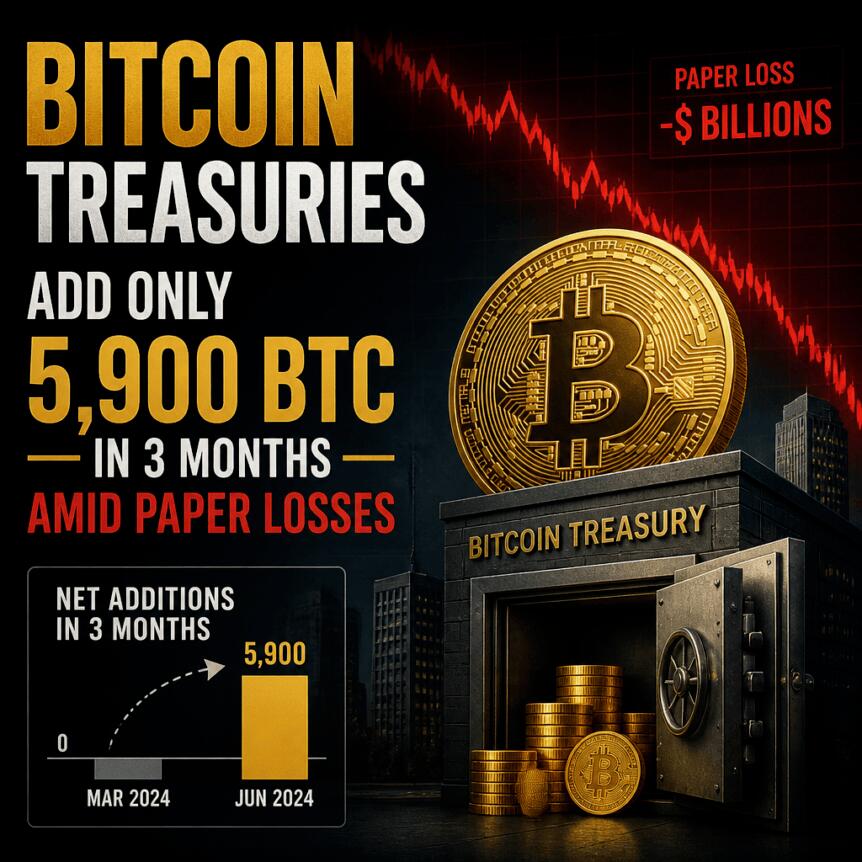
- Glassnode reports listed corporate treasuries added about 5,900 BTC in 2026 over roughly three months—far below the scale of purchases seen in July 2025.
- For existing corporate holders, the aggregate corporate treasury cost basis averages around $80.5K, keeping the cohort roughly 6% under water versus spot.
- Glassnode says 2026 has featured two attempts to reclaim that cost basis, but both failed as price could not stay above the level.
- ETF flows have turned negative again, with US spot Bitcoin ETFs recording net outflows of $462.7 million in the five trading days through Sept. 11.
- Glassnode frames current conditions as a “market in waiting,” pointing to weakening demand signals in realized cap.
Corporate buys shrink as treasuries stay underwater
In 2026, listed companies have accumulated approximately 5,900 BTC, Glassnode said, citing its “FlowsNetCompanies” treasury flow charts. The number is presented as notably small relative to acquisition intensity during July 2025, when companies bought around 89,000 BTC even while BTC/USD was trading above $100,000.
That contrast matters because it highlights a shift in corporate behavior: rather than continuing to add at a pace that could meaningfully change the supply-demand balance, many buyers appear to be waiting for clearer price confirmation. Glassnode notes that current treasuries have not yet normalized into a profitable position.
In the latest edition of its newsletter, The Week Onchain, Glassnode stated that the “Corporate Treasury Cost Basis” for existing holdings sits at about $80.5K—roughly 6% above spot—meaning the group is collectively underwater.
Glassnode also emphasized that 2026 has only produced two efforts to reclaim that cost basis, and both attempts were unsuccessful due to price failing to hold above the target level. The analysis argues that a buyer that has paused purchases while remaining in a paper loss is not acting as active support.
“A reclaim of $80.5K would put the treasuries back in profit and remove one layer of overhead supply; until then their entry is one more ceiling.”
Strategy’s pace slows, but it remains a dominant holder
While corporate demand is depicted as broadly muted, not every company has stopped buying entirely. Business intelligence firm Strategy—widely cited as holding one of the largest corporate Bitcoin treasuries—made its most recent purchase at the end of August, adding 4,603 BTC. The purchase is described by earlier reporting from Cointelegraph as the company’s first acquisition in two months.
Even with that incremental addition, Strategy’s broader position still reflects the same macro reality: Glassnode data cited in the report places the cost basis of Strategy’s 845,050 BTC holdings at $75,412. That figure is below the average corporate cost basis referenced for the overall treasury cohort, but the wider point remains that corporate accumulation is not currently acting as a steady, price-anchoring flow across the sector.
Why Glassnode calls it a “market in waiting”
The slowdown in corporate purchases is occurring alongside shifting macro and investor-risk conditions. Glassnode frames the current state as consistent with broader caution in the crypto market, where uncertainty about BTC’s forward strength tends to suppress incremental buying.
This caution was echoed in US policy developments: on Wednesday, the US Federal Reserve implemented its first interest-rate hike since July 2023, according to Cointelegraph’s coverage. Rate-hike cycles typically tighten financial conditions and can weigh on liquidity-sensitive assets, which helps explain why demand for Bitcoin products can become more reactive to short-term price moves.
One way to measure that sensitivity is through spot Bitcoin ETF flows. Earlier coverage from Cointelegraph noted that US spot Bitcoin ETFs saw net outflows of $462.7 million across five trading days through Sept. 11. The report also states this reversed a sequence of three consecutive weeks of net inflows, reinforcing the idea that near-term risk appetite has cooled.
Glassnode links these ETF and broader market patterns to what it calls a “market in waiting.” It further adds that Bitcoin’s realized cap—defined in crypto analytics as the cumulative price at which the supply last moved on-chain—has begun to fall as of Sept. 15. A decline in realized cap is interpreted as weaker demand at prevailing prices, suggesting fewer participants are willing to establish new cost anchors higher up the curve.
In the analysis, realized cap is cited at around $1.069 trillion. Glassnode’s interpretation is conditional: a return to positive daily realized cap changes would indicate that buyers are coming back and supporting prices. Conversely, outflows while BTC trades below the mean would suggest that “range’s buyers” are beginning to give up.
For investors and traders, this matters because the “ceiling” described for treasuries and the “waiting” posture described via realized cap both point to the same dynamic: demand is not being expressed aggressively at current levels. When both corporate accumulation and ETF-based flows soften, the market can become more dependent on narrow pockets of buying rather than a broad, continuous bid.
“A return to positive daily Realized Cap changes would say the buyers are back; a run of outflows while price sits under the mean would mean the range’s buyers have started to give up,” Glassnode concluded.
What to watch next in corporate and on-chain demand
The key question now is whether corporate treasuries and wider market participants will resume accumulating strongly enough to change the balance between overhead supply and fresh demand. Glassnode’s framework implies that reclaiming the corporate treasury cost basis near $80.5K could reduce that overhead layer—but it also notes that previous attempts in 2026 failed to hold.
Heading into the next trading weeks, readers should watch for two confirmations: sustained ETF inflows (rather than brief reversals) and signs that realized cap is stabilizing or turning upward again. Together, those signals would better indicate whether the “market in waiting” is easing—or whether the current pause in corporate buying will continue to weigh on sentiment.
This article was originally published as Bitcoin Treasuries Add Only 5,900 BTC in 3 Months Amid Paper Losses on Crypto Breaking News – your trusted source for crypto news, Bitcoin news, and blockchain updates.