Datavault AI (NASDAQ: DVLT) had a rough trading day on Tuesday, losing nearly 50% of its dollar value after investors learned that the company has been unable to access the Bitcoin it stored
Datavault AI (NASDAQ: DVLT) had a rough trading day on Tuesday, losing nearly 50% of its dollar value after investors learned that the company has been unable to access the Bitcoin it stored on the Biconomy exchange for roughly 4 months.
After revealing the failed attempt to recover its Bitcoin, the firm also warned that financial statements going back to more than one year can no longer be regarded as fully accurate.
Why did Datavault’s stock crash?
Datavault’s DVLT stock crashed about 49.6%, from $0.133 to close at $0.067 in one session, per Google Finance data.
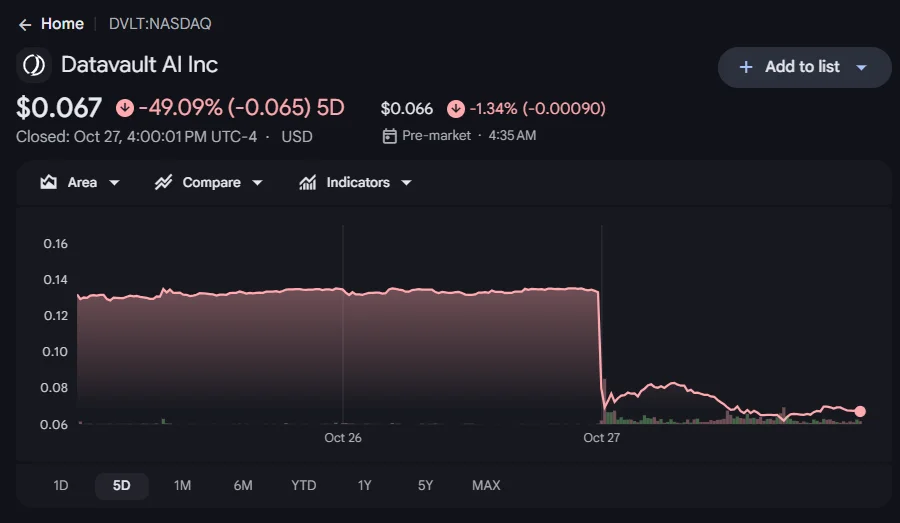
Trading volume saw an 8-fold explosion, as around 250 million shares traded during the session.
The collapse was triggered by an SEC filing revealing that a June 2026 Datavault request to withdraw Bitcoin from its Biconomy wallet to an outside account remained unprocessed as of the October disclosure. The 8-K did not include any reason for the withdrawal pending for four months now.
The shockwave has spread throughout the Bitcoin community, entering Bitcoin developer Jameson Lopp’s radar. Lopp wrote on X that Datavault “just crashed because they informed investors that they haven’t been able to withdraw BTC from the exchange” while holding its funds. Lopp also noted that the transfer requests had been on hold for four months.
Datavault, Scilex and Biconomy have not commented publicly on the news.
How Scilex entered the picture
In September 2025, Scilex Holding Company entered into a deal with Datavault to pay $150 million for 15 million DVLT shares, plus a pre-funded warrant covering 263,914,094 additional shares. The price was set in Bitcoin, about 1,328.43 BTC at a spot rate of $112,915.52 per coin.
The transfer never appeared on the public Bitcoin blockchain because Scilex credited 1,309.04 BTC directly to Datavault’s Biconomy wallet. Instead, balances simply changed within the exchange.
The 19.39 BTC shortfall in the transfer was attributable to cash advances Scilex had made, per the 8-K filing.
Between September 2025 and January 2026, Datavault sold 491.431 of those coins back to Scilex for about $40.5 million.
In a separate June 2026 deal, Scilex and Datavault signed a term sheet where Scilex would acquire 837 BTC from the Biconomy wallet for $50 million. The new SEC filing now warns that the deal might never close.
Why the books have to be restated
Datavault’s audit committee cited an accounting error related to the Scilex deal as the reason four sets of financial statements, from Q3 2025 to Q2 2026, should no longer be regarded as accurate.
After reviewing the transaction, the company decided that Bitcoin never qualified as a digital asset on its books. Instead, the filing states the amount should have been booked as a subscription receivable from the share issuance, a figure that reduces stockholders’ equity rather than padding the asset side of the balance sheet.
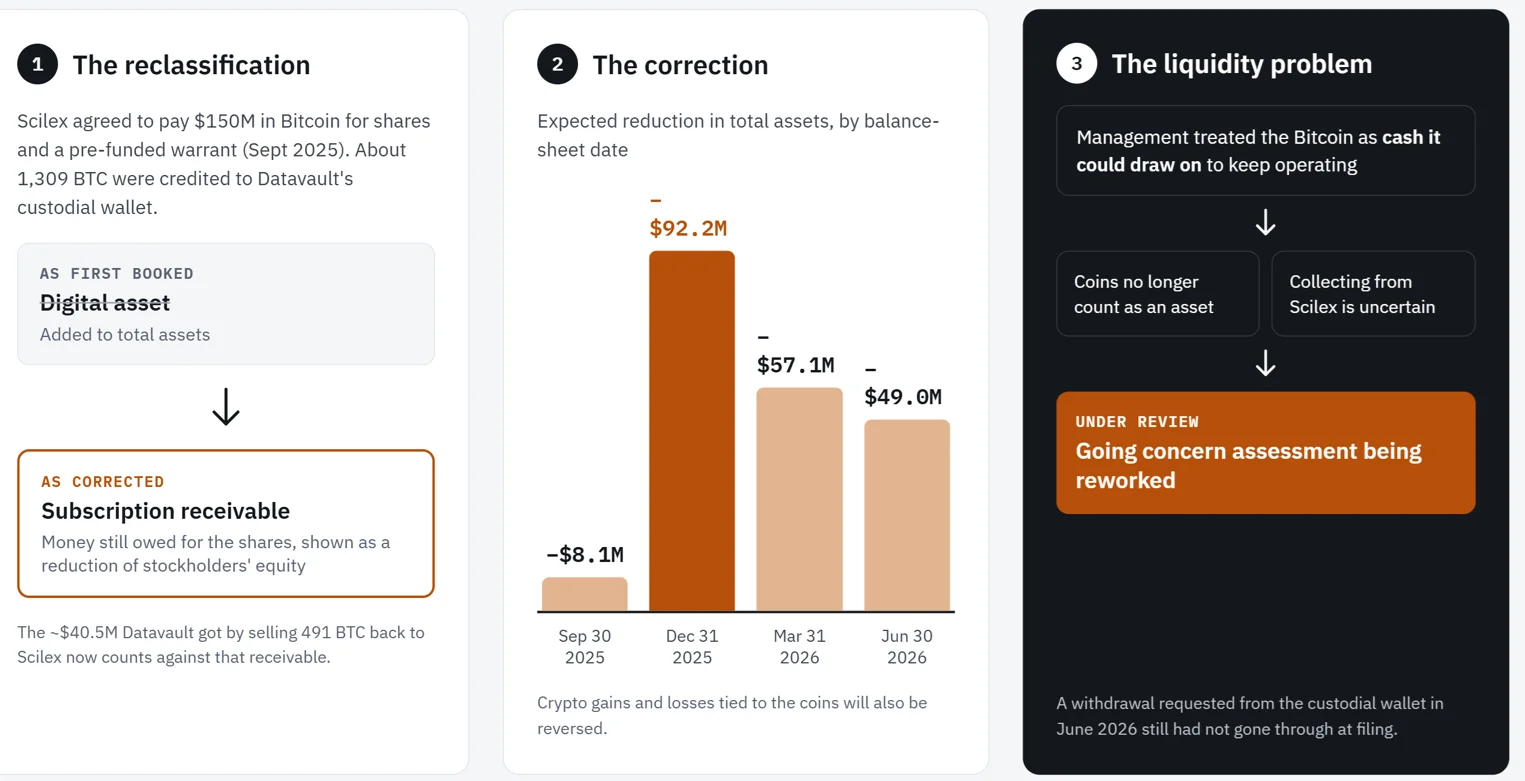
Bitcoin received from Scilex in exchange for new shares is being reclassified. Four quarters of financial statements will be restated, and the company’s ability to keep operating is under fresh review. Source: SEC
The correction is steep. Datavault expects the restatements to cut total assets by $8.1 million, $92.2 million, $57.1 million and $49.0 million as of September 30, 2025, December 31, 2025, March 31, 2026 and June 30, 2026, respectively.
There is a liquidity problem behind the numbers. Management had treated those Bitcoin balances as cash it could draw on to keep operating. With the coins no longer counted as an asset and the collection from Scilex uncertain, the company said it is reworking its going concern assessment.
Where the Bitcoin came from
The Bitcoin at the center of the dispute passed through Biconomy before it ever reached Datavault. Scilex’s own disclosures show it raised $200 million in Bitcoin by selling stock in its subsidiary Semnur Pharmaceuticals, then routed $150 million of that into the Datavault purchase. Reports name Biconomy as the buyer on the Semnur side.
Both companies had been building ties to the exchange this year. Datavault announced plans in April to list a meme coin portfolio and real-world asset tokens on Biconomy, which was founded in 2019 and says it serves more than 10 million users across over 180 countries. Scilex planned to list its own “Dream Bowl” meme coin there.
The episode lands as investors sour on Bitcoin treasury companies more broadly. Cryptopolitan reported in January that about 40% of the top 100 such firms were trading below the value of their Bitcoin holdings, a reversal from the premiums that once let them raise equity and buy more coins.
If you're reading this, you’re already ahead. Stay there with our newsletter.