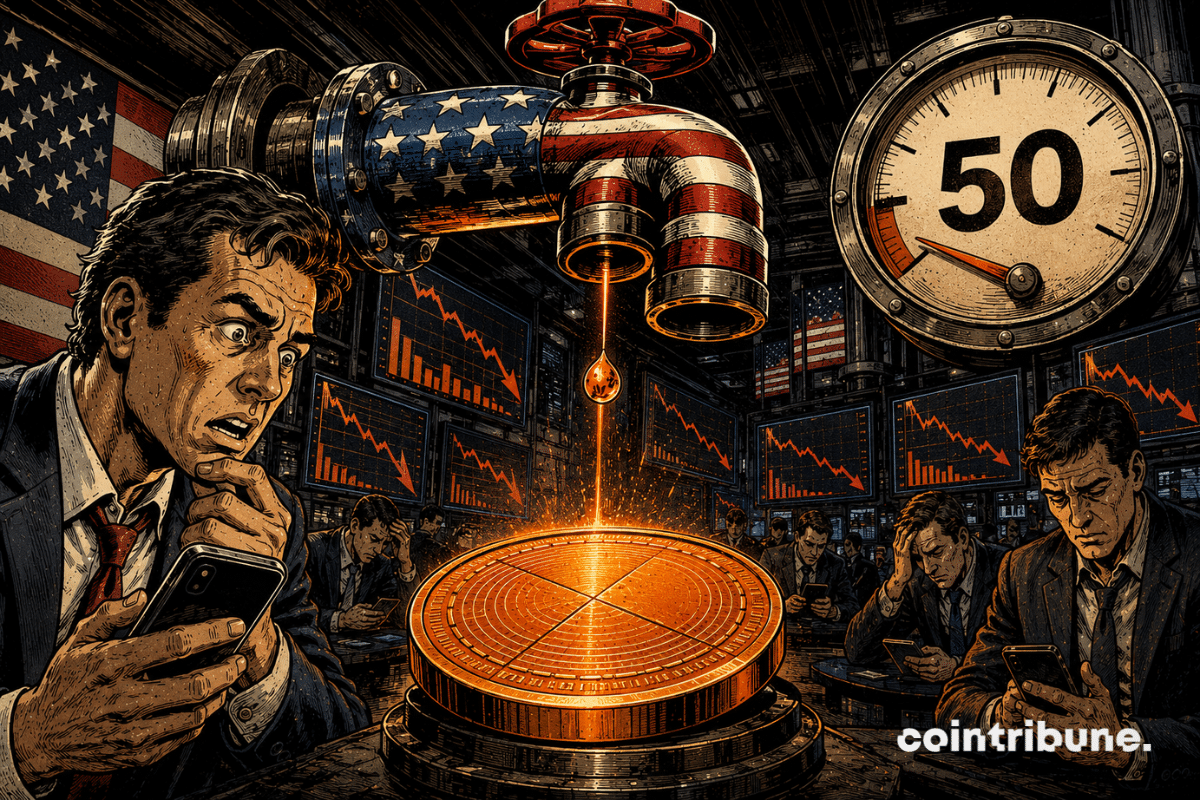
Bitcoin has been trading cheaper in the United States than in the rest of the global market for 50 consecutive days. This rare signal comes from the Coinbase Bitcoin Premium Index, which rema
Bitcoin has been trading cheaper in the United States than in the rest of the global market for 50 consecutive days. This rare signal comes from the Coinbase Bitcoin Premium Index, which remained negative until July 7–8. Behind this subtle gap, a reality is confirmed: American demand for BTC shows signs of fatigue.
In brief
- Bitcoin has been trading at a discount on Coinbase for 50 days.
- American Bitcoin ETFs show about 6 billion dollars of outflows in 2026.
- The return of sustained inflows on IBIT remains the key signal to watch.
Coinbase shows a record discount
Bitcoin has been cheaper on Coinbase than on Binance for 50 consecutive days. This record sequence extends the weakness already observed in Bitcoin ETFs, where American withdrawals weigh on sentiment. The Coinbase Bitcoin Premium Index compares the price of BTC on Coinbase, a platform widely used in the United States, to that observed on Binance, which is more representative of the international market. When the index turns negative, American buyers pay less than the rest of the world.
The last cited reading hovers around -0.0742%. The gap seems small. But its duration makes it significant. A one-time discount can be ignored. A discount persisting for 50 days tells a deeper imbalance. The sequence supposedly started on May 19, 2026. It surpasses the previous record of 40 consecutive days in negative territory. Yet, Bitcoin tried to rebound during this period with several positive sessions.
This paradox shows that the American market no longer plays the leading role it held after the arrival of spot ETFs. In 2024 and 2025, American institutional flows often set the tone. In 2026, the situation appears colder. Demand may be coming from elsewhere.
Asian, European, or offshore buyers can support the price, even when Coinbase shows a discount. But the lack of sustained American appetite weakens the quality of the rebound. Bitcoin thus remains in a strange zone. It is not abandoned. It is not being driven by an American institutional rush either. The market moves forward with an engine running but without strong acceleration.
Your 1st cryptos with BitgetThis link uses an affiliate program.Bitcoin ETFs confirm the same malaise
American spot bitcoin ETFs send the same signal. Since the beginning of 2026, they have shown about 6 billion dollars of net outflows. At the end of June, withdrawals exceeded 2.6 billion dollars in just nine trading sessions.
This dynamic aligns with Coinbase’s discount. American investors are reducing their exposure or waiting for clearer signals. Bitcoin remains monitored, but capital has not yet returned strongly. The BlackRock IBIT case is central. The market expects steady inflows into this fund since it often serves as an institutional barometer. Without solid flows into IBIT, American recovery seems hesitant.
Net outflows do not necessarily mean a lasting rejection. They may reflect arbitrages, risk management, or rotation toward other assets. But when combined with 50 days of Coinbase discount, the diagnosis becomes more serious. Net outflows are no longer isolated noise.
A rebound will depend on the return of American flows
Bitcoin can rebound without the United States. But a sustained recovery becomes more difficult if the world’s leading financial center remains cautious. ETFs, Coinbase, and major American institutions still strongly influence overall market liquidity.
To reverse the trend, several signals will be needed. The Coinbase Premium will need to return sustainably to positive territory. ETFs will need to show several weeks of net inflows. And buyers will need to defend support zones without relying solely on technical rebounds. The macro environment also remains decisive. Rates, inflation, and American liquidity directly affect risk appetite. If the Fed remains restrictive, investors may prefer to wait rather than increase their BTC exposure.
This American weakness does not condemn Bitcoin. It simply indicates that the market has lost an important engine. BTC can still stabilize, especially if international demand compensates. But to regain a real upward move, it will have to convince Wall Street, ETF managers, and Coinbase buyers again.
The 50-day signal thus deserves close monitoring. It does not say that Bitcoin is broken. It says that American demand is no longer strong enough to drive the market alone. The next phase will depend on the ability of ETF flows to return in an environment where Bitcoin liquidity remains the real nerve of war.