Bitcoin (BTC) whales (accounts holding between 1,000 and 10,000 BTC) have been consistently accumulating the cryptocurrency since late May. This period of accumulation began in early May, whe
Bitcoin (BTC) whales (accounts holding between 1,000 and 10,000 BTC) have been consistently accumulating the cryptocurrency since late May. This period of accumulation began in early May, when prices were around $80,000, and has continued even as prices declined 17.25% to a current $66,256.
Whales load up on Bitcoin despite market swings
Unlike previous months, the period since May shows unprecedented, continuous accumulation despite geopolitical and macroeconomic headwinds. In the last month alone, this cohort has accumulated 48,000 Bitcoins. This brings their total stash to 3.09 million Bitcoins, similar to the amount they held in February of this year.
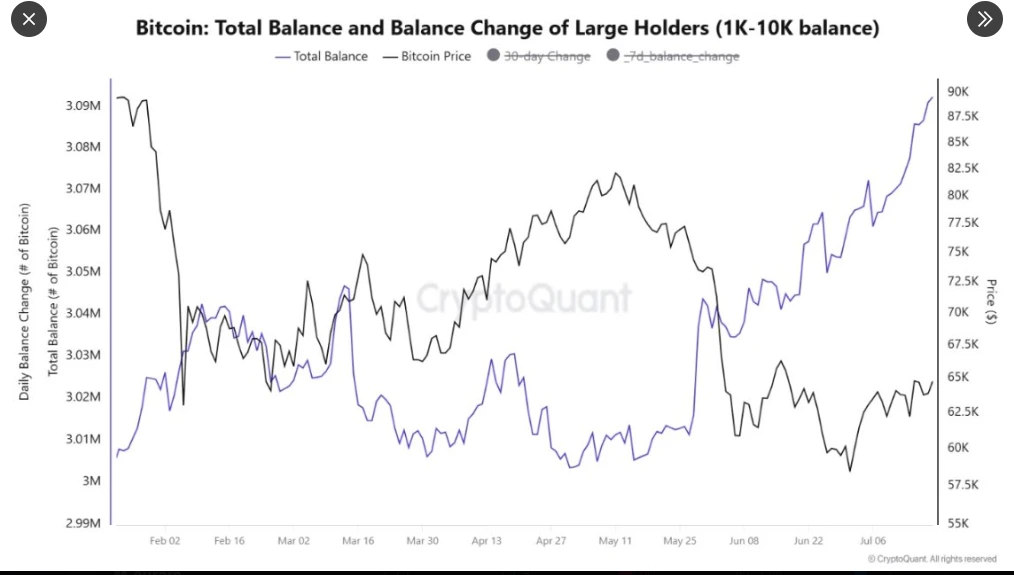
Source: Crypto Quant
These whales likely represent institutions that thrive on Dollar-Cost Averaging (DCA) rather than timing markets for ripe entry levels.
Even then, these whales are likely anticipating a major market turnaround following recent developments in global crypto regulation and technical setups.
US President Donald Trump recently signed an ethics package barring him and any other high-ranking officials from profiting off the crypto policies they shape. Despite this development, nations such as Japan and Russia are way ahead of America in terms of crypto regulation. This builds pressure for swift policy legalization, seeing as the US aims to lead the crypto industry on a global scale.
Technical setups
On-chain metrics such as MVRV (Market Value to Realized Value) and CVDD (Cumulative Value-Days Destroyed) suggest a potential cycle bottom between $40,000 and $50,000.
However, one technical trifecta indicates we may have arrived at a historically dominant accumulation zone.
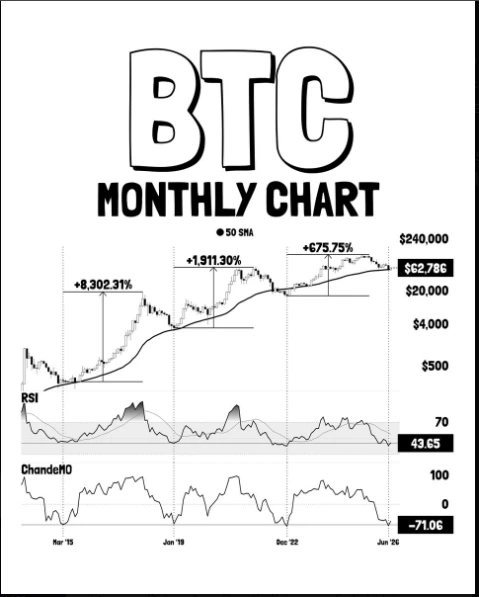
Source: Ali Charts
The monthly Relative Strength Index (RSI) is below 43.65, the Chande Momentum Oscillator is at -71, and BTC is actively trading around its 50-month moving average. The combination of these offers a highly favorable risk-to-reward ratio, driving whale attention away from shorting and into accumulation.