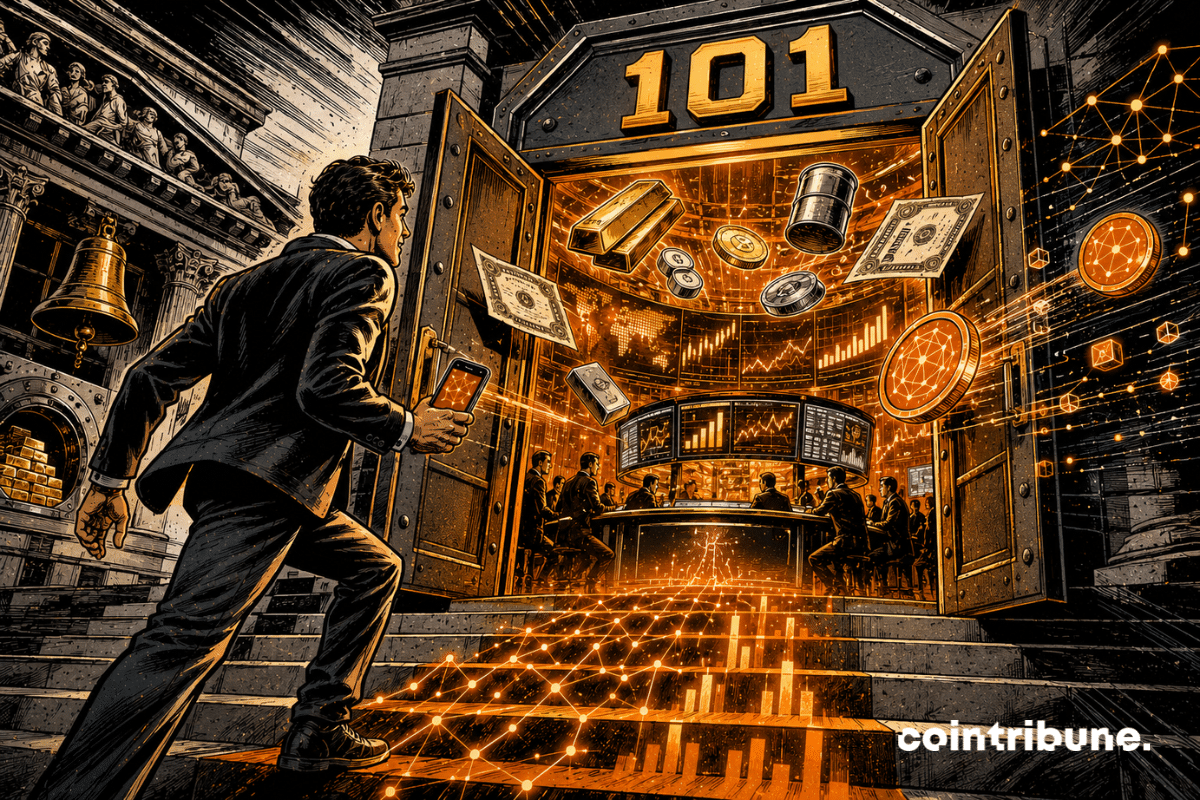
Bitget has launched TradFi 101, a long-term education program designed to help crypto users understand traditional finance. The initiative arrives as the exchange expands into stocks, commodi
Bitget has launched TradFi 101, a long-term education program designed to help crypto users understand traditional finance. The initiative arrives as the exchange expands into stocks, commodities, ETFs, foreign exchange and tokenized assets. Its message is direct: access to more markets is not enough if traders do not understand how those markets work.
En bref
- Bitget has launched TradFi 101 for crypto-native investors.
- The program includes six modules and 100 financial questions.
- Bitget wants education to support its Universal Exchange expansion.
Bitget Bridges the Financial Knowledge Gap
Bitget built TradFi 101 for users who entered finance through crypto but now follow interest rates, equities, gold and global liquidity. The initiative supports a wider shift already visible in Bitget user portfolios, where digital assets increasingly sit beside traditional investments.
This transition creates a knowledge problem. A crypto trader may understand wallets, tokenomics and blockchain cycles but remain unfamiliar with earnings reports, bond yields or central bank policy. Those gaps become more important when several asset classes appear inside one trading account.
Bitget wants the program to make these subjects accessible without turning them into simplified trading promises. The curriculum focuses on how financial systems operate, why markets react and how risk changes across different products.
Your 1st cryptos with BitgetThis link uses an affiliate program.Six Modules Cover the Basics of Global Markets
TradFi 101 consists of six structured learning modules. The first introduces financial foundations, while the second presents major asset classes as part of a global wealth checklist. Other sections explain market mechanics, macroeconomics and trader psychology.
Bitget plans to answer 100 essential financial questions through short lessons aimed at crypto-native audiences. Weekly content, community participation and assessments will support the main curriculum.
The risk module may be one of the most relevant. Moving from spot crypto into leveraged commodities, currencies or CFDs exposes users to unfamiliar pricing models. A successful strategy in one market may perform badly in another because volatility, liquidity and trading hours differ.
The final module examines the Universal Exchange model. It explores how traditional and digital assets can coexist within one environment as tokenization reduces the technical distance between blockchains and established financial markets.
Bitget Turns Education Into UEX Infrastructure
Bitget already gives users access to crypto assets, tokenized stocks, ETFs, commodities, currencies and precious metals. Its Universal Exchange strategy aims to remove the need to switch between separate crypto exchanges and traditional brokers.
Recent products show how quickly this model is developing. Bitget Stocks 2.0 connects tokenized equities with U.S. market liquidity. Stock+ gives eligible users access to real U.S. shares through regulated brokerage infrastructure.
TradFi 101 adds a missing layer to that ecosystem. A platform can place gold, stocks and crypto on the same screen, but a unified interface does not make the products identical. Each market follows its own rules, risks and economic drivers.
Education therefore becomes part of Bitget’s product infrastructure. Better-informed users may understand why gold reacts to monetary uncertainty, why equities move after earnings reports and why foreign exchange markets respond to interest-rate expectations.
Bitget describes TradFi 101 as an open industry initiative. Coin Bureau, CoinGecko and TradingView are among the participating or invited ecosystem contributors named in the announcement. The project is intended to involve media platforms, researchers, educators and creator communities.
This collaborative model could give the curriculum more range. Exchanges understand trading behavior, while research platforms and educators can provide broader context. The challenge will be maintaining a clear separation between financial education and product promotion.
TradFi 101 also reflects a larger competition among exchanges. Platforms are no longer judged only by token listings or trading fees. They increasingly compete through market data, automation, security and access to traditional assets.
For Bitget, education supports both user protection and expansion. A trader who understands position sizing, liquidity and leverage is better prepared to navigate a multi-asset platform. That does not eliminate losses, but it may reduce decisions based entirely on hype or incomplete information.
The Universal Exchange era will require more than a large product catalog. Users must understand what they own, how a market operates and which risks accompany each instrument. By linking TradFi 101 with its multi-asset strategy, Bitget is betting that financial knowledge will become as important as market access.