Bitget Proof of Reserves: Deposits, Airdrop Rewards and Hack Timeline The exchange has released its latest Bitget Proof of Reserves update, reporting an overall reserve ratio of 131%. The new
Bitget Proof of Reserves: Deposits, Airdrop Rewards and Hack Timeline
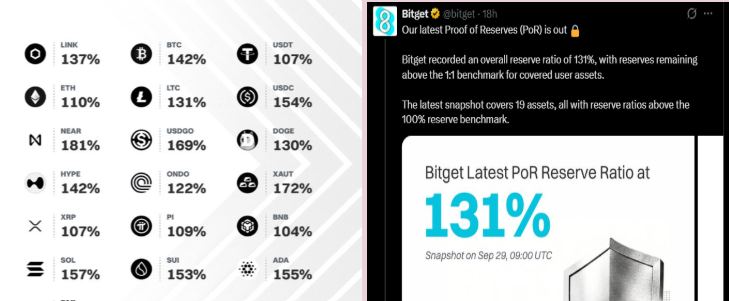
The exchange has released its latest Bitget Proof of Reserves update, reporting an overall reserve ratio of 131%. The news follows a security incident on the exchange in late September. Bitget also promoted its Alliance Program, which features a $10M+ crypto airdrop reward pool, and shared new findings from security firm SlowMist. A reserve ratio above 100% is a positive sign, but it does not remove every risk.
At a Glance
Reserve ratio: 131% overall.
Assets covered: 19, all above the 100% benchmark.
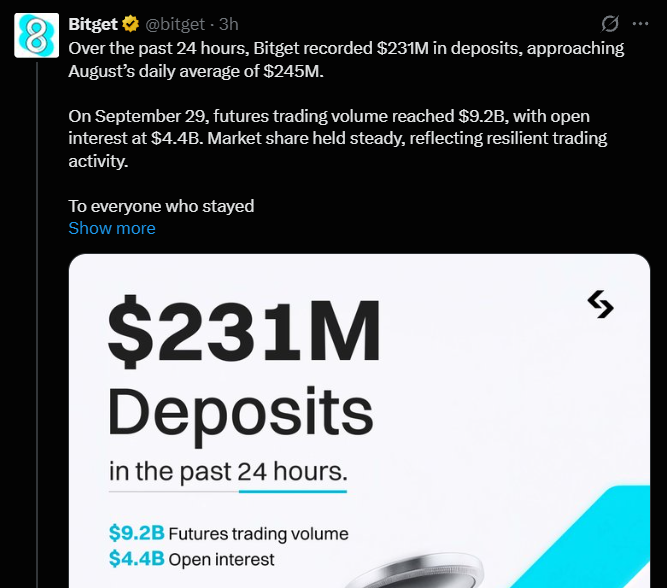
Recent deposits: $231 million over 24 hours.
September 29 futures volume: $9.2 billion.
Open interest: $4.4 billion.
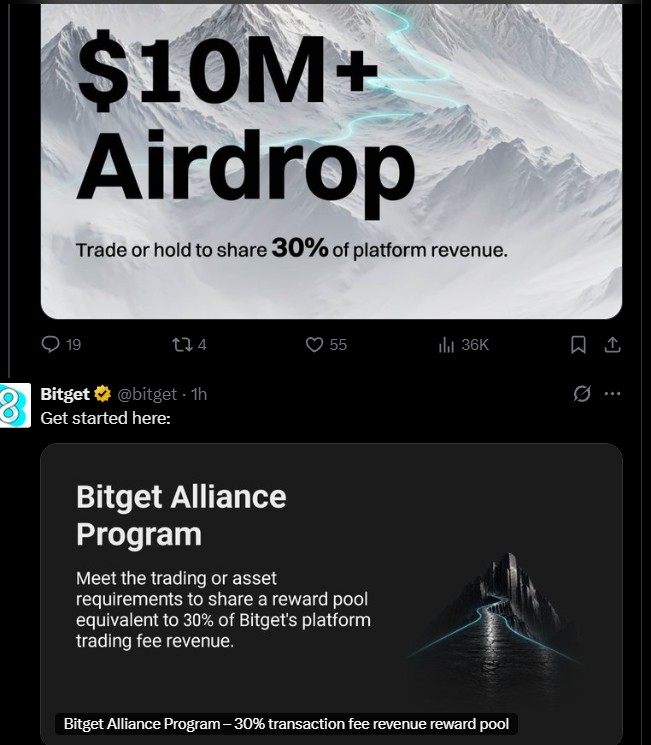
Alliance Program: $10M+ airdrop pool, funded by 30% of trading fee revenue.
Hack findings: SlowMist found third-party product abuse, a zero-day flaw and a custom withdrawal tool.
Bitget Reports 131% Reserve Ratio in Latest Proof of Reserves.
Bitget Proof of Reserves is a transparency check used by crypto exchanges. It aims to show that an exchange holds at least as many assets as its users have deposited. Bitget says its latest snapshot covers 19 assets, and each one sits above the 100% benchmark. Bitget also says it publishes a Merkle Tree proof each month, and users can check their own balances on its Proof of Reserves page.
A ratio above 100% means reported reserves exceed the covered user assets. That is useful information. However, a reserve check does not stop hackers, fix software flaws, or remove counterparty risk. It answers one question only: does the exchange hold enough assets?
Source: Official PoR Report
Bitget Deposits and Trading Activity Show Signs of Returning Toward Normal
It has recorded $231 million in deposits over the past 24 hours. That figure is close to its stated August daily average of $245 million. On September 29, futures trading volume reached $9.2 billion, and open interest stood at $4.4 billion.
Bitget described these numbers as deposit activity moving back toward normal levels. That view comes from the exchange, not from an independent source. Still, these metrics matter. Deposits show whether users trust a platform with their funds. Volume and open interest show how active traders are.
Source: X
Bitget Alliance Program Offers $10M+ Airdrop Reward Pool
The Bitget Airdrop Program shares 30% of the platform's trading fee revenue with users. The pool can grow past 10 million USDT. The current displayed pool is 1,568,800.98 USDT. It is split into two parts:
Trading reward pool (60%): 941,280.59 USDT.
Asset reward pool (40%): 627,520.39 USDT.
To qualify, a user needs an average daily valid trading volume of at least 100 USDT. For the asset pool, the daily and 7-day average valid asset value must both be at least 100 USDT. The 7-day averages are capped at 3,000,000 USDT for both.
Rewards are paid in USDT, so no token price applies. Bitget's page does not name a claim date, so check the official program page for current weekly timing. Rewards depend on the stated formulas and are not guaranteed.
 Source: Official X Post
How the Bitget Airdrop Rewards Are Calculated
Category
Key Details
Total reward pool
$10M+ stated by Bitget wallet
Funding
30% of platform trading fee revenue
Trading rewards
60% of weekly reward pool
Asset rewards
40% of weekly reward pool
Minimum level
100 USDT daily average
7-day average cap
3M USDT
Eligible activity
Spot, futures, and stock trading
Exclusions
Onchain, CFDs, U.S. Stock+, Convert, zero-fee pairs
In simple terms, your trading reward is your share of the platform's valid 7-day average trading volume, applied to 60% of the weekly pool. Your asset reward works the same way, using your share of valid 7-day average asset value and 40% of the pool. A bigger share of activity means a bigger reward, up to the cap.
What Happened in the Bitget Hack? SlowMist Reveals New Findings
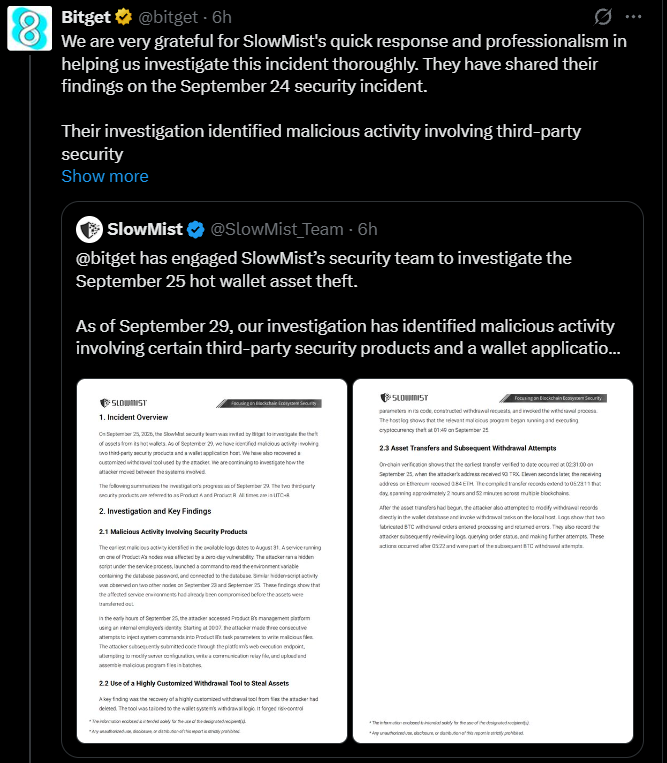
Bitget hired SlowMist to investigate the theft of assets from its hot wallets. As of September 29, SlowMist found malicious activity involving two third-party security products, called Product A and Product B, plus a wallet application host.
On Product A, a service node was hit by a zero-day vulnerability. The attacker ran a hidden script, read a database password from an environment variable,e and connected to the database. On Product B, the attacker reached the management platform using an internal employee's identity. They then tried to inject system commands and upload malicious files.
SlowMist also recovered a custom withdrawal tool from files the attacker had deleted. The tool forged risk-control parameters, built withdrawal requests, and triggered the withdrawal process. SlowMist says it is still studying how the attacker moved between systems.
Bitget Hack Timeline: From Early Compromise to Unauthorized Transfers
All times below are UTC+8, as reported by SlowMist.
Date/Time
Reported Development
Aug. 31
Earliest malicious activity in available logs, involving Product A
Sept. 23
Similar hidden-script activity on another Product A node
Sept. 25, 00:07
First attempts to inject commands into Product B
Sept. 25, 01:49
Malicious program began stealing crypto, per host logs
Sept. 25, 02:31
Earliest verified on-chain transfer
Sept. 25, 02:31 to 05:23
Transfers across multiple blockchains over about 2 hours 52 minutes
After 05:22
Attempts to alter records and trigger BTC withdrawals
Sept. 29
SlowMist published its findings so far
Bitget hack update referred to the incident as September 24 in its post, while SlowMist dates it September 25 in UTC+8.
Source: X
What Bitget Says Comes Next After the Security Incident
Bitget said SlowMist's findings match the attack path it shared earlier. It plans to apply the findings, strengthen security controls, and keep protecting users. The crypto exchange also points to its Protection Fund as an added layer of risk cover.
Readers should keep two ideas apart. Reserve transparency shows whether assets are on hand. Cybersecurity shows whether systems can resist attackers. Strong numbers in one area do not prove strength in the other.
Conclusion
Bitget crypto exchange is pairing a 131% reserve ratio, a $10M+ reward program and fresh SlowMist findings in one update. Deposit and volume figures suggest activity is recovering, according to the exchange. The security investigation is still ongoing, and the crypto hack risk is not fully resolved. Users should check the numbers themselves before acting.
Disclaimer: This article is for informational purposes only and is not financial advice. Reserve ratios, reward terms, and security statements come from Bitget and SlowMist. Cryptocurrency trading and reward programs carry risk, including the loss of funds. Always do your own research and verify current Proof of Reserves data, program rules, and security updates before making any decision.