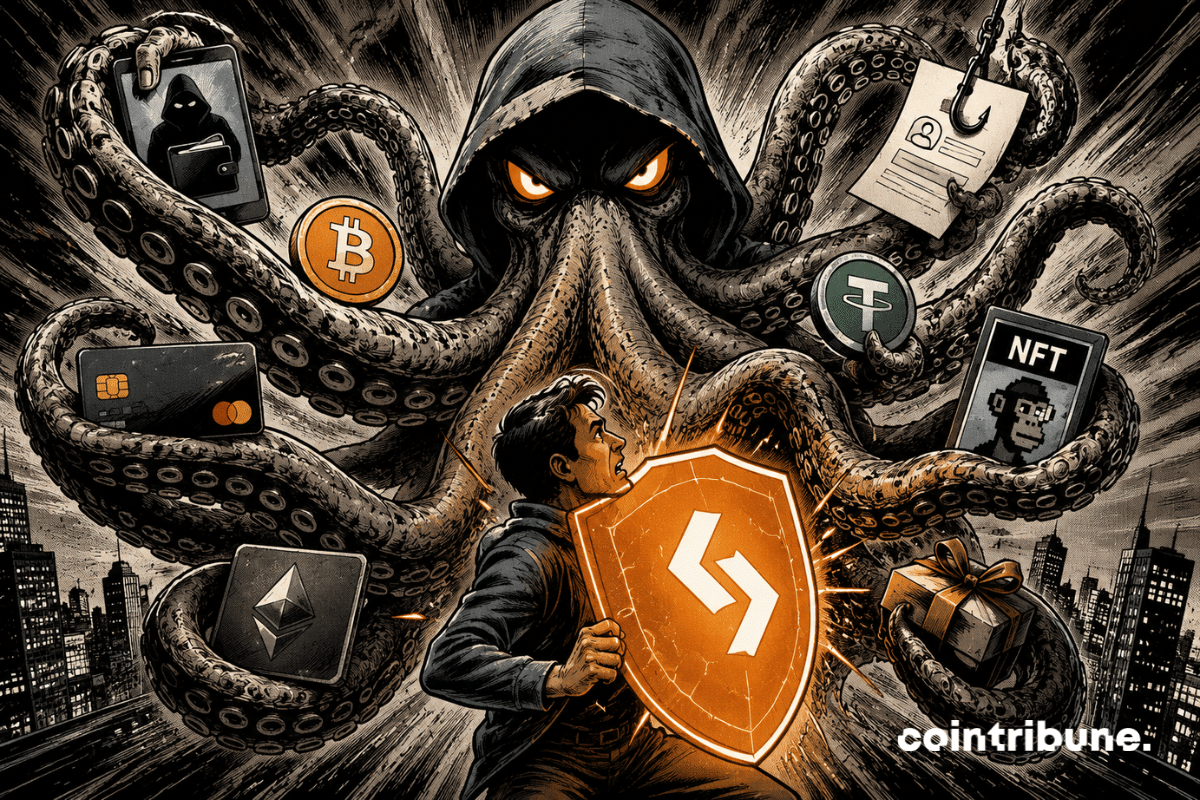
The crypto industry has absorbed wave after wave of attacks, hacks, and increasingly sophisticated fraud schemes over recent years. Yet some players refuse to retreat and instead choose to re
The crypto industry has absorbed wave after wave of attacks, hacks, and increasingly sophisticated fraud schemes over recent years. Yet some players refuse to retreat and instead choose to reinforce their defenses as threats evolve. Against that backdrop, Bitget has launched a new global security campaign, arguing that wider financial access must be matched by stronger user protection in an increasingly interconnected trading environment.
En bref
- Bitget launched Anti-Scam Month 2026 to educate users across increasingly complex multi-asset trading environments worldwide.
- Interpol estimated multi-asset financial scams caused more than $442 billion in global losses during 2025.
- The campaign targets phishing, fake applications, malicious smart contracts, AI scams, and risky token schemes.
- Bitget will publish reports with security agencies, RWA institutions, and AI partners during June globally.
Bitget sounds the alarm after a global fraud wave wiped out $442 billion
The scale of the threat has become impossible to ignore. According to Interpol, multi-asset financial scams generated more than $442 billion in losses worldwide during 2025. That figure extends far beyond the traditional crypto sphere and now reaches tokenized stocks, commodities, ETFs, foreign exchange products, and AI-linked financial services.
Bitget believes this changing landscape requires a stronger defensive posture. The exchange therefore launched Anti-Scam Month 2026 under the banner « More Assets, Stronger Shield: Stay Safe in the Multi-Asset Era ». The initiative reflects a simple reality: as financial ecosystems merge, fraud techniques evolve just as rapidly.
As Gracy Chen, CEO of Bitget, explained:
The financial system is becoming increasingly interconnected as users move across crypto, tokenized assets, commodities, and traditional financial markets within the same trading cycle. As market access expands, scam tactics are evolving just as quickly. Security today requires more than platform infrastructure. It also highly depends on helping users better recognize risk as financial activity becomes more multi-asset by design.
The message is clear. A stronger marketplace demands stronger armor. For Bitget, security is no longer merely a technical feature. It has become a strategic fortress protecting users navigating an increasingly complex financial battlefield.
Why predators are now targeting every corner of the crypto market
Fraudsters have adapted with remarkable speed. Traditional phishing campaigns still exist, but they are now joined by far more sophisticated attack vectors. Fake applications, SMS spoofing, malicious smart contracts, identity manipulation systems, and AI-generated scams are multiplying across the digital landscape.
As tokenized products enter mainstream markets, attackers increasingly hunt where liquidity gathers. In this dense financial jungle, every new gateway can become a potential ambush point. Investors moving between crypto assets, tokenized securities, and traditional instruments often leave traces that criminals seek to exploit.
Your 1st cryptos with BitgetThis link uses an affiliate program.Bitget argues that education must therefore complement infrastructure. Throughout June, the company will publish detailed articles and educational videos focused on emerging risks. These resources will dissect phishing systems, fraudulent applications, dangerous token schemes, and deceptive smart-contract mechanisms.
The objective is not simply to react after losses occur. Instead, Bitget seeks to reinforce the chainmail protecting users before attacks materialize. In an environment where one careless click can trigger devastating consequences, prevention increasingly resembles the strongest line of defense available.
Artificial intelligence opens a dangerous new front for digital scammers
Artificial intelligence has accelerated innovation throughout digital finance. Unfortunately, it has also expanded the arsenal available to cybercriminals. Deepfake technologies, automated impersonation tools, synthetic identities, and AI-assisted deception campaigns are becoming increasingly difficult to detect.
Bitget’s campaign dedicates significant attention to these emerging risks. The company plans to collaborate with on-chain security agencies, real-world asset institutions, and AI industry partners to publish specialized anti-fraud reports later this month. Live X Spaces discussions will also bring together researchers and ecosystem participants to examine evolving threats.
Behind these initiatives lies a broader transformation. Bitget now serves more than 125 million users and provides access to over 2 million crypto tokens alongside tokenized stocks, commodities, precious metals, ETFs, and foreign exchange products. Such expansion naturally enlarges the attack surface facing users.
- Interpol estimates global multi-asset fraud losses exceeded $442 billion during 2025.
- Bitget now serves more than 125 million users worldwide.
- The platform offers access to over 2 million digital tokens.
- More than 100 tokenized stocks are available through Bitget’s ecosystem.
- Anti-Scam Month 2026 runs throughout June across global markets.
The timing of this initiative appears particularly relevant. During May alone, the crypto sector reportedly suffered around 60 separate security incidents, generating approximately $683 million in losses. Against that backdrop, Bitget’s message is straightforward: stronger adoption will require stronger protection, especially as digital finance becomes increasingly interconnected.