BitGo acquired NYDIG’s institutional trading business on August 27, 2026, adding roughly 30 staff along with derivatives, financing and structured-products capabilities. No price was disclose
- BitGo acquired NYDIG’s institutional trading business on August 27, 2026, adding roughly 30 staff along with derivatives, financing and structured-products capabilities. No price was disclosed.
- NYDIG is redirecting resources toward bitcoin mining and power infrastructure, a shift it began in March 2025 by acquiring Crusoe’s mining operation.
- The deal lands seven months after BitGo’s IPO, with its stock down 60% from the offer price and the company facing a federal securities class action over bitcoin-driven losses.
BitGo has bought NYDIG’s institutional trading business, taking on the unit’s derivatives, structured products and financing desk along with about 30 of its staff. Neither company disclosed a price.
The deal reads as much like balance sheet management as market expansion. BitGo’s own bitcoin holdings have been the main source of its recent losses, and the business it just bought earns fees on client trades rather than taking directional bitcoin exposure of its own.
NYDIG’s second pivot away from trading
For NYDIG, this is the second time in eighteen months it has traded trading infrastructure for mining and power assets. It bought Crusoe’s bitcoin mining operation, more than 270 megawatts of capacity across 20-plus sites, in March 2025. NYDIG CEO Tejas Shah said the latest sale lets the company focus fully on a power and data center pipeline it puts at more than 3 gigawatts, with over 1 gigawatt deliverable in 2027 and 2028.
A stock down 60% since January
BitGo went public on the NYSE at $18 a share on January 22 and has since lost 60% of its value. Both of the stock’s worst single-day drops came right after earnings reports blaming bitcoin’s price for the loss, not the underlying business. The BitGo Q2 2026 results also highlighted the tension: revenue climbed 80% to $4.3 billion, while the company still recorded a $19 million net loss largely tied to its bitcoin holdings.
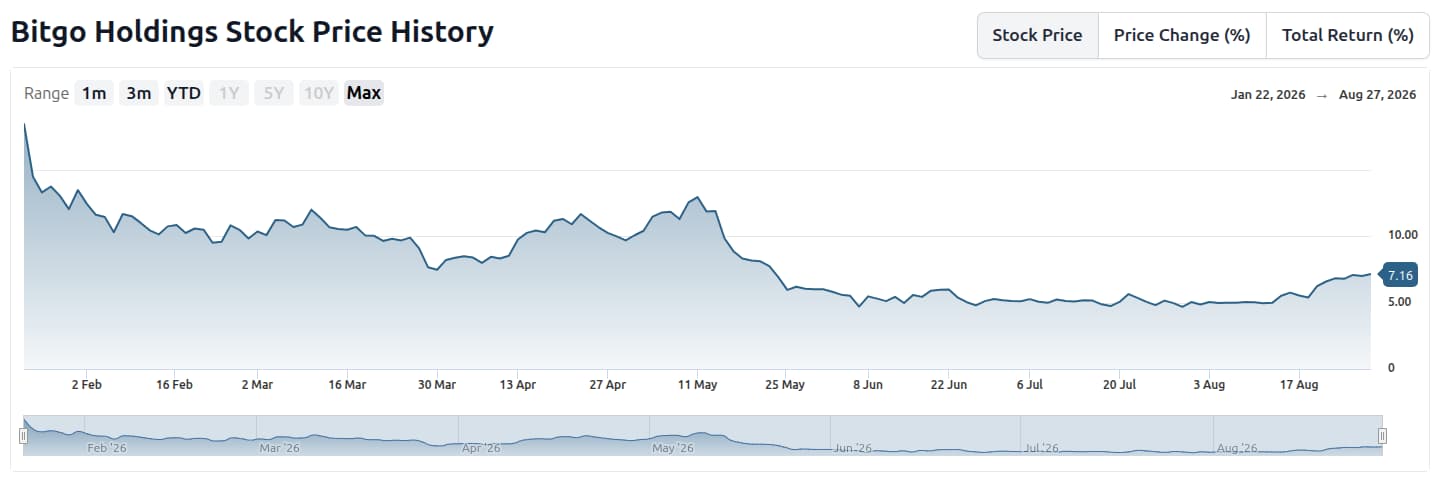 Bitgo Stock Price
BTGO has lost 60% of its IPO value in seven months, with the two sharpest single-day drops both landing on earnings reports where bitcoin’s price drove the loss.
A shareholder lawsuit over the same pattern
That pattern is now the subject of a federal securities class action, with an August 7 lead-plaintiff deadline. The suit alleges BitGo understated how exposed the business was to swings in digital asset prices, covering investors who bought BTGO shares between the January IPO and mid-May. BitGo Korea’s VASP registration in South Korea adds a separate regulated expansion track, allowing the company to provide virtual asset custody and transfer services to institutional and enterprise clients.
BitGo’s underlying business is not struggling. Second-quarter revenue rose 80% to $4.3 billion and assets on its platform grew 31% to $65.2 billion. But the company still posted a $19 million net loss, driven by an $18.8 million unrealized loss on the bitcoin it holds directly, against a $55.8 million gain in the same quarter a year earlier. A business that earns fees on other people’s trades, instead of taking a market position with its own balance sheet, gives BitGo a second kind of revenue that quarter-to-quarter bitcoin swings don’t touch the same way.
Whether that actually shows up in future results depends on how BitGo books the new unit’s revenue and how much market risk the acquired derivatives and financing book carries on its own. If NYDIG’s former trading desk turns out to be just as exposed to bitcoin’s swings as BitGo’s own treasury has been, the diversification argument weakens considerably. That distinction also matters for BitGo’s broader security profile, given the BitGo bitcoin wallet hack challenge that put its custody infrastructure under scrutiny after CEO Mike Belshe challenged Anthropic’s Claude to move 100 BTC from a public BitGo wallet.