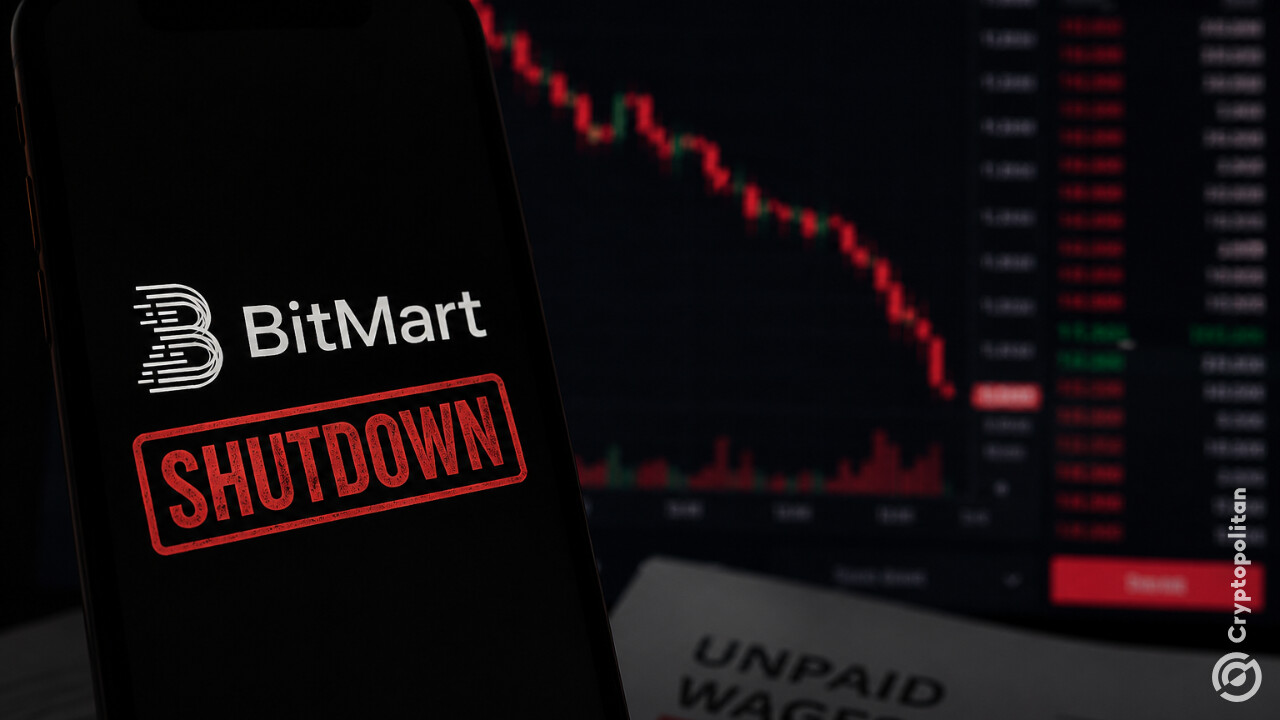
The closing down of BitMart has turned into a test of trust for the crypto exchange industry as a whole. Current and former employees and users already locked out of the exchange are demandin
The closing down of BitMart has turned into a test of trust for the crypto exchange industry as a whole. Current and former employees and users already locked out of the exchange are demanding to know where their unpaid salaries and funds stand.
The conflict arises as traders monitor the indicators of stress among mid-size exchanges. From the perspective of users, BitMart stands for the fact that an exchange can use terms like “responsible” and “orderly” when talking about shutting down the business while users are left waiting for their money. This difference between the official statements and the reality of users makes the dispute bigger than BitMart itself.
Staff and users are naming names
On August 17, an account under the name BitMart 币市 (@BitMart_zh) openly criticized the company’s management and also tagged co-founder Sheldon and the official exchange account in the post. The account demanded an explanation from the company, claiming that several users have been unable to withdraw their funds even after all this time, and many employees still have not received their pay for the last month.
The criticism came after Sheldon’s comment made on August 8, where he stated that the company didn’t “run away” and would not do so in the future either. He also advised the users to be careful about screenshots and leaks made by the present and former employees, contrary to what he said. He mentioned that the core team is still busy with the inventory of assets and completing system maintenance before the next step of an “orderly” shutdown.
Frozen withdrawals and an unanswered solvency question
The accusations made by employees come after a more serious charge. Whale Alert reported on August 10 that one of the co-founders of OpenGradient said his market-making team was unable to withdraw money from BitMart and wondered if the exchange was solvent. The company has insisted that withdrawals are still being processed, and Sheldon has denied any wrongdoing in terms of client funds.
This assurance goes back to May 23, when BitMart blamed its withdrawal problems on a scheme of volume farming involving 239 connected accounts. The exchange also promised to make its proof of reserves public “at an appropriate time.” Almost three months have passed since then, but nothing has been revealed so far.
A closure clock that runs to January 2027
The deadline is set in stone. On July 26, BitMart announced that it would stop accepting any new deposits, sign-ups, or orders on that date at 01:30 UTC. All futures and spot trading is expected to come to an end on August 26, 2026, at 01:00 UTC. The exchange will close its operations officially on January 31, 2027, at 15:59 UTC, thereafter, customers will have limited access to their accounts.
During the wind-down process, it is likely that users will still be able to withdraw. BitMart has asked users to complete their verification and make withdrawals by 05:00 UTC on August 26, although the company has cautioned that there may be additional compliance checks in processing some requests.
In its July 27 breakdown, the Bitcoin Foundation noted that BitMart has not filed for bankruptcy and has yet to disclose the time frame for users to continue withdrawals after operations cease.
Why rivals are rushing to publish reserves
It is becoming increasingly difficult to ignore the comparison with competitors. MEXC announced an August proof-of-reserves audit report by Hacken on August 14. According to the report, MEXC had a reserve ratio of over 100% for all of its main assets, including 288% for Bitcoin. The company announced its findings in the context of its commentary on a continuing trend of exchanges merging in 2026.
That is the message from BitMart’s silence. With an exchange shutting down without clarifying its solvency and whether employees were paid, the competitors have a chance to convince the customers that their books are better.
For traders, the message is simple: while fees and features are important, real reserves are more important when trust begins to erode. Thus, BitMart’s ending has to be assessed not just based on how smooth the conclusion is, but on how transparent and responsible it is regarding its customers’ funds.
The smartest crypto minds already read our newsletter. Want in? Join them.