Key Takeaways Bitwise CEO Hunter Horsley argues the “too expensive” debate misses Bitcoin’s scale. He frames Bitcoin’s $2 trillion value against a $400 trillion global asset pool. He sees fou
Key Takeaways
- Bitwise CEO Hunter Horsley argues the “too expensive” debate misses Bitcoin’s scale.
- He frames Bitcoin’s $2 trillion value against a $400 trillion global asset pool.
- He sees four structural tailwinds all favoring crypto at once.
- Short term, US spot Bitcoin ETFs have seen seven straight weeks of outflows.
- The million-dollar price targets are projections from a firm with a crypto stake.
Against a backdrop of the hottest US inflation in years, 4.2% in May, the highest since April 2023, a Fed holding rates at 3.50%-3.75% with some officials still penciling in hikes, and a run of ETF outflows, a familiar question has resurfaced: is Bitcoin finally too expensive for new capital? The CEO of one of the largest crypto asset managers thinks that question misses the point entirely. Hunter Horsley of Bitwise argues that fixating on the $60K mark misses the forest for the trees, and that Bitcoin at current prices looks expensive only against where it has been, not against where he believes it is going.
Why “Too Expensive” Is the Wrong Frame
Horsley’s starting point is that asking whether Bitcoin at $80K or $100K is too expensive misunderstands the scale of what it’s competing for. “There’s something like $400 trillion of money and assets in the world,” he says. “There’s now a new option on the menu. It’s called Bitcoin. It’s worth $2 trillion.” At $2 trillion against a roughly $400 trillion addressable market, Bitcoin’s share is about 0.5%. Against that backdrop, he calls the debate over buying at $80K versus $100K “almost silly.”
The point isn’t that Bitcoin can’t fall, it’s that arguing over a 20% price difference distracts from the size of the pool Bitcoin is positioned against. That’s the lens his whole case runs through.
The Pie Is Growing, Not Just the Slice
The part Horsley thinks is most underappreciated is that Bitcoin’s total addressable market is itself expanding. He uses gold as the analogy: it was worth about $3 trillion twenty years ago and is now in the $25-30 trillion range, a tenfold expansion of the asset class, not just price appreciation. In his framing, the pool of “dollars looking for a home” is growing at the same time Bitcoin’s share of it is growing. “Its share is growing and the pie is growing,” he says, describing the total addressable market for crypto as “dollars looking for a home, and it’s a one-way train.”
Where the Big Price Targets Come From
This scale argument is what underpins the eye-watering numbers some at Bitwise float. CIO Matt Hogan has suggested Bitcoin in the millions is reasonable, with a specific figure of $6.5 million, while Electric Capital’s Avishal puts the range at $5-10 million. Horsley’s logic supports the direction: even at ten times its current size, Bitcoin would still be a small fraction of where global capital parks itself. He leans on a compounding argument too, comparing it to how Buffett made the vast majority of his wealth late in his career, suggesting Bitcoin’s largest gains may come later in the adoption curve as compounding accelerates.
The ladder is easy to follow once the scale frame is in place. At 5% of global assets, Bitcoin would be a $20 trillion asset, roughly a tenfold move from today. At parity with gold’s current $25-30 trillion, it’s larger still. And at the $6.5 million figure Hogan considers reasonable, it would stand as a dominant global reserve asset. Each rung depends on the same assumption: that the addressable market keeps growing while Bitcoin’s share of it climbs. The people calling $60K expensive, in Horsley’s view, are doing what people did at $1K, $10K, and $100K, anchoring to the recent price rather than the future addressable market.
It’s worth being clear that these are projections, not forecasts with any guarantee behind them, and they come from people whose business is built on crypto adoption. The scale framing is a real argument; the specific million-dollar figures are the most speculative part of it.
READ MORE:
 Binance Is Halting EU Services on July 1: What It Means for Users
Four Tailwinds Running at Once
The core of Horsley’s case is that four structural forces are all moving in Bitcoin’s favor at the same time, independently of price:
- Eroding institutional trust: declining faith in institutions and governments over the past five years, a trend he says Bitcoin directly benefits from.
- Growing money supply: with $400 trillion in global assets and rising, more money means more capital hunting for stores of value, and Bitcoin is now on that menu.
- Generational wealth transfer: millennials and Gen X rank crypto among their top two preferred asset classes while boomers rank it near the bottom, and as he puts it, “with every year that passes, those individuals start to control institutions.”
- The rotation to alternatives: professional investors are already shifting away from public equities and fixed income, a flow Bitcoin sits directly inside, though with the Fed holding rates at 3.50%-3.75%, higher bond yields currently give that rotation some competition.
On the generational point, his evidence was a CFO who had just raised $2 billion and called Bitwise, not to debate Bitcoin’s merits, but simply to ask how to buy it. “He just wanted to know how he could buy it. It was already intuitive to him,” Horsley says, calling that kind of pre-existing conviction a structural tailwind people underestimate. His overall read: “Every structural tailwind is aligned to crypto’s benefit. It’s actually unbelievable to me.”
The Short-Term Reality the Thesis Has to Sit Against
Horsley’s case is structural and long-term, and the immediate data cuts the other way, which is worth stating plainly. US spot Bitcoin ETFs have now logged seven straight weeks of net outflows, roughly $7.28 billion in total, with the pace re-accelerating sharply in the latest week. The week ending June 25 saw $1.35 billion leave, the second-largest weekly outflow in the recent run, behind only the $1.72 billion exit during the early-June drop below $60K.
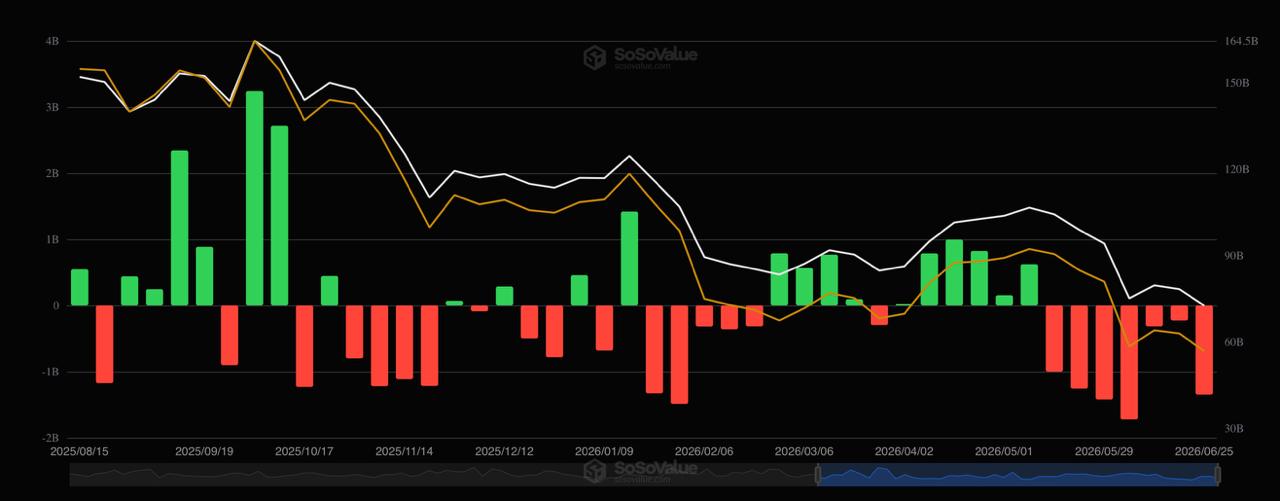
Source:
SoSoValue / Bitcoin ETF Weekly Data
What makes it notable is the timing: that selling happened while price was already depressed in the $59-62K range, so institutions weren’t trimming into strength, they were continuing to exit at cycle lows. A brief mid-June slowdown had hinted the selling might be exhausting itself, but the late-June snap-back erased that read. None of this disproves Horsley’s long-arc thesis, structural cases play out over years, not weeks, but it’s the honest counterweight: the same institutions his generational-adoption argument leans on are, right now, net sellers.
The Payment Use Case Was Just Out of Order
Horsley also reframes Bitcoin’s long-disappointing payment story as a sequencing problem rather than a failure. “In order for somebody to want to accept a payment, they first need to agree that it has value,” he argues. The last 15 to 20 years were spent debating whether Bitcoin has value at all, so expecting widespread payment adoption during that window was premature. Now that the value question is largely resolving, he believes the payment use case becomes viable, pointing to Walmart rolling out Bitcoin payment acceptance across its merchant base. His summary: people overestimated how much Bitcoin would be used beyond a store of value over the last ten years, and are underestimating how much it will be used over the next ten.
The Honest Context
Horsley’s thesis is coherent and ambitious: a small share of a vast, growing pool, pushed by four tailwinds at once, with a payment story that’s finally in sequence. As a framework for how a major asset manager sees Bitcoin’s long arc, it’s worth understanding. Two things keep it grounded, though. The million-dollar price targets are projections from people with a direct commercial interest in Bitcoin’s adoption, not predictions to bank on, and the entire thesis is a long-term, structural one, it says nothing about where Bitcoin trades next month, and as the recent ETF outflows show, assets can bleed hard in the short run even when a long-term case is intact. The argument is a serious one about scale and direction. The timing, and the specific numbers, are where the certainty drops away.
This article is for informational purposes only and does not constitute financial advice. Consult a professional before making investment decisions.The post Bitwise CEO On Why Bitcoin Has Far More Room to Grow appeared first on Coindoo.