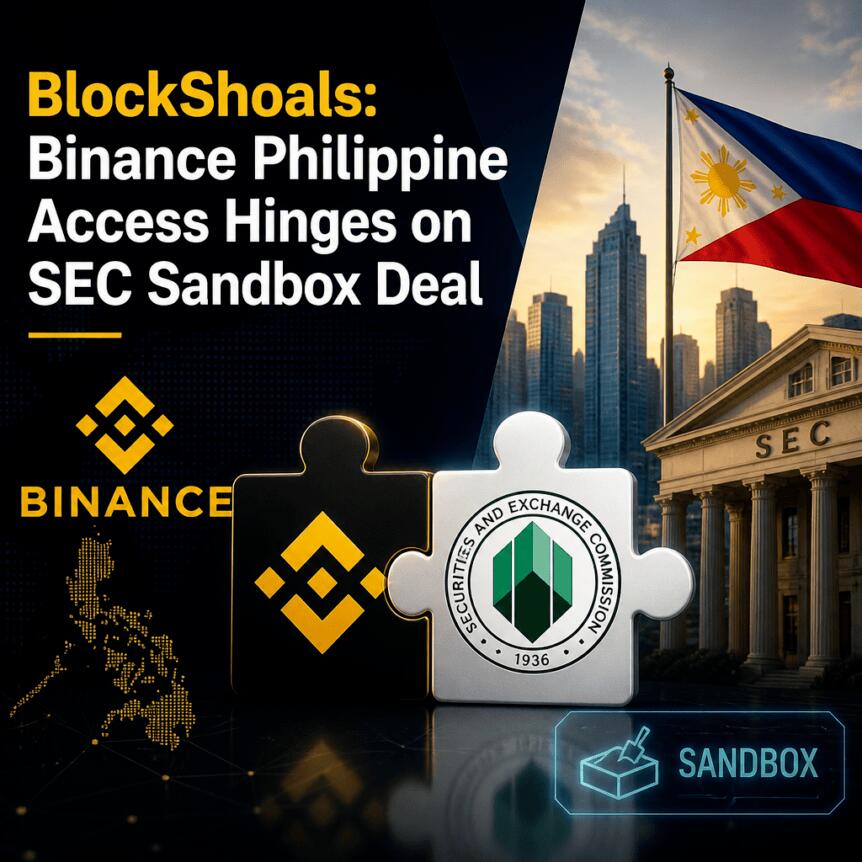
Binance’s renewed accessibility in the Philippines through a local arrangement with BlockShoals Technologies is being framed as a matter of regulatory jurisdiction rather than licensing clear
Binance’s renewed accessibility in the Philippines through a local arrangement with BlockShoals Technologies is being framed as a matter of regulatory jurisdiction rather than licensing clearance by the country’s central bank, according to a legal adviser speaking at Philippine Blockchain Week 2026. The position hinges on a key distinction: the parties describe the structure as limiting activities to regulated crypto trading access under the Securities and Exchange Commission (SEC), while excluding peso transfers and other functions that would fall under Bangko Sentral ng Pilipinas (BSP) oversight.
In separate feedback to Cointelegraph, the BSP stated that neither Binance nor BlockShoals is authorized to operate as a virtual asset service provider (VASP). The exchange’s approach also references participation in the SEC’s Strategic Sandbox (StratBox), which regulators say does not remove firms from applicable licensing obligations or cross-agency compliance requirements.
Key takeaways
- The SEC framework is presented as covering Binance’s crypto trading access in the Philippines, while BSP oversight is linked to peso transfer and other central-bank–regulated activities.
- The BSP said it has not authorized either Binance or BlockShoals to operate as a VASP, and noted ongoing coordination with the SEC.
- Participation in the SEC’s Strategic Sandbox does not eliminate requirements to comply with laws and any licensing conditions imposed by relevant regulators.
- Binance’s renewed accessibility follows earlier SEC actions in 2023–2024 related to registration and licensing concerns, including requests to block website access.
Jurisdictional split: SEC trading access vs. BSP-regulated payments
Marie Antonette Quiogue, head of legal at BlockShoals, argued that Binance’s local offering can operate without a VASP license from the BSP, provided the arrangement does not include activities the BSP regulates. In her account, trading access falls under SEC jurisdiction, whereas peso movement—described as “clearly under the jurisdiction of the BSP”—is not part of the proposed workflow.
Quiogue said BlockShoals acts as a crypto asset intermediary that connects Philippine users to Binance’s global trading platform. She acknowledged that neither Binance nor BlockShoals has applied for a local VASP license. The legal adviser did not dispute the BSP’s characterization that the entities lack VASP authorization, but maintained that the absence of such a license does not, by itself, preclude services that are governed by the SEC.
She also emphasized that if the companies introduce products or activities that fall under a different regulator’s remit, they must obtain the relevant authority. This point is operationally significant for compliance teams: it implies that the scope of the product offering—particularly any integration that could be interpreted as facilitating payment flows—could determine whether additional permissions are required.
BSP warning: sandbox participation is not a substitute for licensing
The BSP’s position, as relayed to Cointelegraph, was direct: neither Binance nor BlockShoals is authorized to operate as a VASP. The BSP further stated that entry into a regulatory sandbox does not exempt an entity from meeting applicable legal and regulatory requirements, including licensing obligations assigned to the relevant authorities.
The regulator said it was coordinating with the SEC regarding the matter. For institutional observers, this matters because sandbox participation is often used to allow experimentation while compliance frameworks are being developed; however, regulators in many jurisdictions clarify that sandbox status does not create a legal safe harbor for conduct outside the sandbox’s defined scope or outside the permissions granted by other agencies.
Unresolved questions typically arise around boundaries—particularly where technology, payments, and customer onboarding processes can be interpreted as payment facilitation, asset custody, or other regulated services. In this case, the dispute is not framed as customer trading activity alone, but rather whether the operational model introduces regulated peso transfer or other BSP-governed functions.
SEC StratBox structure and how it is being used
Quiogue said the arrangement is presented as part of the SEC’s Strategic Sandbox, or StratBox. The structure is described as: BlockShoals, operating under the SEC’s crypto asset intermediary framework, introduces users to Binance’s platform, while the parties avoid “moving pesos.”
From a policy perspective, the framing highlights a common regulatory architecture in crypto: trading and certain market-facing activities are sometimes handled by securities or investment regulators, while payment-related issues and fiat conversion are addressed by central banks or financial authorities. The practical compliance impact is that firms must map product flows to regulator-specific concepts (for example, what constitutes a payment service, a VASP activity, or another regulated financial function).
Quiogue also stated that authorization must be sought from the “relevant regulator” when services fall outside the SEC’s remit. This statement signals that the parties’ legal risk is likely to increase if new services are rolled out that involve elements potentially characterized as regulated by other Philippine agencies.
Background: earlier SEC actions and attempts to restrict access
Binance’s situation in the Philippines has been under scrutiny for some time. According to records cited by Cointelegraph, the SEC issued warnings in November 2023 that Binance was not authorized to sell or offer securities in the country because it had not obtained necessary licenses and registrations. The SEC’s notice also tied its concerns to Binance’s corporate and offering status within the jurisdiction.
In March 2024, the SEC said it asked the National Telecommunications Commission to block access to Binance’s website and related webpages, and internet providers subsequently restricted access following the order. At the time referenced by Cointelegraph’s reporting, Binance’s platform was again accessible to users in the Philippines.
This sequence underscores a compliance and enforcement dynamic frequently seen in cross-border crypto operations: regulators may challenge the legal basis for offering services to residents, then require structural changes or legal clarifications to resume access. The present dispute appears to revolve around whether the reconfigured arrangement sufficiently addresses licensing gaps or jurisdictional conflicts, particularly in relation to BSP-controlled payment functions.
What to watch next
Key developments to monitor include whether the SEC and BSP reach a formal alignment on the scope of permitted activities under the current StratBox-linked arrangement, and whether the parties’ operational model changes in ways that could bring peso transfer or other payment-regulated functions into the transaction flow. For compliance teams, the central question remains practical: how each element of onboarding, payments, and customer interaction is interpreted under Philippine licensing and cross-agency oversight frameworks.
This article was originally published as BlockShoals: Binance Philippine Access Hinges on SEC Sandbox Deal on Crypto Breaking News – your trusted source for crypto news, Bitcoin news, and blockchain updates.