Tokenized Treasuries have spent years proving that a bond can be represented on a ledger. BNY and Citadel Securities just tested a more demanding question: can the tokenized security move thr
Tokenized Treasuries have spent years proving that a bond can be represented on a ledger.
BNY and Citadel Securities just tested a more demanding question: can the tokenized security move through the same financing workflow institutions already use every day?
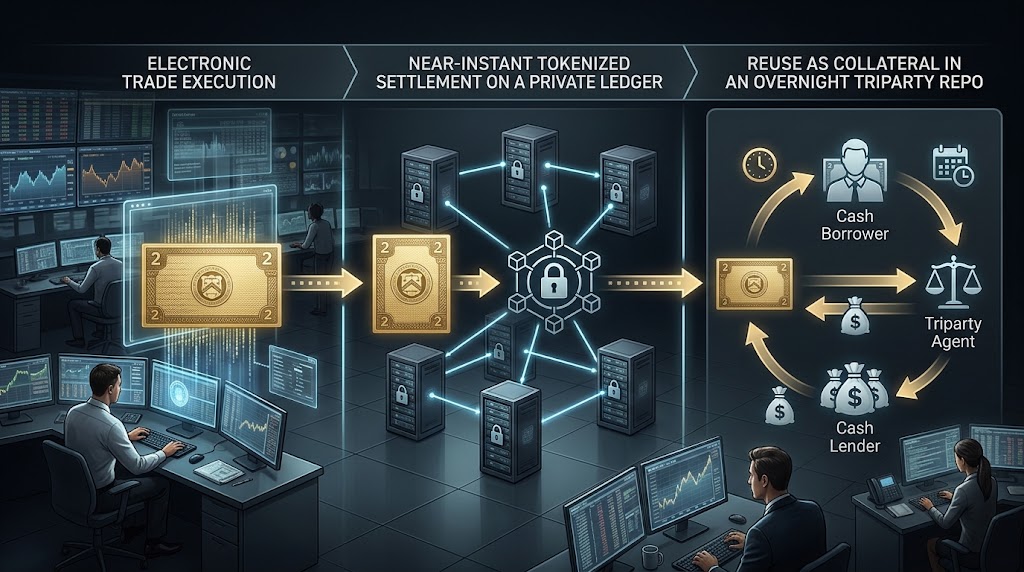
BNY says Citadel Securities purchased a two-year U.S. Treasury note through BNY on Tradeweb, had a tokenized representation recorded on BNY's private digital ledger, settled the asset within minutes and then used it as collateral in an overnight triparty repo.
BNY calls it the first use of tokenized assets on a major triparty repo platform.
That makes the transaction more important than another tokenized issuance. The asset did not stop after settlement. It immediately became financing collateral.
A repurchase agreement is economically simple: one party provides securities as collateral and receives cash, with an agreement to reverse the trade later.
In practice, repo is one of the core funding mechanisms behind government-bond markets, dealers and institutional balance sheets.
The important distinction is that a Treasury has two lives. It is an investment asset, and it is collateral that can be pledged to obtain short-term liquidity.
Tokenization becomes more useful when it supports both roles.
BNY's workflow moved the same tokenized representation from trade execution and near-instant settlement into overnight financing without waiting for the conventional T+1 settlement cycle to complete first.
Nothing in the transaction required institutions to abandon the legal structure of the Treasury market.
Citadel Securities still bought a U.S. government security. BNY still acted in familiar settlement and collateral-management roles. The repo remained a financing transaction between identifiable institutions.
The blockchain-like element sits underneath that process as a new record and transfer layer.
That is a very different tokenization thesis from putting a Treasury token on a public exchange and asking retail investors to trade it 24/7.
Optimisus recently covered another institutional version of the same idea when Franklin Templeton's tokenized money-market shares were used as off-exchange collateral for Bybit trading. In both cases, the interesting use is not the token itself. It is making collateral more portable without forcing the asset into the same custody stack as the trading venue.
Traditional settlement creates a timing gap between trade execution and the moment an asset is fully available to be reused.
If a Treasury settles within minutes and can immediately enter a financing transaction, the institution can put the asset back to work sooner.
That can matter for collateral velocity, intraday liquidity and the amount of idle cash or securities a firm needs to hold while waiting for settlement.
The benefit is not that a blockchain makes the Treasury more valuable. It is that the same Treasury can move through the balance sheet faster.
A digital representation moving instantly is useful only if every participant knows what ownership and settlement mean legally.
BNY's advantage is that it already sits inside the conventional Treasury settlement and triparty repo market. The tokenized representation is being connected to an established legal and operational framework rather than trying to replace that framework from scratch.
That is the institutional pattern Optimisus has been tracking across tokenized finance. The SEC is considering structures where the corporate share register itself can live on a blockchain, while regulated venues are testing tokenized stocks with real securities rights rather than synthetic exposure.
The common requirement is legal recognition of the thing the token represents.
Tokenization pilots often end after issuance or settlement.
The BNY-Citadel transaction went one step further into a core market workflow that institutions already understand and already need.
That is why the triparty repo matters more than the phrase near-instant settlement.
A market becomes useful when assets can move between functions: buy, settle, pledge, finance, release and reuse.
Tokenized Treasuries are beginning to do that inside incumbent infrastructure.
If the model scales, the future of institutional tokenization may be less visible than crypto expected. Traders may still see a Treasury, a repo rate and a collateral account. The tokenization layer will matter because it makes those things move faster underneath.
This is not financial advice.