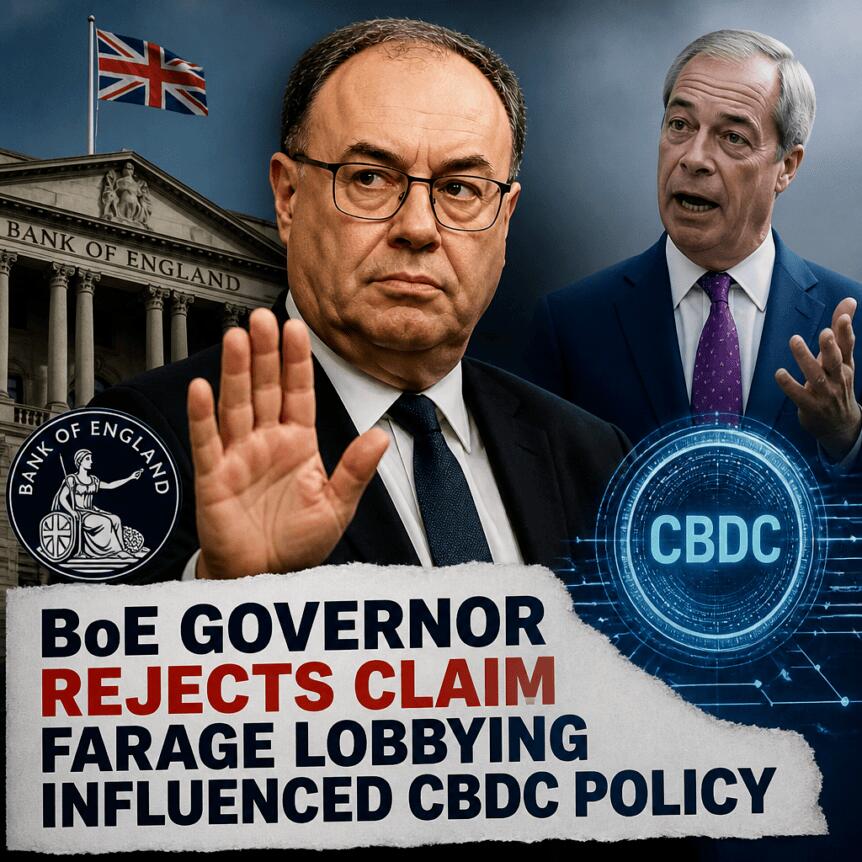
Bank of England Governor Andrew Bailey has denied that lobbying or political pressure from Nigel Farage affected the central bank’s thinking on a potential UK central bank digital currency (C
Bank of England Governor Andrew Bailey has denied that lobbying or political pressure from Nigel Farage affected the central bank’s thinking on a potential UK central bank digital currency (CBDC), according to a report by The Guardian. Bailey’s remarks reportedly come in a letter obtained by the publication after a meeting between the two in which cryptocurrencies were among the topics discussed.
At the same time, the Bank of England continues its work on the proposed “digital pound,” stressing that it is still in the design stage and that no decision has been made about whether to introduce it. The juxtaposition of ongoing CBDC research with intensifying scrutiny of political figures underscores how UK crypto policy is increasingly intertwined with public trust and governance questions.
Key takeaways
- Bailey reportedly said the BoE has mechanisms to recognize attempts to influence policymaking and that no policy changes followed any interventions by Farage.
- Farage, a long-standing CBDC critic, resigned his parliamentary seat this week amid reports about accepted “gifts” connected to the crypto industry.
- The Bank of England reiterated that it has not decided whether to launch a digital pound and that any move would require further analysis and public consultation.
- Earlier this year, the BoE launched a six-month pilot exploring tokenized asset settlement using central bank money.
Bailey denies Farage influence on CBDC policy
In its Wednesday report, The Guardian said it obtained a letter written by Bailey following his meeting with Farage. The governor’s message, as described by the outlet, indicates that Bailey believes the BoE is “able to spot” efforts to sway central bank decision-making.
Bailey also reportedly addressed what (if anything) changed after the meeting. He wrote that it was a discussion covering “a range of topics, including cryptocurrencies,” and said he was “happy to confirm that no policy changes have taken place as a result of interventions” by Farage.
The reported denial arrives amid broader political controversy around Farage. Earlier this week, Farage resigned his parliamentary seat, with reports citing claims that he accepted “gifts” from individuals with ties to the crypto industry. Cointelegraph has previously covered the resignation in connection with those allegations.
Separately, Farage has maintained that he did not break the law, according to an X livestream in which he stated he had “not broken the law in any way at all,” as referenced in his post.
BoE maintains that the digital pound is not decided
While the political noise grows, the Bank of England’s stance on CBDC development remains consistent: it is exploring the digital pound without committing to implementation.
In a recent update, the central bank said that “no decision has been made on whether to introduce a digital pound.” The BoE also emphasized that any future launch would depend on further work, including analysis and public consultation, according to the bank’s digital pound update referenced in the article.
This matters for markets and users because CBDCs—unlike purely speculative technology projects—depend heavily on institutional design choices and regulatory guardrails. Even when a central bank is actively experimenting, it can still decide not to proceed after weighing privacy, financial stability, and operational feasibility.
Pilot work on tokenized settlement continues
The BoE’s digital pound timeline remains tied to experimentation rather than deployment. Earlier this year, the Bank launched a six-month pilot aimed at understanding how tokenized assets could be settled using central bank money.
As described in the source, the pilot involved 18 companies and was designed to test practical components of a future framework for on-chain settlement—part of a broader push to modernize UK financial infrastructure. Earlier coverage from Cointelegraph noted the BoE’s decision to select Chainlink for its synchronization lab to support the work.
For investors and builders, this type of pilot is significant because it can clarify which technical approaches are viable when the “asset” being moved is paired with central bank settlement rather than commercial bank money. It also helps explain how tokenized systems might interact with existing market practices—an area where many real-world asset tokenization efforts have struggled to translate concepts into resilient infrastructure.
At the same time, the BoE’s public messaging leaves room for uncertainty. Research pilots can inform future decisions, but they do not automatically translate into a CBDC launch. The key question moving forward will be whether the BoE concludes that the digital pound’s benefits outweigh the risks and whether the public consultation process produces sufficient confidence.
Political scrutiny widens beyond CBDC debate
The report detailing Bailey’s denial comes as the UK government’s crypto-adjacent political controversy expands beyond CBDC opinions. The Guardian also reported that the UK’s National Crime Agency is investigating transactions involving other senior Reform UK figures over suspected money laundering.
That broader context is relevant to how CBDC narratives may develop in the UK. Even if policymakers insist that central bank decisions are made independently, public trust can be affected when high-profile political figures are connected to allegations involving the crypto industry. This can influence how comfortable lawmakers and the public feel about the governance and oversight of any future digital currency.
What to watch next is whether the BoE provides more detail on how it evaluates influence attempts and governance risks in its CBDC process, and how the ongoing investigations and Farage-related claims evolve alongside the Bank’s experimental work toward the digital pound’s potential role in the UK financial system.
This article was originally published as BoE Governor Rejects Claim Farage Lobbying Influenced CBDC Policy on Crypto Breaking News – your trusted source for crypto news, Bitcoin news, and blockchain updates.