Key Takeaways The FAA has granted Boeing authorization to establish an additional 737 MAX production facility in Everett, WA, with plans to reach 52 aircraft monthly by early 2027. Treasury D
Key Takeaways
- The FAA has granted Boeing authorization to establish an additional 737 MAX production facility in Everett, WA, with plans to reach 52 aircraft monthly by early 2027.
- Treasury Department sources indicate China may purchase 500–550 more Boeing planes, potentially coinciding with President Xi’s anticipated September U.S. visit.
- Singapore Airlines is considering acquiring at least 50 widebody aircraft, with the Boeing 777X among the options under review.
- Boeing’s first-quarter earnings exceeded Wall Street forecasts, reporting a $0.20/share loss compared to the anticipated $0.68 deficit, while revenue climbed 14% year-over-year to $22.22 billion.
- Analysts maintain a “Moderate Buy” rating with a mean price target of $259.80; shares closed Friday at $215.72.
Boeing (BA) shares closed at $215.72 on Friday, sliding 0.8% despite an accumulation of favorable news surrounding the aerospace giant.
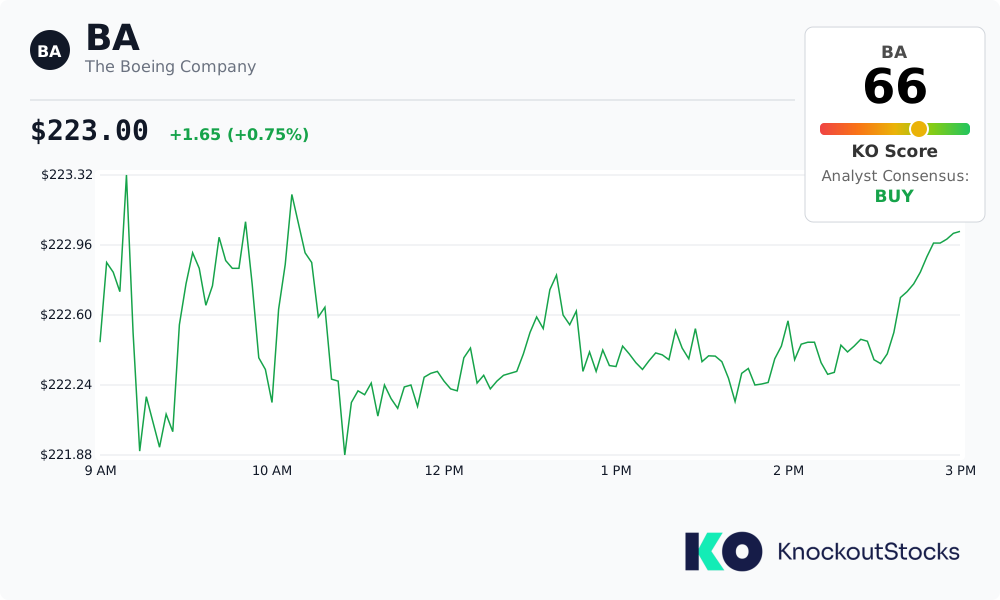 The Boeing Company, BA
Regulators at the FAA have given Boeing the green light to launch a second 737 MAX final assembly facility in Everett, Washington. Operations commence July 6, with the company targeting monthly production expansion from 47 aircraft to 52 units by the first quarter of 2027. CEO Kelly Ortberg emphasized a disciplined approach to ramping up output, prioritizing quality assurance throughout the process.
Regarding aircraft deliveries, Boeing completed the handover of two 787-9 Dreamliners to Riyadh Air, representing the initial portion of a commitment for as many as 72 planes. United Airlines received the inaugural higher-weight iMTOW variant of the 787-9, enabling extended range and increased payload capacity on routes departing San Francisco.
The company’s latest quarterly financial performance surpassed Wall Street expectations. Boeing recorded a per-share loss of $0.20, significantly better than the consensus estimate calling for a $0.68 deficit. Total revenue reached $22.22 billion, marginally topping projections while representing a 14% year-over-year increase.
China Opportunity Takes Center Stage
The potential China business represents the development garnering the most investor attention. An initial agreement covering approximately 200 aircraft was perceived as disappointing by market participants. However, Treasury Department officials have subsequently indicated Beijing may ultimately order between 500 and 550 additional planes. A potential trigger point could arrive with President Xi’s planned September visit to the United States.
China’s ongoing dependence on American-manufactured components for its domestic C919 commercial aircraft program provides additional negotiating dynamics to the bilateral relationship. This geopolitical and commercial context has contributed to Boeing’s stock recovery in recent trading sessions.
Separately, Singapore Airlines has acknowledged it is evaluating the acquisition of no fewer than 50 widebody jets. The carrier is weighing both the Boeing 777X and Airbus A350-1000 platforms. Discussions remain in preliminary phases.
Challenges Persist
Despite positive momentum, Boeing continues to face operational hurdles. German authorities have launched an investigation following a nose-gear failure incident involving a Boeing 787 at Frankfurt airport that resulted in worker injuries. The episode has reignited concerns regarding quality oversight within the 787 manufacturing process.
NASA has placed the Starliner spacecraft program “under review” after complications during its crewed test mission. Future missions are expected to proceed without crew, creating schedule pressure given the International Space Station’s anticipated decommissioning timeline before 2030.
The 777X program continues to present difficulties. Deliveries have been postponed until next year — approximately seven years past the original schedule. Several carriers have responded by ordering Airbus alternatives to address capacity requirements.
ING Groep NV dramatically expanded its Boeing holdings during the fourth quarter, increasing its position by more than 2,000% through the addition of 736,861 shares, bringing total ownership to 772,400 units. Vanguard and Geode Capital similarly boosted their stakes in the same reporting period. Institutional investors collectively control 64.82% of outstanding shares.
Wall Street price targets span from $250 (Wells Fargo and Morgan Stanley with equal-weight ratings) to $295 (Tigress Financial and Jefferies maintaining buy recommendations). The average analyst target stands at $259.80, suggesting approximately 20% appreciation potential from present trading levels.
Boeing’s 52-week trading band extends from $176.77 to $254.35, with the 50-day moving average positioned at $220.80.
The post Boeing (BA) Stock: FAA Green Light, Potential China Mega-Deal and Strong Q1 Spark Rally appeared first on Blockonomi.