Earlier today, a Nigerian X user shared a screenshot showing a Bolt driver on their way to a pick-up point, captioning it, “A xenophobe is on his way to pick up a ghost passenger.” This was n
Earlier today, a Nigerian X user shared a screenshot showing a Bolt driver on their way to a pick-up point, captioning it, “A xenophobe is on his way to pick up a ghost passenger.” This was not just a random prank; it was a coordinated message that resonated with thousands of Nigerians on X.
The campaign of ghost bookings aimed at South African Bolt drivers had returned.
The tactic is simple and somewhat elegant in its frustration. A user in Nigeria opens the Bolt app, books a ride to any destination in South Africa, Johannesburg, Cape Town, or Pretoria, and never shows up.
The driver burns fuel, loses time, sits in traffic waiting, and earns absolutely nothing. Multiply that across hundreds of simultaneous bookings, and the disruption compounds quickly. Bolt has no clean solution for it. Unlike some platforms, rides can be booked without an upfront deposit, meaning the only penalty for a no-show is a cancellation fee that rarely covers what the driver already lost.
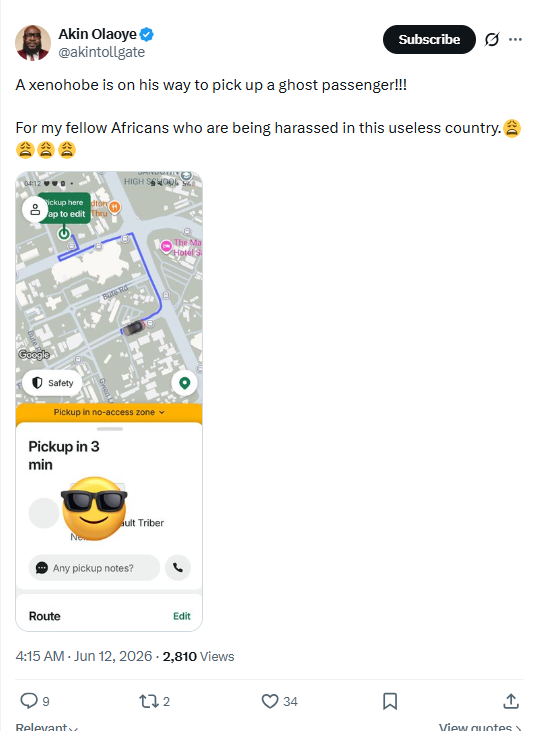
The post spread fast, accumulating thousands of views within hours. Many Nigerians in the comments were asking how to replicate it. Others were referencing a near-identical campaign from 2024 where the same tactic circulated widely under the phrase “Bolt for Bolt.”
One user dug up an archived post from that year that read, “South Africans, it is Bolt for Bolt. We mount”, signalling clearly that this was not a new idea but a revived one, triggered by a familiar provocation.
Similar read: MTN Ghana targeted as ‘South Africa Must Go’ protests hit Accra
The year 2026 saw a surge in xenophobic attacks targeting African migrants in South Africa, which escalated into a serious international issue. These weren’t isolated incidents; Nigerian citizens were killed. Ghana responded by formally evacuating 300 of its citizens via a chartered flight, as they no longer felt safe in the country.
Both Nigeria and Ghana formally complained to Pretoria and summoned South African diplomats to address the violence. Specifically, Nigerian Minister of Foreign Affairs Bianca Odumegwu-Ojukwu spoke with her South African counterpart regarding the deaths of two Nigerians.

Bolt
One of these individuals was found in a Pretoria mortuary after an alleged encounter with metro police. Minister Odumegwu-Ojukwu condemned these incidents as “utterly condemnable” and demanded justice from South Africa.
A protest with history and real victims like Bolt drivers in the middle
What is unfolding now is not the first time South African companies have become collateral targets of Nigerian anger over xenophobia. In 2019, the last major wave of anti-immigrant violence in South Africa triggered Nigerian protesters to attack and loot MTN’s offices in Abuja. South African retailers operating in Nigeria were also targeted during that period.
The logic both then and now is the same: if South Africa does not protect African migrants, African countries will make South African businesses feel the cost.
This time the weapon is digital. But the people actually absorbing that cost are not the South African government or the anti-immigrant protest movements driving the xenophobia. They are ordinary Bolt drivers, men and women trying to earn a living through ride-hailing, many of whom have nothing to do with the politics consuming the country around them.

South Africa Must Go protest in front of MTN Ghana
That contradiction was not lost on everyone online. Several voices pushed back hard against the campaign, arguing that targeting random drivers was both unjust and counterproductive.
A user pointed out that South African companies like MTN contribute enormously to African economies. MTN’s Nigerian operations are the group’s single largest revenue market globally, generating hundreds of billions of naira annually.
Another Ghanaian user noted that MTN contributes approximately 16 billion South African rand to Ghana’s economy. “This is a disgrace. We shouldn’t encourage this at all,” they wrote, arguing that economic interdependence between South Africa and the rest of Africa is too deep for this kind of retaliation to land cleanly.
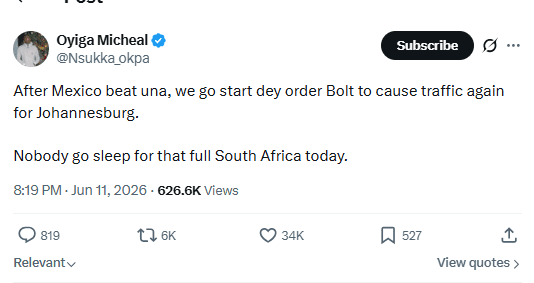
An X post
Others were less sympathetic to that reasoning. Several posts argued that when a government repeatedly fails to protect African migrants and the diplomatic channels produce no visible results, economic disruption, however imperfect its targeting, is one of the few tools ordinary people have. “ABeg how dem dé do this thing make I follow you show dem pepper,” one user replied, mixing frustration and dark humour in a way that captured the mood.
Bolt has not issued any public statement on the campaign or indicated whether it has mechanisms to detect and block coordinated ghost-booking patterns. Until it does, the app remains the chosen battlefield for a diplomatic conflict that South Africa’s government has so far failed to resolve.