Price discovery is the process through which buyers and sellers establish a token’s market value. For a new meme coin, fixed-rate funding, bonding curves, and direct liquidity launches create
Price discovery is the process through which buyers and sellers establish a token’s market value.
For a new meme coin, fixed-rate funding, bonding curves, and direct liquidity launches create different paths into trading.
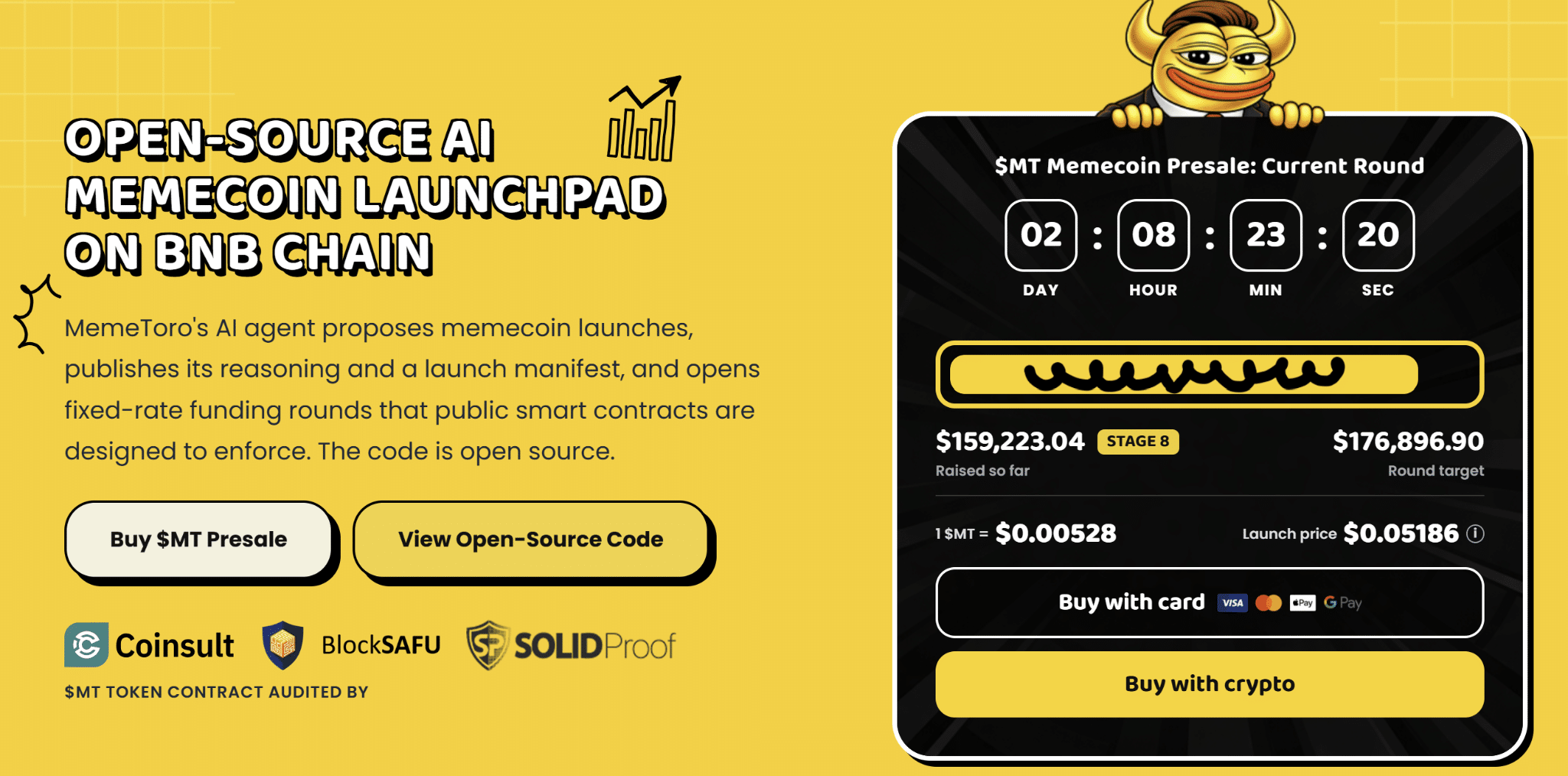
MemeToro is a BNB Chain project developing an open-source AI agent and a planned FairLaunchEscrow framework for documented, fixed-rate memecoin funding rounds. MemeToro has raised more than $160K in Stage 8. It supports comparison.
What Is Meme Coin Price Discovery?
Meme coin price discovery is how an early token moves from a launch setting to a market price shaped by buying, selling, liquidity, and demand. The launch structure determines how people can enter.
A fixed-rate round uses one stated price for a defined period. A bonding curve changes the price automatically as participants trade, while a direct-liquidity launch starts when a creator supplies tokens and assets to a pool.
Model
How early price works
Key detail
Fixed-rate funding
One published price during a set window
Supply, cap, deadline, and outcome rules
Bonding curve
Price adjusts as buys and sells occur
Curve, slippage, and migration point
Direct liquidity
Opening pool sets the first market
Pool size, paired asset, and controls
Users need to know what terms apply before joining a funding round or trading an early pool.
How Does Fixed-Rate Funding Set an Early Meme Coin Price?
Fixed-rate funding gives every eligible participant the same stated rate during funding. Users can inspect the entry condition before contributing.
MemeToro’s planned flow uses fixed-rate public funding after its AI agent prepares a documented launch proposal. The proposal is intended to show a token concept, supply, price, caps, timing, and contract path.
The process has four stages:
- Propose: The agent scans public signals and drafts a token idea.
- Verify: Users review the evidence and terms.
- Fund: A fixed-rate round follows the published conditions.
- Launch: Escrow logic applies the stated outcome.
MemeToro’s open-source AI agent links an early price to a public proposal rather than only a fast chart.
How Do Bonding Curves Change Early Token Pricing?
A bonding curve changes the token quote through a formula in the launch contract. As users buy, the quote rises; as users sell, it can fall according to the curve design.
This model creates live price discovery from the first trade. Users should understand that the displayed price, liquidity, and slippage may change between opening the page and confirming a transaction.
At a graduation point, liquidity can move into a decentralized exchange pool, where market trading begins.
Before using a bonding curve, check:
- the starting price and curve progression
- the supply assigned to the curve
- the graduation target and liquidity destination
- trading fees, wallet limits, and anti-bot rules
How Do Public Terms and Contracts Support Clearer Price Models?
Public terms and contracts show how the starting rate, funding window, and next stage are intended to work. A launch page should explain its success, failure, and exit conditions.
MemeToro’s FairLaunchEscrow development connects published terms to planned BNB Chain contract actions. Its technical materials describe contribution limits, deadlines, claims, refunds, finalization, liquidity handling, and an exit window for leaving before the relevant cutoff.
Public item
Why users need it
Supply
Shows how many tokens are part of the launch
Entry method
Explains fixed pricing or a moving curve
Time window
Defines when funding terms apply
Caps
States participation limits
Outcome rules
Covers exits, refunds, claims, and finalization
MemeToro has published code and examples for its agent pipeline, manifests, and draft escrow framework. The work is an early MVP, but it shows how research, funding conditions, and planned trading activity can be documented together.
What Should Users Compare Before a Meme Coin Starts Trading?
Users should compare the price model, supply plan, liquidity path, contract rules, and public information before a meme coin starts trading. The goal is to identify the structure behind the price a user is viewing.
MemeToro’s Stage 8 raise above $160K provides context for platform development. $MT is intended to support platform access, transactions, launch funding, rewards, staking, and future memecoin trading, while creator launches are designed to have their own published conditions.
The MT tokenomics show a 1.2 billion supply: 852,000,000 $MT for public sale, 120,000,000 for CEX reserves, 90,720,000 for marketing partners, 60,000,000 for MemeToro Trading, 53,280,000 for MT Rewards, and 24,000,000 for the MT Team.
Readers can go to the how-to-join MemeToro for official participation information. Whether a launch uses a fixed rate, bonding curve, or direct liquidity, clear terms explain how its early price is formed.
FAQs
What is fixed-rate funding?
It is a format where eligible participants join at one published token price during a stated period.
What is a bonding curve?
It is a contract-based system where the token quote changes as people buy or sell.
What is slippage?
Slippage is the difference between an expected trade price and the executed price.
What is liquidity migration?
It moves a token and paired assets into a public decentralized-exchange trading pool.
Does a launch price guarantee a later market price?
No. A launch price describes the early entry model, while later prices follow market activity and liquidity.
More Information on MemeToro ($MT) Presale Here:
Website: https://memetoro.com/
X: https://x.com/memetoro_mt
Telegram: https://t.me/memetoro_mt
YouTube: https://www.youtube.com/watch?v=gY0jgWy_DtA
Continue Reading: Bonding Curve or Fixed Price? How Meme Coin Launch Prices Are Set