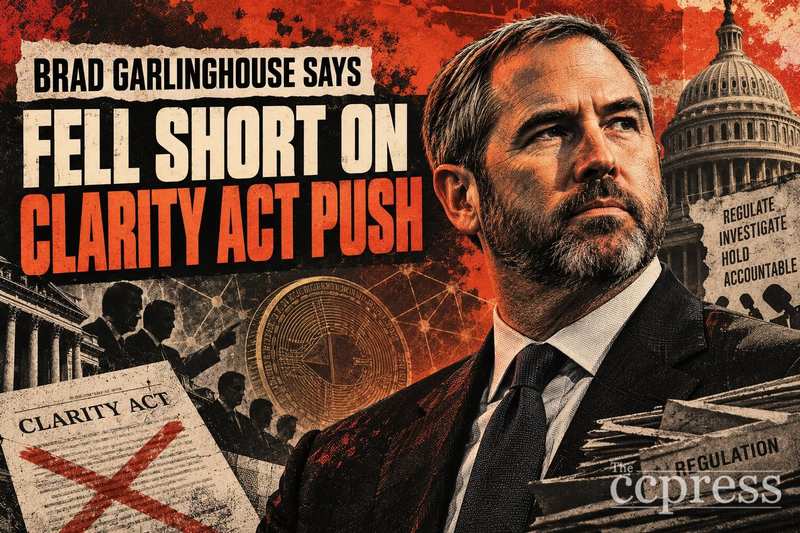
Ripple CEO Brad Garlinghouse took to X to admit his team came up short in its push to advance the Digital Asset Market Clarity Act, a rare public acknowledgment of a legislative stumble from
Ripple CEO Brad Garlinghouse took to X to admit his team came up short in its push to advance the Digital Asset Market Clarity Act, a rare public acknowledgment of a legislative stumble from one of crypto’s most vocal policy advocates.
Garlinghouse posted the admission directly on X, acknowledging the shortfall in his team’s effort to move the bill forward. The statement drew attention precisely because Garlinghouse has been among the most prominent industry voices pushing for the legislation. For related coverage, see Crypto Clarity Act advances, awaits full Senate vote and Trump’s signature.
Earlier this year, Garlinghouse had signaled confidence that the Clarity Act could pass soon, making the admission of falling short a notable shift in tone.
What the Clarity Act Represents for Crypto Regulation
The Digital Asset Market Clarity Act, introduced in the 119th Congress as House Bill 3633, is designed to establish a regulatory framework for digital assets in the United States. The bill attempts to draw clearer lines between which tokens qualify as securities and which fall under commodity regulation.
For Ripple, the company Garlinghouse leads, the stakes are direct. The absence of regulatory clarity has shaped the company’s legal battles for years. Garlinghouse has previously noted that the SEC nearly forced Ripple to shut down entirely during the agency’s 2020 enforcement push.
The bill has faced friction from multiple directions. U.S. crypto leaders have pushed back on specific stablecoin terms in the Senate draft, complicating the coalition needed to move the legislation forward. Those internal industry disputes add legislative drag even when there is broad support for the bill’s core goal.
A Setback, Not a Surrender
Garlinghouse’s admission signals that the industry’s lobbying muscle did not translate into legislative momentum this cycle. That gap between advocacy and outcome is significant: Ripple and allied firms have invested heavily in Washington, and the shortfall suggests the legislative path remains harder than public optimism implied.
The Clarity Act had moved further than many expected, advancing through committee and awaiting a full Senate vote. Falling short at that stage is a more consequential stumble than an early procedural failure.
What Garlinghouse’s public acknowledgment does not answer is whether the gap was a matter of timing, coalition building, or political headwinds beyond the industry’s control. No additional details on next steps or revised strategy were available at time of publication.
The question now is whether this admission reshapes how aggressively the industry recalibrates for the next legislative window, or whether Ripple’s broader policy ambitions quietly absorb the loss and reset for the next session. Garlinghouse’s track record suggests he will not stay quiet for long.
Additional source references: source document 1.
Disclaimer: This article is for informational purposes only and does not constitute financial or investment advice. Cryptocurrency and digital asset markets carry significant risk. Always do your own research before making decisions.
The article Brad Garlinghouse Says Team Fell Short on Clarity Act Push first featured on theccpress.com.