Central Bank Meets Crypto Firms on Stablecoin Forex Limits Crypto news out of Brazil centers on Brazil stablecoin rules after the Banco Central do Brasil (BCB) met industry players behind clo
Central Bank Meets Crypto Firms on Stablecoin Forex Limits
Crypto news out of Brazil centers on Brazil stablecoin rules after the Banco Central do Brasil (BCB) met industry players behind closed doors on November 19, 2026. The session explained how existing foreign exchange (FX) rules apply to cross-border operations that use stablecoins.
No new rule was announced. The aim was to align how different business models are understood.
The most detailed public account comes from Valor Econômico, which obtained an internal document summarizing the meeting. Digital asset companies and industry associations attended. The BCB has not published a press release on this session, so the details below are attributed to that report.
Where Brazil Stablecoin Rules Turn a Transfer Into Forex Settlement
The central bank separated two kinds of activity. The first is a payment or international transfer with virtual assets, which authorized virtual asset service providers (VASPs, known as PSAVs in Brazil) may carry out under set conditions.
The second is a forex (câmbio) settlement, where a Brazilian institution takes responsibility for delivering foreign currency abroad.
Flow described
Classification
Authorization needed
Client pays reais, institution sells stablecoins and sends them to the client's overseas wallet.
International transfer with virtual assets; the Brazilian service ends at delivery.
Virtual asset (PSAV) authorization.
Client pays reais, institution converts to stablecoins and arranges delivery of dollars or other currency abroad.
Forex settlement.
Specific authorization to operate in the currency-exchange market
An overseas provider's later conversion into fiat is treated separately, as long as it is not part of a structured operation arranged by the Brazilian institution. The BCB stressed that small structural differences can change the FX classification.
These clarifications apply existing rules, mainly Resolução BCB nº 521, dated November 10, 2025. It brought certain VASP activities into the foreign exchange market, including international transfers, stablecoin purchases and sales, and some transfers involving self-custody wallets.
Lower limits apply in some cases when the counterparty is not an authorized FX institution. The rollout is staged, starting in February 2026, with key parts from May 2026.
Stablecoin Sandwich Label Faces a Push to Retire It
The BCB asked the industry to stop using the vague term "stablecoin sandwich" (operação sanduíche). According to Valor, the regulator identified more than 20 different models under that label. Some may be permitted and others not.
For compliance teams, the Brazil stablecoin rules now turn on how each flow is built, not on what it is nicknamed. The central bank prefers precise legal and regulatory terms.
Other points covered, as reported by Valor:
Authorized financial institutions that use virtual assets as back-end infrastructure for international transfers remain subject to foreign exchange rules.
Trade finance payments with virtual assets need the same client identification, documentation, and classification controls as traditional foreign exchange services.
Institutions that buy foreign currency to acquire virtual assets abroad and resell them in Brazil must adjust how they register their foreign exchange position.
The BCB drew attention to non-resident real accounts used by foreign providers.
A public consultation on professional-to-professional operations, such as liquidity providers and treasuries, is expected.
The BCB also signaled that it will issue written clarifications on remaining questions and is open to further meetings.
Reporting Errors Force a Reset of C212 Data Rules
A large part of the meeting dealt with the C212 report (file ACAM212), which covers virtual asset services in the foreign exchange market and is sent through the BCB's STA file-transfer system. It applied to operations from May 2026.
About 100 providers submitted roughly 600,000 records. Many had serious errors: dollar-pegged stablecoins valued at a few cents of reais, zero quotes, amounts that appeared as trillions of reais, and fictitious names for foreign parties.
Item
Outcome reported
May 2026 data
Used only for internal studies
Operations from November 2026
Formal reporting resumes.
First submission deadline
December 5, 2026
System checks
New automatic validation added
The BCB reportedly warned that a file accepted without error does not mean the data is correct. Providers must verify payer and receiver details abroad.
What Brazil's Stablecoin Rules Mean for Crypto Firms and Users
Firms holding only a virtual asset license should check whether any product promises delivery of dollars abroad. On the reported reading, that may need foreign exchange authorization instead. Firms that deliver stablecoins to a customer's overseas wallet and stop there sit in the permitted category.
Users of Brazilian platforms can check how their provider is authorized. This is not legal advice, and stablecoin news in this area can change quickly.
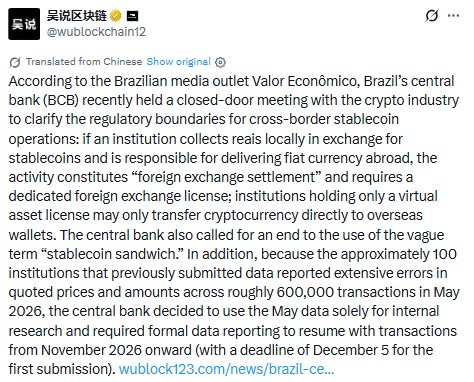
Wu Blockchain also shared a summary of the Valor report on X.
Latest crypto updates from Brazil are likely to follow, but the meeting itself changed no law. For now, Brazil's stablecoin rules hinge on who delivers the foreign currency. The next date to watch is December 5, 2026.
Disclaimer: This article is for information only and is not financial advice. Crypto and leveraged derivatives carry a high risk of loss. Do your own research and consult a licensed adviser before trading.
