Why Did Brazil Raise Money Laundering Concerns Over Stablecoins? Brazil Stablecoin Rules are under fresh scrutiny after a senior central bank official said legitimate money picks up a "dirty
Why Did Brazil Raise Money Laundering Concerns Over Stablecoins?
Brazil Stablecoin Rules are under fresh scrutiny after a senior central bank official said legitimate money picks up a "dirty money" label once it is converted into stablecoins.
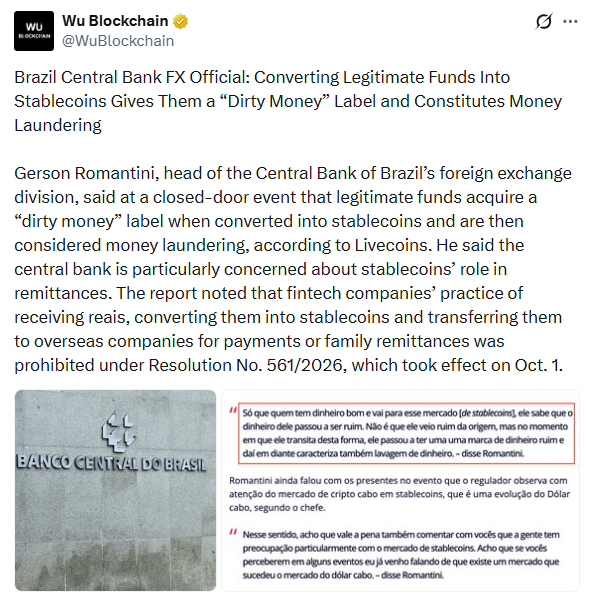
According to a post on X by WuBlockchain, Gerson Romantini, head of the foreign exchange division at the Central Bank of Brazil, said such conversions are then treated as money laundering.
He spoke at an industry event hosted by Exchange Informática, and a Livecoins report says the session was closed to the press. The central bank is especially concerned about the role of stablecoins in remittances.
What Did Brazil Central Bank Official Say About Stablecoins?
Romantini said the money is not bad at its origin. The mark appears the moment funds move through stablecoins, and that, in his view, brings the laundering label.
He also described the stablecoin market as the successor to the older informal "dólar cabo" market. That comparison explains why the regulator is watching remittance flows so closely.
The practice at the center of the debate is simple. A fintech receives Brazilian reais, converts them into stablecoins, and sends the value to an overseas company.
The funds then pay bills or reach family members abroad. The post states this model is prohibited under Resolution No. 561/2026, which took effect on October 1.
How Does Resolution 561 Change Brazil Stablecoin Transfers?
The Central Bank of Brazil published Resolution 561 on April 30, 2026. It amended Resolution 277/2022, which covers international payment and transfer services known as eFX.
Under the change, settlement between an eFX provider and its foreign counterparty must use traditional foreign exchange or a non-resident account held in reais.
The rule targets the settlement leg of these payments, which is why cross-border stablecoin payments sit at the center of the current debate.
Which Stablecoin Conversion Models Can Still Operate in Brazil?
Romantini told attendees that regulators have seen two types of so-called sandwich operations. One is allowed and the other is not, according to the report.
The allowed model uses virtual assets as infrastructure for an exchange operation, in place of a system such as Swift. It remains a currency exchange, so it can proceed.
The barred model sells the stablecoin to the client, who takes ownership and then sells it abroad to settle in fiat. Romantini said the client really wants to swap reais for dollars, so firms cannot offer that structure.
He added that the central bank has not yet inspected such offers because of limited resources, though it has heard some institutions provide them.
Could November 19 Bring New Restrictions on Brazilian Fintechs?
An unnamed source told Livecoins that a meeting on November 19 could bar fintechs from this market entirely and leave it to banks. This remains unconfirmed.
The central bank did not answer questions after three days, and its public agenda lists no event for that date, the report says. The meeting date and its outcome stay unverified.
The pressure arrives as Brazilian exchanges already deal with tighter central bank rules, including higher capital requirements that pushed some platforms to end services.
Regulatory pressure on stablecoins is a recurring theme in crypto news today, including in markets outside Brazil.
Expert Take: What Remains Uncertain About Brazil Stablecoin Rules?
The data suggests two separate layers. Resolution 561 is written and in force. Romantini's laundering comment is a spoken view at a closed-door event, not a published rule.
The main uncertainty is the November 19 meeting. No official bank statement confirms it, and no enforcement action has been cited. Firms that built remittance products on stablecoin settlement carry the largest exposure.
Key signals include any official central bank clarification and changes to fintech product offerings.
Conclusion
Brazil Stablecoin Rules now combine a binding settlement rule with a sharp public warning from a senior official. The rule itself is clear.
The laundering label and the possible fintech ban rest on remarks and an unconfirmed source, and the central bank has not commented.
Disclaimer: This article is for information only and is not financial, legal or investment advice. Crypto assets and regulation can change quickly, and unconfirmed reports may not prove accurate. Always verify details with official sources.