The inclusive growth of the BRICS could allow emerging countries and their populations to benefit optimally from the global economy. Such an ambition goes beyond wealth redistribution, howeve
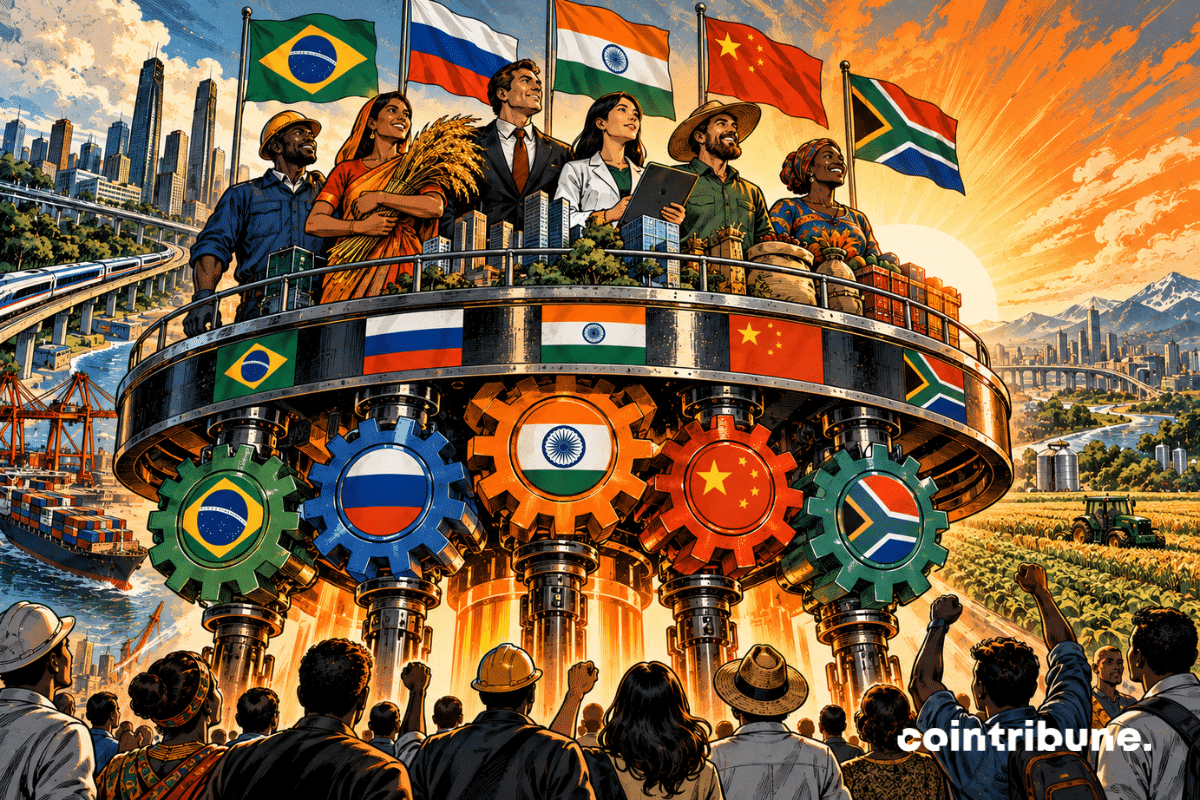
The inclusive growth of the BRICS could allow emerging countries and their populations to benefit optimally from the global economy. Such an ambition goes beyond wealth redistribution, however the commitments made in New Delhi remain difficult to measure.
In brief
- The BRICS place inclusive growth at the heart of their economic strategy.
- The bloc wants to better integrate emerging countries into the global economy.
- The New Development Bank finances infrastructure and sustainable development.
- Members seek to strengthen the use of national currencies in their exchanges.
- The BRICS demand better representation in global economic governance.
Growth that involves more populations
The leaders of the BRICS alliance placed “inclusive global economic growth” at the center of their summit on September 12 and 13 in New Delhi. This concept starts from a simple observation. An increase in gross domestic product does not necessarily guarantee an immediate improvement in living standards for the entire population.
Growth becomes inclusive when many people directly participate in value creation. It is then based on productive employment, education, health, access to credit, and the presence of sufficiently developed infrastructure.
Several elements help understand this approach :
- Jobs created must offer sustainable incomes ;
- Small businesses must have easier access to financing ;
- Disadvantaged populations must benefit from public services ;
- Remote territories must benefit from infrastructure ;
- Growth must not rely on a few sectors or social groups.
Narendra Modi stated:
We have tried to promote inclusive global growth.
This is not a concept invented by the BRICS. The World Bank and other international organizations have been using it since the 2000s. They simultaneously assess the pace of growth and how its benefits are distributed.
The BRICS extend the principle to relations between states
Now, the alliance applies this logic on a global scale. An inclusive international economy must not only produce more wealth. It must offer the possibility for more countries to join high value-added activities and participate in rulemaking.
Thus, the BRICS demand better access to technologies, financing, and global production chains. They request that emerging countries not remain mere suppliers of raw materials or cheap labor.
Such a demand also concerns global governance. Thus, the New Delhi Declaration calls for significant representation of developing economies at the International Monetary Fund and the World Bank.
The BRICS bloc accounts for about half of the world’s population, nearly 40% of global GDP, and more than a quarter of international trade, according to data provided by the Indian presidency. Its weight reinforces its demand for reforming institutions founded at the end of the Second World War.
The BRICS Bank must finance this ambition
The New Development Bank is the bloc’s main financial instrument. Founded in 2015, it finances infrastructure, energy projects, transport, water networks, and various sustainable development programs.
At the end of June, the institution had approved 141 projects for a cumulative amount of 44 billion dollars. This amount represents an average of nearly 312 million dollars per project. However, it remains modest compared to the financing needs of the eleven member countries.
The BRICS countries also want to develop the use of national currencies in trade and investment. Their goal is to reduce transaction costs and their dependence on systems dominated by the dollar.
Yet, the summit did not create any common currency. The bloc’s authorities favor interconnection of existing payment systems. This approach takes into account the differences between monetary policies and avoids the automatic creation of a supranational central bank.
This declaration also supports open multilateral trade based on the rules of the World Trade Organization. At the same time, it condemns unilateral sanctions and trade barriers incompatible with these rules.
€20 bonus for registering on BitvavoThis link uses an affiliate program.Internal divergences limit the results
First, the inclusive growth of the BRICS faces imbalances within the group. Indeed, China has industrial and financial power clearly superior to several partners. India notably recorded a trade deficit of 112 billion dollars with Beijing.
Member countries also do not share the same geopolitical interests. Some have close relations with the United States, while Russia and Iran face significant Western sanctions. Such stances complicate the adoption of common financial mechanisms.
In New Delhi, the obtained declaration reveals, however, that the bloc can reach a compromise. Leaders defended multilateralism. They called for maximum restraint in the Middle East, despite disagreements between Iran and the United Arab Emirates.
Now, the main test may come from the implementation of commitments. The funding volumes of the New Development Bank, the place of local currencies, and the real access of companies to value chains will allow evaluating whether this inclusive growth goes beyond diplomatic discourse.