Key Highlights Bristol Myers Squibb adds a second Nvidia DGX SuperPOD featuring eight DGX Vera Rubin NVL72 systems to enhance AI-driven pharmaceutical research. The upgraded infrastructure pr
Key Highlights
- Bristol Myers Squibb adds a second Nvidia DGX SuperPOD featuring eight DGX Vera Rubin NVL72 systems to enhance AI-driven pharmaceutical research.
- The upgraded infrastructure provides up to 10 times better performance per megawatt compared to earlier technology.
- BMS gains access to Nvidia’s BioNeMo platform alongside the Agent Toolkit designed for pharmaceutical AI workflows.
- The collaboration, now approaching its third year, has already reduced AI-powered target identification from weeks to mere days.
- Research applications span oncology, hematology, cardiovascular conditions, immunology and neurological disorders.
Bristol Myers Squibb (BMY) is deepening its technology alliance with Nvidia (NVDA), announcing plans to implement a second Nvidia DGX SuperPOD equipped with eight DGX Vera Rubin NVL72 systems. Following the announcement, BMY stock climbed 0.31% while NVDA shares rose 2.28%.
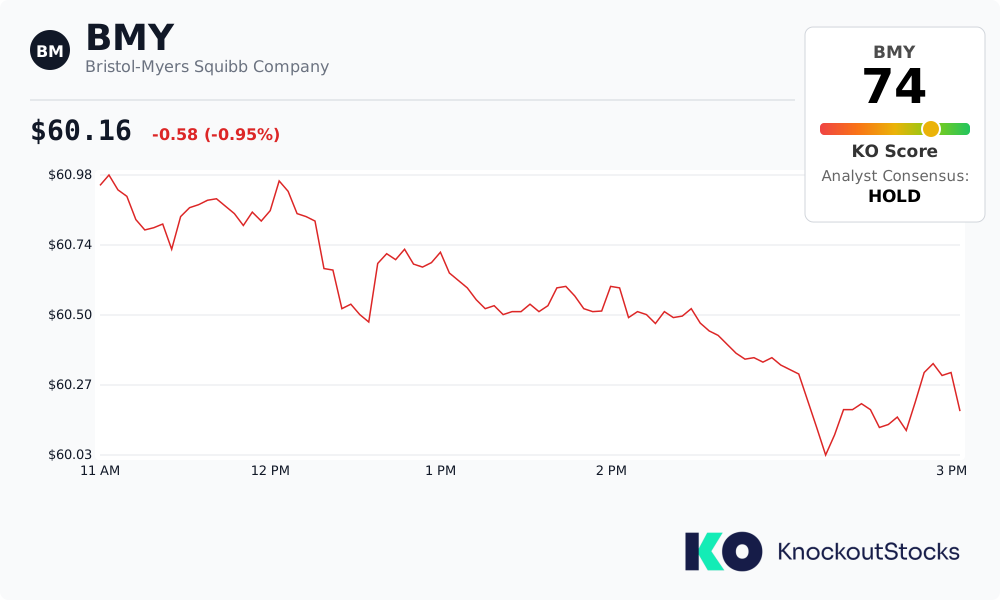 Bristol-Myers Squibb Company, BMY
This latest deployment expands upon a partnership initiated approximately three years earlier when BMS first introduced its original DGX SuperPOD. The initial system has proven its value by dramatically reducing the timeframe for AI-assisted target identification—transforming what once required weeks of manual analysis into days.
The Vera Rubin platform represents a significant computational advancement. According to Nvidia, it provides up to tenfold performance improvement per megawatt versus prior generations, enabling BMS to execute substantially more demanding AI operations without proportional increases in energy consumption.
Neither organization revealed specific financial details regarding the agreement.
Capabilities of the Enhanced Infrastructure
BMS intends to integrate both SuperPODs into one consolidated platform available to researchers at its facilities worldwide. This eliminates the previous constraint where only select specialists could access high-performance computing resources.
The unified system will enable diverse applications ranging from developing custom foundation models to executing agentic AI processes—autonomous workflows where AI agents independently manage tasks like target identification and validation with limited human oversight.
A particularly noteworthy element is BMS’s “Predict First” methodology. Rather than immediately synthesizing compounds and conducting laboratory testing, researchers leverage AI forecasting to identify promising candidates before any physical experimentation begins. This approach eliminates less viable programs early on, concentrating laboratory resources where success probability is highest.
The enhanced system will also enable scientists to explore broader chemical landscapes and execute more sophisticated molecular simulations.
BioNeMo Integration and Research Expansion
Under the expanded agreement, BMS receives access to Nvidia’s BioNeMo platform along with the BioNeMo Agent Toolkit—specialized software engineered for biological and pharmaceutical AI implementations.
This hardware-software integration enables researchers to execute predictions, construct agentic workflows and develop models leveraging BMS’s proprietary scientific datasets.
BMS has additionally utilized its current AI capabilities to broaden its portfolio of CELMoD compounds—specially designed molecules that selectively eliminate disease-causing proteins. These therapeutics are under investigation for blood cancers and additional conditions.
Research domains supported by the enhanced computing infrastructure encompass small molecule development, biologics, clinical implementations and digital twin technologies.
Greg Meyers, Chief Digital and Technology Officer at BMS, stated the organization has “made a deliberate bet on AI” and is witnessing tangible benefits throughout its development pipeline and business operations.
Robert Plenge, Chief Research Officer, articulated the objective succinctly: “It’s raising the probability that each program we advance is the right one.”
The post Bristol Myers Squibb (BMY) Doubles Down on Nvidia (NVDA) AI Tech for Drug Development appeared first on Blockonomi.

 𝐉𝐔𝐒𝐓 𝐈𝐍: Bristol Myers Squibb Expands AI Infrastructure With Nvidia DGX Vera Rubin –
  𝐊𝐞𝐲 𝐇𝐢𝐠𝐡𝐥𝐢𝐠𝐡𝐭𝐬: