Key Takeaways Broadcom stock advanced more than 1% on Tuesday, finishing at $389.32 Investor capital shifted from software to hardware following IBM’s disappointing Q2 guidance Morgan Stanley
Key Takeaways
- Broadcom stock advanced more than 1% on Tuesday, finishing at $389.32
- Investor capital shifted from software to hardware following IBM’s disappointing Q2 guidance
- Morgan Stanley’s Joseph Moore maintained his Buy rating with a $502 price target on AVGO
- Moore estimates Broadcom retains approximately 80% of Google’s TPU chip supply and expects that position to hold
- Analyst consensus rates AVGO as Strong Buy, with an average target of $513.29
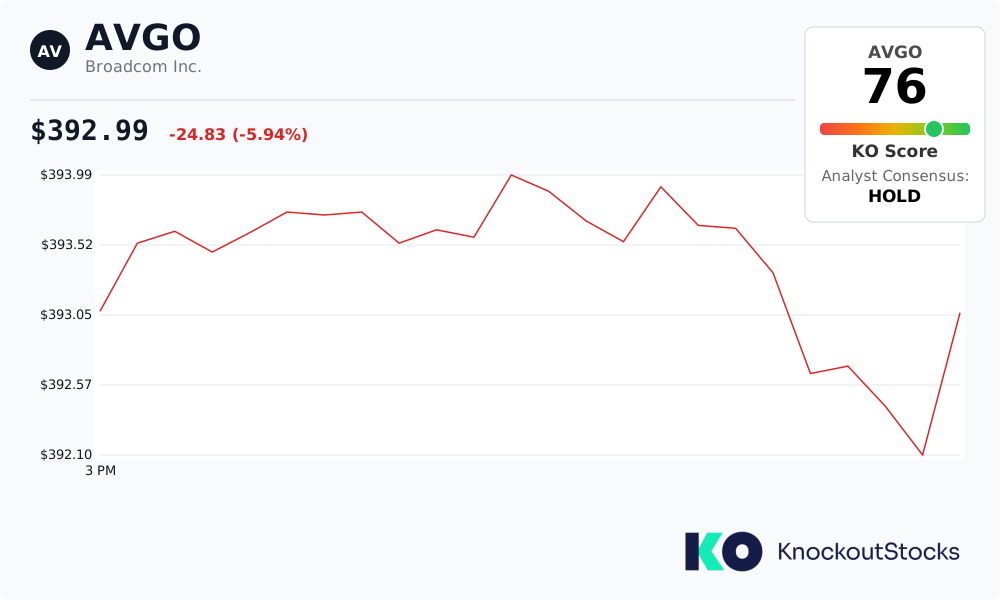
Broadcom (AVGO) finished Tuesday’s trading session with gains exceeding 1%, closing at $389.32, even as the broader technology sector showed weakness. The upward movement stemmed from two catalysts: capital flowing out of software names and a reaffirmed bullish outlook from Morgan Stanley.
 Broadcom Inc., AVGO
The exodus from software stocks began after IBM released preliminary Q2 results ahead of schedule. IBM’s management warned that both top-line revenue and adjusted net profit would fall short of Wall Street expectations.
CEO Arvind Krishna explained that enterprise clients were reallocating budgets away from software and into physical infrastructure—specifically storage solutions, memory modules, and server hardware. This reallocation strategy appears driven by efforts to secure capacity before anticipated price hikes linked to AI infrastructure expansion.
This capital redeployment brought hardware manufacturers like Broadcom into the spotlight. The semiconductor company produces specialized AI accelerators and networking chips designed for AI workloads, positioning it directly in line with this spending trend.
AVGO has delivered a modest 13% gain year-to-date, underperforming many semiconductor competitors. This relative weakness largely stems from ongoing questions about whether MediaTek will capture a larger portion of Google’s TPU chip business from Broadcom.
Morgan Stanley Maintains Conviction
Morgan Stanley’s Joseph Moore tackled this competitive concern head-on in his latest research note. He reaffirmed his Overweight (equivalent to Buy) stance on AVGO with a $502 target, asserting that “AVGO remains a core AI winner.”
Moore recognized that MediaTek has established a legitimate presence in Google’s TPU chip development. Google has strategic incentives to diversify its supplier base, and MediaTek represents a viable option for 3nm TPU production.
However, Moore remains unconvinced that this poses a material threat. He projects Broadcom will maintain roughly 80% of Google’s TPU supply business going forward. He characterized concerns about AVGO’s market share falling to 50% or facing complete displacement as “premature.”
His confidence rests on several factors: Broadcom’s superior access to high-bandwidth memory, advanced packaging expertise, and manufacturing scale that competitors cannot easily match in the near term.
Moore further highlighted that Broadcom has multiple new ASIC customers scheduled to accelerate production in the latter half of 2027. These emerging relationships provide growth drivers independent of the Google partnership.
Street Sentiment
Moore’s optimism reflects the broader Wall Street perspective. The analyst community rates AVGO as Strong Buy, with 23 Buy recommendations against only three Hold ratings.
The consensus price target stands at $513.29, suggesting approximately 32% upside potential from present trading levels.
Moore positions Broadcom as the second-most compelling AI semiconductor investment after Nvidia, citing its dominance in custom ASIC design and AI networking solutions.
Tuesday’s trading saw the stock fluctuate between $384.71 and $397.24. The 52-week range extends from $273.00 to $495.00, illustrating the significant pullback from recent peak valuations.
Morgan Stanley’s research update, dated July 15, 2026, represents the most recent analyst commentary on the stock.
The post Broadcom (AVGO) Stock: The Overlooked AI Chip Winner Analysts Are Backing appeared first on Blockonomi.