When telecom operators decide where to deploy towers, they face tough choices about quotas between urban and rural communities because of return-on-investment, sustainability, and security co
When telecom operators decide where to deploy towers, they face tough choices about quotas between urban and rural communities because of return-on-investment, sustainability, and security concerns. What then becomes of Nigerians in underserved communities when operators always decide otherwise?
The federal government is making a pivotal intervention to address these issues. Through the 3,700 telecom towers rollout for rural communities, the initiative, facilitated under the Nigeria Universal Communication Access Project (NUCAP), wants to bring 20 million Nigerians in rural communities back online.
Rural communities, having the highest connectivity divide, feature low population densities, lower purchasing power, and limited Average Revenue Per User (ARPU). Meanwhile, capital and operational expenditures remain the same as running the same tower in urban areas.
And this is where the real question lies.
 Minister of Communications, Innovation and Digital Economy, Bosun Tijani
While the project has seen its first tower deployment in Bendel, Abia State, the federal government, through the Minister of Communications, Innovation and Digital Economy, Dr Bosun Tijani, has yet to provide a clear answer on who maintains and shoulders the operational costs of these towers for sustainability.
“One of the fundamental challenges with extending telecommunications infrastructure into rural areas is the commercial viability of such investments,” Solomon Otema, a telecom expert with deep knowledge of telecom tower management, told Technext in a conversation.
“I believe the real challenge is not necessarily constructing the towers themselves but ensuring the long-term operational sustainability of the infrastructure,” he added.
Also Read: These 5 FG projects are set to roll out in October; here’s how they’ll affect the $1tn digital economy.
Who takes the operational responsibility?
The federal government does not have the operational capacity to run 3,700 towers in remote Nigeria. In fact, telecom operators and tower management companies such as IHS Towers, ATS and Indus Towers often struggle to prevent fibre optic cable, base stations and other telecom infrastructure from theft and vandalism in rural Nigeria.
The Federal Government is reportedly proposing to implement the project through a Special Purpose Vehicle (SPV), with the government retaining a majority equity stake. But the specific arrangements governing long-term operations and maintenance would ultimately depend on the commercial agreements established with participating entities.
Under this plan, the best bet for the federal government is to partner with mobile network operators (MNOs) and tower companies (TowerCos), where certain telecom towers remain under the ownership of the MNOs, and the TowerCos assume responsibility for managing and maintaining the infrastructure on their behalf in exchange for an agreed management fee.
“I would favour an arrangement where the government facilitates the initial investment and experienced private-sector operators assume long-term operational responsibility under clearly defined performance obligations,” Otema said, noting that the government should focus on facilitating investment and ensuring appropriate governance and accountability.
He added that the contractual framework should also clearly define responsibilities for routine maintenance, corrective interventions, security, power availability, major equipment replacement, and long-term asset renewal.
 Solomon Otema
Another concern is that the federal government didn’t mention the involvement of MNOs and TowerCos in the facilitation of this project, considering the fact that MTN, Airtel, and Globacom already possess established telecoms networks, spectrum resources, customer relationships, and experience delivering services across Nigeria.
“A project of this nature requires more than capital investment. It requires infrastructure deployment capabilities, telecommunications network integration, operational expertise, commercial arrangements, and long-term asset management,” Otema said.
In fact, their participation, particularly from the planning and design stages, would be important in ensuring that the proposed infrastructure locations align with network expansion requirements and can be effectively integrated into operational telecoms networks.
Measuring the 3,700 towers’ success
Historically, Nigerian infrastructure projects stall or even stumble when transitioning beyond Phase 1. A similar rural connectivity project, initiated in 2001 under the National Rural Telephony Project (NRTP), didn’t go beyond the planning and execution stage as it suffered from poor design and a lack of proper oversight.
If this project performs differently, Otema suggests that the measure of its success should not simply be whether 3,700 towers have been constructed, but whether the investment has delivered the value it was intended to create.
Last week, Bosun Tijani unveiled the infrastructure roadmap to deploy 1,989 new towers across 436 local government areas (LGAs), tagged as the initial phase as part of the 3,700 towers, and has already launched the first in Bende, Abia State. With the entire project expected to be completed by 2028, fingers are crossed on the success rate and the government’s ability to ensure adequate completion.
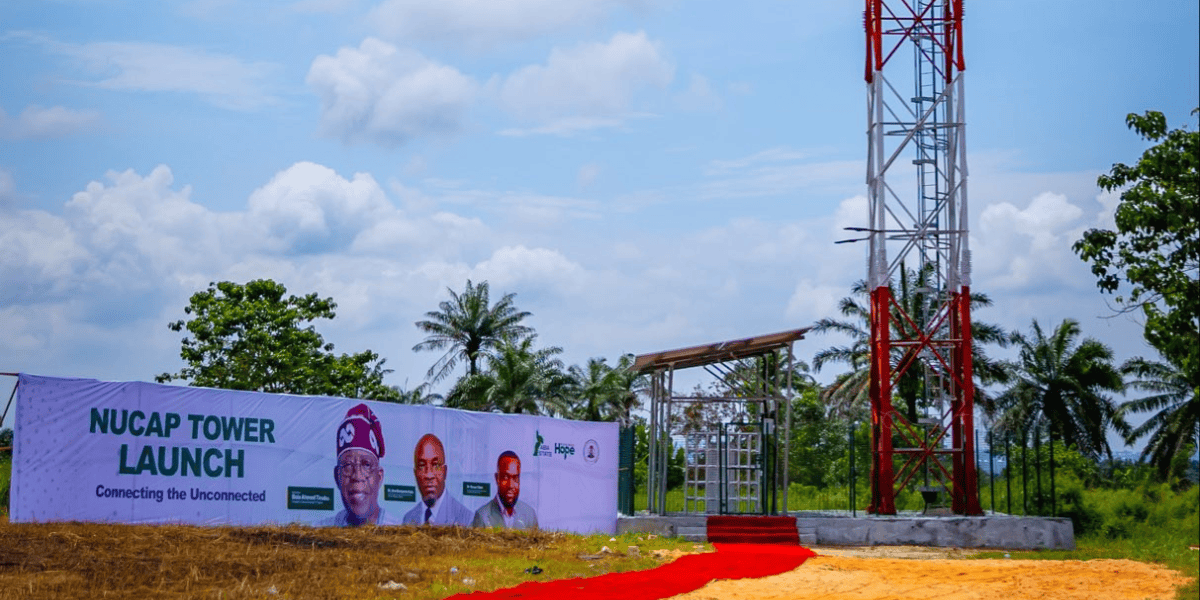
The 3,700 towers’ first site in Umuorie village, Bende Local Government Area, Abia State. (IM: ‘Bosun Tijani).
Aside from measuring the complete delivery, Otema believes value creation from this infrastructure should be a priority. According to him, the project should be measured by three key performance indicators: infrastructure outputs, connectivity outcomes, and broader socioeconomic impact.
He noted that a project could successfully construct all 3,700 telecoms towers within the approved timelines and budget, and on that basis be considered successful. “However, if a significant proportion of those towers are not delivering reliable connectivity to the intended communities, one would have to question whether the project has actually achieved its objectives,” he added.
Quality-driven metrics will then measure the proportion of sites carrying live telecoms traffic, network availability, service quality, and the number of previously underserved people who have gained access to reliable connectivity.
Also Read: Before the 3,700 telecom towers: Here’s what happened to Nigeria’s previous rural connectivity projects
Smartphone affordability and digital literacy pose a threat
Amid these success indicators, what happens when people have the network and are unable to utilise it?
While extending network coverage to a rural community could improve access to market information, facilitate financial transactions, enable communication between businesses and customers, and help farmers obtain necessary insights, the extent to which these opportunities translate into measurable economic benefits still depends on smartphone affordability and digital literacy.
A GSMA report shows that about 140 million Nigerians are in a usage gap. Meaning that these people are within the coverage map, but unable to access internet services due to affordability constraints, among others.

Despite these challenges, Otema noted that it wouldn’t suggest that basic connectivity has no value in the absence of smartphones or advanced digital literacy. Even access to reliable voice and basic messaging services can deliver meaningful social and economic benefits, particularly in communities that previously had limited or no telecoms coverage.
However, the headline objective of the 3,700 telecom tower project is to provide network and internet access to 20 million Nigerians.
But “the objective should not merely be to connect 20 million people, but to ensure that connecting those 20 million people creates meaningful and sustainable economic value,” Otema noted.