Buying Bitcoin with Paysafecard is possible, but almost never directly: hardly any regulated crypto exchange accepts the 16-digit prepaid code as a means of payment. The clean route runs thro
Buying Bitcoin with Paysafecard is possible, but almost never directly: hardly any regulated crypto exchange accepts the 16-digit prepaid code as a means of payment. The clean route runs through your own Paysafecard account and the PaysafeWallet, and from there by SEPA transfer or debit card to an exchange authorised under MiCA. If you hand codes to exchange services or private sellers instead, you often pay steep mark-ups and lose all protection should anything go wrong.
There is an understandable reason behind the search. For many people Paysafecard is digital cash: you buy the code at a petrol station or a kiosk, pay in notes and coins, and need neither a bank account nor a credit card. That very feature clashes with buying Bitcoin from a licensed provider, because the provider has to know who is buying from it. This guide sets out which routes exist, what they cost and where their limits lie.
Paysafecard at a crypto exchange: an anonymous prepaid code meets anti-money-laundering rules
Paysafecard is an e-money product. It is issued by Paysafe Prepaid Services Limited, based in Dublin, which says it is supervised by the Central Bank of Ireland. E-money is a monetary value stored electronically, issued by a supervised institution in return for a deposit and accepted as a means of payment. The prepaid code itself carries no name. That is convenient at the till, but a problem for any exchange.
Since the EU's Markets in Crypto-Assets Regulation, MiCA, took full effect, providers of crypto services in the EU need authorisation as a CASP, short for crypto-asset service provider. An authorised CASP has to identify its customers before they trade, and it must be able to trace where deposits come from. An anonymous voucher code hardly fits into this framework. Many exchanges therefore do not offer Paysafecard at all and rely on SEPA transfers, cards, PayPal or instant bank payments instead.
A provider that sells you Bitcoin for a code without any identification is consequently almost always operating outside this framework. Whether a company holds an authorisation can be looked up in the register linked on the MiCA page of the European Securities and Markets Authority, ESMA. In Germany, the financial regulator BaFin also maintains a company database.
Paysafecard limits 2026: €50 per payment and a €4 fee from the second month
Before you even think about Bitcoin, it is worth looking at the terms of the code itself. According to Paysafecard's page on fees and limits, the following applies in Germany:
- Without registration you can pay at most €50 per payment, even if the code is worth €100.
- Codes are sold in shops in denominations of €10, €15, €20, €25, €30, €50 and €100.
- An unregistered code starts costing money from the second month: once 30 days have passed since purchase, Paysafecard deducts a monthly fee of €4 from the balance.
- If you have a remaining balance paid back to you, you lose 5 percent of the amount, capped at €5 per refund.
- A registered Paysafecard account costs €2 a month only from the 13th month onwards, and only if you have made no transaction for twelve months.
The monthly fee of €4 looks small, but it eats into the balance quickly. A €100 code left lying in a drawer for three months is worth only €88. After a year it is down to €52. The chart further below shows how the value declines compared with a registered account.
KYC when buying Bitcoin with Paysafecard: no licensed exchange will let you in without ID
KYC stands for "Know Your Customer" and refers to the identity check that banks and crypto service providers require before the first transaction. It usually takes place by video call or with a photo of your identity document and your face. For buying Bitcoin with Paysafecard, this means that at most the route to the code remains anonymous, never the purchase from a licensed provider. Anyone who accepts this has two clean routes available. Anyone unwilling to do so ends up with exchange services or private trading, and that is where the risks begin.
Even at Paysafecard itself you need an account to pay more than €50 per transaction. The higher limits of the "Unlimited" tier require additional verification, which according to Paysafecard sales partners involves an identity document. According to Paysafecard, the limits for gifting balance between accounts are €150 per transaction in a standard account and €300 in a verified account.
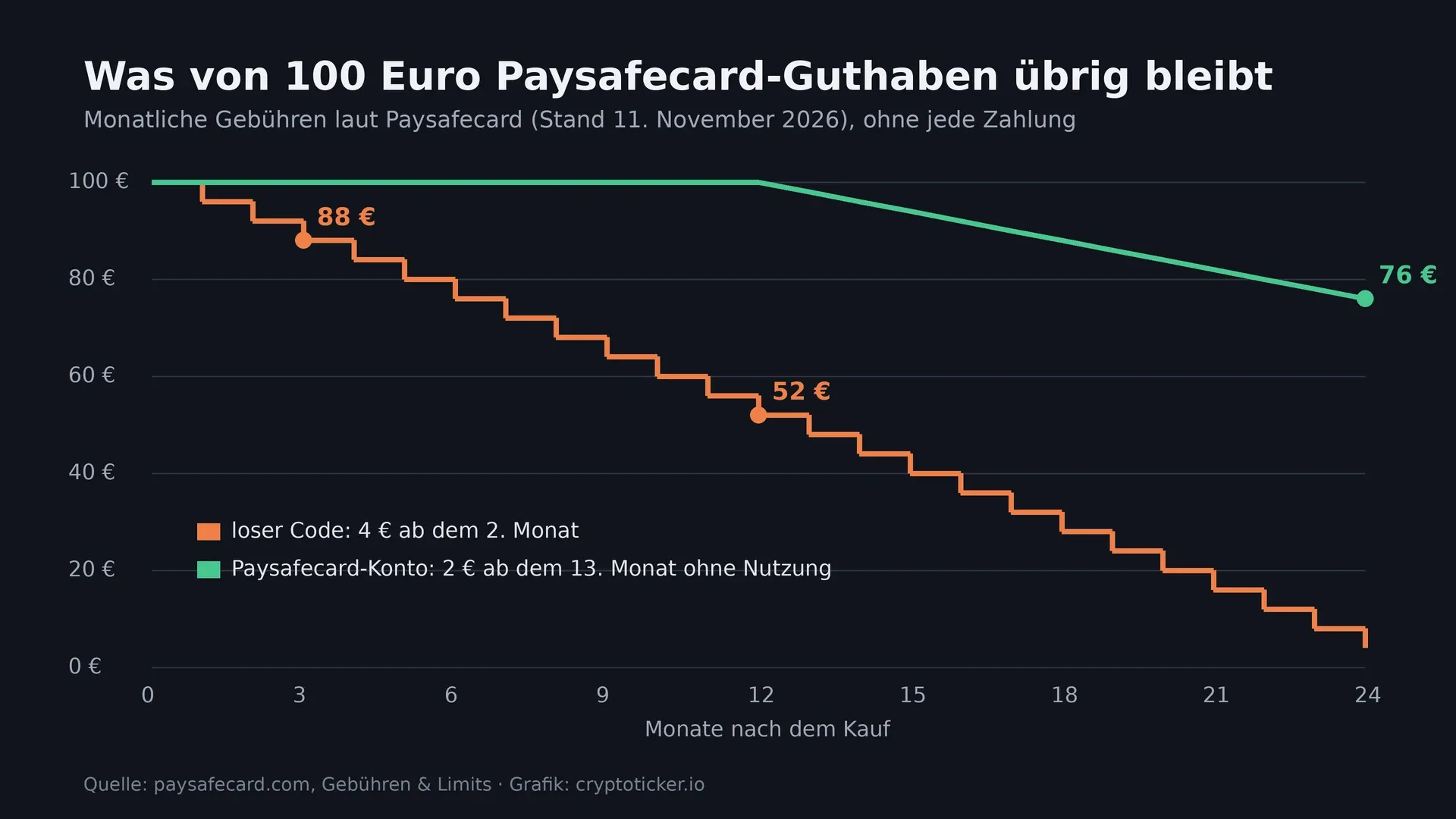
A prepaid code loses value month after month for as long as it is not held in an account.
PaysafeWallet and SEPA transfer: the regulated route from Paysafecard to a crypto exchange
The PaysafeWallet used to be called "Account & Card" and is Paysafecard's account solution. You log in to your Paysafecard account, activate the wallet and top it up with your codes or by SEPA transfer. According to Paysafecard, you can send and receive money within the euro area from the wallet and pay with a debit Mastercard.
This produces the route with the fewest intermediate stops:
- Open a Paysafecard account and have it verified.
- Load the codes into the account so that the €4 fee for loose codes does not apply.
- Activate the PaysafeWallet and send the balance by SEPA transfer to your crypto exchange.
- Buy Bitcoin on the exchange and, if you wish, move it to a wallet of your own.
Most exchanges only accept transfers from an account held in your own name. Before making the first transfer, look in your exchange's help section to see whether it accepts deposits from e-money accounts. Which providers credit euro transfers cheaply and sell Bitcoin at low spreads is shown in our comparison of the ways to buy Bitcoin.
Paysafe Mastercard as a payment method: buying Bitcoin by debit card
The second option uses the PaysafeWallet's debit Mastercard. In the free "Start" plan, Paysafecard says you get a virtual card, each card payment costs €0.10 and payments in foreign currencies incur a charge of 2 percent. In the "Plus" plan, which costs €36 a year, card payments are free of charge, foreign currency costs 1 percent and you also receive a physical card.
Many exchanges and brokers accept Mastercard. There, however, the surcharge for card payments is added on top, which the exchange sets itself and which is usually well above the cost of a bank transfer. We have worked out how large the difference can be using the example of credit cards: buying Bitcoin with a credit card. Prepaid and virtual cards are, moreover, not accepted everywhere. If the payment is made in dollars, the wallet's currency conversion surcharge applies as well.
For small amounts the card is convenient. For regular purchases a transfer is almost always cheaper. If you already have a current account, a neobank with crypto trading or buying via PayPal will often get you there faster and more cheaply than the detour via prepaid codes.
Crypto voucher dealers for Paysafecard: mark-ups and the question of MiCA authorisation
Online, exchange services advertise that they will swap Paysafecard directly for Bitcoin. You enter the code, provide a wallet address and are sent Bitcoin in return. That sounds simple, but it comes with three catches that you should be aware of beforehand.
The first catch is the price. The service bears the risk that a code was stolen or obtained through fraud, and it passes that risk on in the rate. Older guide pages report deductions of up to 20 percent on the redeemed balance. The second catch is authorisation: whether the service is authorised as a CASP in the EU is shown in the ESMA register, not on its advertising page. The third catch concerns the legal position of the code itself. Paysafecard expressly advises entering codes only at authorised web shops, meaning merchants that have officially integrated Paysafecard as a payment method.
If you are still considering this route, first establish whether the service appears on the list of Paysafecard web shops and whether it is listed in an EU register. If neither is the case, the code is in all likelihood gone, and nobody is liable to you for it.
The PaysafeWallet debit card is the second regulated route from prepaid balance to an exchange.
P2P trading with Paysafecard codes: a code once passed on is lost
P2P trading (peer-to-peer) means that two private individuals trade directly with each other, often through a platform that merely acts as an intermediary. Offers to sell Bitcoin in exchange for Paysafecard codes keep appearing there. For you as a buyer, this is the riskiest route of all.
A Paysafecard code works like a banknote. Anyone who knows the 16 digits can spend the balance. If you send the code to a seller who then delivers no Bitcoin, there is no chargeback of the kind available with a direct debit or a credit card. Conversely, many honest sellers avoid Paysafecard because they can never be sure whether a code originates from fraud and will later be blocked. What remains are, strikingly often, offers with a high premium or of unclear origin.
Paysafecard scams: fake authorities, voucher tricks and counterfeit exchanges
On its own security page, Paysafecard warns about recurring scams. Authorities, institutions, lawyers or courts never demand payment by Paysafecard. If you are asked by phone or email to settle a fine or a reminder fee with codes, you are dealing with fraudsters. According to Paysafecard, the codes also cannot be hacked or multiplied with a generator; offers that promise exactly that are themselves the trap.
In the crypto world, two further variants are added. The first is the fake exchange that lures you with free Bitcoin or a bonus and demands a Paysafecard code as a "fee" for the withdrawal. The second is the supposed support team that contacts you about an alleged problem with your account and wants the codes for "unlocking" it. The same rule applies in both cases: never pass on the code by chat, phone or email. If you have already done so, have the balance blocked immediately through Paysafecard customer service and report the matter to the police.
Depending on the country in which you live, gains from selling or swapping Bitcoin may be taxable, regardless of whether you paid with Paysafecard, a card or a bank transfer.
Bitcoin bought with Paysafecard: exchange account or your own wallet
If the Bitcoin stay on the exchange, the provider holds them in custody for you. With an authorised CASP this is regulated, as it must keep client assets separate. If you want to hold larger amounts for years, you will often move them to a wallet of your own. A hardware wallet is a small device that stores the private keys offline, so that they never leave a device connected to the internet. For amounts that go beyond a few Paysafecard codes, this is the usual solution.
With small sums, the network fee for the transfer can weigh noticeably on the result. Before withdrawing, therefore, work out what share of your purchase will go on the fee, and preferably bundle several purchases into a single withdrawal.
Bitcoin with Paysafecard: without ID, the route ends at €50
Buying Bitcoin with Paysafecard is possible if you take the detour via a verified account. The direct, anonymous variant almost always leads to unregulated services or private individuals. Working through the steps below one after another keeps you with providers that are subject to supervision.
- Choose how to buy: compare whether a bank transfer, a card or PayPal works out cheaper for you than the detour via prepaid codes, in our comparison of the ways to buy Bitcoin.
- Find an authorised exchange: make sure your exchange holds MiCA authorisation and accepts deposits from e-money accounts, for instance with the help of our overview of regulated crypto exchanges.
- Settle custody: decide before buying whether the Bitcoin will stay on the exchange or move to a wallet of your own, and compare the available hardware wallets for that purpose.
(As of November 11, 2026. This article is not investment advice. Prices and fee structures change; check the terms with the provider before you buy.)