No, you cannot buy Bitcoin at PayPal itself in Germany. Buying is still possible, only by way of a detour: several regulated trading venues accept PayPal as a deposit method, and the trade it
No, you cannot buy Bitcoin at PayPal itself in Germany. Buying is still possible, only by way of a detour: several regulated trading venues accept PayPal as a deposit method, and the trade itself then takes place on the exchange. The distinction sounds like a technicality, but it determines who holds your money, which fee applies and from what point you are allowed to move the coins you bought.
This article answers the question for German investors with real figures rather than marketing promises: what the payment route costs, which withdrawal hold follows it, which protection you explicitly do not get and what changes on the tax side. By the end you will know when PayPal is the more convenient route and when it simply becomes too expensive.
Can you buy Bitcoin with PayPal? The short answer for Germany
PayPal runs its own crypto service in several countries: users buy, hold and sell coins directly in the PayPal app, without ever opening an account at an exchange. Germany is not one of them. An in-house check on September 22, 2026 shows this clearly: the crypto product page on PayPal's US site responds with HTTP 200, the British one does the same, while the German address returns HTTP 404. There is simply no product here for such a page to point to.
What does work in Germany is the second route: PayPal as a means of payment at a crypto service provider. You top up your account at a trading platform in euros via PayPal and buy Bitcoin there. In this setup PayPal is a payment rail and not a dealer in crypto assets. The contract covering the coins is concluded with the exchange, not with PayPal.
What a payment service is, and what a crypto asset service provider is
Payment service means: the company moves money between two parties and holds it briefly, but does not itself deal in the goods being bought. Crypto asset service provider, referred to as a CASP in the EU's MiCA regulation, means: the company is allowed to exchange, hold and transfer crypto assets for clients and needs its own authorisation to do so. PayPal acts towards you in the first role, the exchange in the second. Confusing the two means looking to the wrong party for help when a dispute arises.
Why PayPal does not sell coins in Germany
The reason lies in the authorisation. Anyone who commercially exchanges or holds crypto assets for clients in the European Union has needed a licence as a crypto asset service provider since MiCA took full effect, granted by a national supervisor and then usable across the EU. A payment services licence is not sufficient for that, even though it is valid throughout Europe.
For you as a buyer this has a pleasant side effect. Because the trade takes place at an authorised exchange, the MiCA obligations apply there: segregation of client funds, disclosure requirements on fees and risks, a complaints office and a named supervisor. Settling the same transaction through an unregulated provider merely because it accepts PayPal would be the worse trade-off.
The cases in which PayPal does appear in crypto after all
Three things are regularly mixed up. The first case is the in-app trading service described above, which does not exist in Germany. The second is PayPal's own stablecoin, a token pegged to the US dollar and issued by an American trustee, which is likewise not part of the German offering. The third case is the deposit at an exchange, which is what this article is about. Only the third case concerns you if you want to buy Bitcoin in Germany today.
How it works in three steps: deposit, purchase, custody
The route is shorter than the preamble suggests, and it breaks down into three clearly separate processes.
First, the deposit. You open an account at a trading platform, complete the identity check with an ID document and a video match, and select PayPal as the method when topping up. The money lands as a euro balance in your exchange account, usually within seconds. At that point you have not bought anything yet.
Second, the purchase. Only now do you place an order. Anyone using the trading view instead of the convenient instant-buy button pays noticeably less in trading fees at most providers for exactly the same amount of Bitcoin. Which venue offers which payment route and what it charges for it changes frequently; our comparison of providers with PayPal deposits keeps track of the current state.
Third, custody. After the purchase the coins sit with the exchange. If you want to move them to your own wallet, this is exactly where you run into the withdrawal hold, which gets its own section further down.
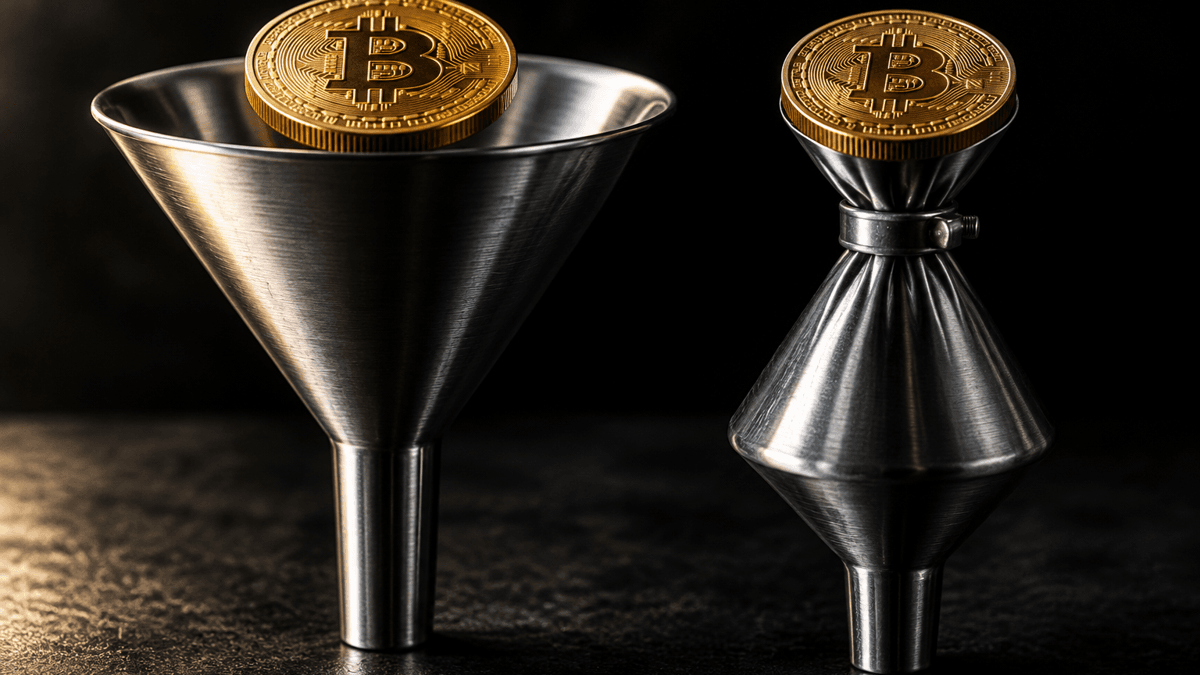
The same purchase amount, two deposit routes: via SEPA it arrives in full, via PayPal the processing fee narrows it.
Fee information in guides goes stale quickly, so here is a look at a primary source. The exchange Kraken publishes its deposit routes per currency. For the euro, PayPal is available there across the entire European Economic Area, with a minimum of one euro and a credit described as near-instant. As a fee, the table names no fixed percentage but processing fees, noting that these depend on the region and are displayed on the final confirmation screen (Kraken, cash deposit options and fees, accessed on September 22, 2026).
The comparison within the same table is the actual finding. Every SEPA deposit route is listed there with a minimum of one euro, the entry free and a duration of zero to three business days. Card payments in the European Economic Area cost 0.25 euros plus 3.75 percent according to the same overview. PayPal sits between these two poles and is therefore more expensive than the free bank transfer, but not automatically as expensive as the card.
Always calculate the surcharge on the purchase amount, not on the gain
A surcharge of 2 percent on 500 euros is 10 euros. That sounds harmless, but at a venue charging 0.25 percent in trading fees it amounts to eight times what the purchase itself costs. Anyone buying more every month pays that surcharge again each time. For a one-off acquisition it hardly matters; across years of a savings plan it adds up to a line item of its own.
Chargebacks and account freezes: the underrated risk
PayPal is known in retail as a convenient right of return. If goods fail to arrive, you open a dispute and get your money back. That very reflex becomes a problem when buying crypto, because it is applied to a transaction that cannot be unwound.
A Bitcoin transfer is final. Once the transaction is confirmed in a block, nobody can claw it back, neither the exchange nor a court. If the underlying euro payment is reversed afterwards, the exchange is left short and recovers the amount from the customer. In practice that means frozen accounts, blocked balances and, in the worst case, a claim that exceeds the original purchase amount.
The rule that follows from this
Use PayPal for crypto purchases only with your own funded balance or a linked bank account that unquestionably covers the amount. Never trigger a buyer protection claim or a chargeback for a deposit that has already led to a purchase. And do not finance crypto purchases through a credit line you cannot settle in the same month.
No buyer protection for financial products: what PayPal itself excludes
Many buyers assume that PayPal buyer protection accompanies every payment. The terms say otherwise. The list of items and transactions expressly excluded from protection includes, alongside real estate, vehicles and cash equivalents, financial products or investments as well as payments relating to gold (whether in physical or exchange-traded form). This version is dated April 15, 2025 (PayPal buyer protection, terms, accessed on September 22, 2026).
A crypto asset is an investment, not a parcel that arrives late. Anyone making a deposit in order to buy Bitcoin is therefore moving outside the protective scope on which PayPal's reputation in online retail is built. The protection that does apply comes from the regulation of the exchange: segregated client funds, disclosure requirements and a competent supervisor.
What still helps in a dispute
Document every deposit with the date, the amount and the reference number, and save the confirmation screen as a PDF. If a dispute with the exchange arises, the provider's complaints office is the first port of call and the competent supervisory authority the second. For a platform authorised in Germany that is BaFin; for an authorisation from another EU state, the authority there.
MiCA and BaFin: how to check the exchange's authorisation
The payment route says nothing about how reputable the trading venue is. The fact that a provider accepts PayPal is not a seal of approval, because the integration can just as easily be built in by a platform that is not allowed to offer services in the EU at all. The check takes two minutes and beats any rating in a forum.
Look up the company name in the public register of the European securities regulator ESMA, which lists every crypto asset service provider authorised under MiCA across the Union. For providers with a German licence you can additionally consult BaFin's company database. What matters is a match of the full company name including its legal form, not just the brand name on the website. Which trading venues can show an authorisation and how their terms differ is brought together in our overview of crypto exchanges.
Three warning signs that should stop the deposit
A provider that does not appear in the register and instead advertises a licence from a third country does not belong on your shortlist. The same applies to platforms that will only accept a deposit to a private bank account or via PayPal's friends and family function, because that bypasses every check. And anyone promising you a guaranteed return is not running a trading venue but a marketing campaign with other people's money.
Bought is not the same as available: after a PayPal deposit, the balance at Kraken is excluded from withdrawal for 72 hours.
The 72-hour hold: when you can move your Bitcoin to your own wallet
This point is missing from almost every comparison, and it is the most important one in practice. In the same Kraken table, next to the PayPal deposit, there is a column headed withdrawal hold, and for PayPal it shows a value of 72 hours. For every SEPA route the entry reads none.
A withdrawal hold is a period during which a deposited amount can be traded but not taken off the platform. It is how the exchange protects itself against exactly the chargeback described in the previous section. For you that means: after a PayPal deposit on Friday evening you can buy straight away, but you cannot transfer your coins to your own wallet before Monday evening.
Why three days on the exchange are a risk
As long as the coins sit with the provider, the corresponding keys are not yours. In the event of insolvency, a breach of the systems or a freeze ordered by an authority, your holdings depend on the state of the company. Three days are short, but they coincide with the moment when freshly bought amounts are typically at their largest. If you plan to hold the assets yourself anyway, choose the payment route by how quickly it releases them again.
Tax: the payment route does not change the holding period, but the fee changes the gain
In Germany, crypto assets held privately count as other economic assets. A sale therefore falls under private disposal transactions pursuant to Section 23 of the Income Tax Act. Two rules follow from this, and they apply regardless of whether you deposited by bank transfer, card or PayPal.
The holding period. If more than twelve months lie between acquisition and disposal, the gain remains tax-free. What counts is the moment of the purchase on the exchange, not the moment of the deposit. If you top up today and only buy in two weeks, the clock also starts only in two weeks.
The exemption limit. Within the one-year period, gains from all private disposal transactions in a given year remain tax-free up to 1,000 euros. The term exemption limit is to be taken literally: if the amount is exceeded by as little as one euro, the entire gain becomes taxable, not just the excess.
The PayPal fee lowers your taxable gain
Incidental acquisition costs form part of the acquisition costs. The surcharge PayPal charges for the deposit therefore increases the acquisition costs and reduces the later gain by the same amount. The prerequisite is evidence that ties the fee to the specific purchase. So file the statements monthly as PDFs, together with the exchange's trade history. Which amounts end up on which form is decided only when the tax return is filed, and until then a complete folder is worth more than any after-the-fact reconstruction.
The tax office sees more than it used to
Under the European reporting obligation for crypto asset service providers, authorised platforms report client data and transaction totals to the tax administration, which exchanges them between member states. The assumption that a purchase via a payment service stays invisible therefore comes to nothing: the reporting happens at the crypto asset service provider, and it knows your identity from the account opening.
PayPal or SEPA transfer? The maths for small and large amounts
There is no universal answer, but there is a workable rule of thumb along two questions: how urgent is the purchase, and how large is the amount?
For small, spontaneous amounts up to around 200 euros, there is a case for PayPal. The surcharge stays small in absolute terms, the credit arrives within seconds, and the three-day withdrawal hold barely matters if the amount is staying on the exchange anyway.
For larger amounts from around 1,000 euros the maths tips over. Two percent on 5,000 euros is 100 euros that permanently disappear from your holdings. A SEPA instant transfer is free at many providers, arrives within seconds depending on the bank, and brings no hold with it.
For regular purchases the case is clearest. A savings plan running twelve times a year via PayPal pays the surcharge twelve times. Over five years at 200 euros a month, that is around 240 euros at 2 percent, without a single additional service being rendered in return.
Frequently asked questions about buying Bitcoin with PayPal
Can I transfer Bitcoin bought with PayPal to a hardware wallet?
Yes, as soon as the exchange's withdrawal hold has expired. Technically the coins are in no way different from those funded by bank transfer. The payment route affects only the waiting period, not the coins.
Is there a minimum amount?
At Kraken the lower limit for a PayPal deposit is one euro according to the fee overview cited above. The minimum order size for trading is separate from that and is higher depending on the venue and the trading pair.
Is buying via PayPal anonymous?
No. Every authorised trading platform in the EU has to identify its customers before it exchanges or holds crypto assets. A payment service as an intermediate step changes nothing about that; it merely adds another station to the process that is kept under your name.
What happens if there is a chargeback problem after the purchase?
The exchange offsets the shortfall against your balance and freezes the account until the matter is resolved. If the balance is not enough, an outstanding claim remains. That is why the funding of the PayPal account should be checked before every deposit.
Is PayPal worth it if I intend to sell straight away?
Rarely. You pay the deposit surcharge, plus trading fees twice for the purchase and the sale, and the gain within one year is taxable above the exemption limit. Short-term back and forth only carries this chain of costs when price moves are substantial.
Buying Bitcoin with PayPal: what to take away
- Check the trading venue first, then the payment route. The provider has to appear in ESMA's MiCA register or in BaFin's company database, with its full company name. Only after that is it worth looking at the terms, as our overview of crypto exchanges allows you to do.
- Work out the surcharge before you confirm. The fee appears on the final confirmation screen. If it is above 2 percent and the purchase is not urgent, take the free SEPA transfer. With PayPal, plan for the 72-hour hold and decide in advance where the coins should go afterwards; which device is suited to that is shown by our hardware wallet comparison.
- Start your records with the first purchase. Deposit receipt, fee statement and trade history belong together in one folder per year, because the fee only lowers your taxable gain if you can prove it. The tools in our comparison of tax tools and portfolio trackers take most of that work off your hands.
(As of September 22, 2026. This article is not investment advice. Prices and fee structures change; check the terms with the provider before you buy.)