Anyone looking to buy Hedera today needs three things: a venue with a genuine euro pair, the fee on the chosen order route, and a place to store it afterwards. All three can be settled before
Anyone looking to buy Hedera today needs three things: a venue with a genuine euro pair, the fee on the chosen order route, and a place to store it afterwards. All three can be settled before the first click. HBAR, the unit of the Hedera network, cost 0.067658 euros in the early hours of October 29; according to CoinGecko data that is 0.075356 US dollars and a market value of around 3.0 billion euros, rank 32. How the price moves from here is tracked continuously in our Hedera price prediction.
Also documented: five reachable venues quoted an HBAR-euro pair within the same hour, and the gap between bid and ask was under a twentieth of a percent at all of them. The difference that ultimately decides the quantity therefore does not come from the market, but from the order route and the fee your provider charges for it.
HBAR is a utility token, not a stake in the network
Hedera is a public network for transactions and data attestations, and HBAR is the unit used to pay inside it. A utility token is a token whose only built-in purpose is access to a network's services, not a participation in its operator. That is exactly how Hedera describes HBAR on its own overview page: as access to the services of the network.
For holders, that means you acquire no stake in a company, no vote over its business and no claim on profit. The network is governed by the Hedera Council, a body of 31 members from eleven industries according to the same page, 16 of them Fortune 500 companies. That body also sets the rate at which staking rewards are paid out. Hold HBAR and you hold a network unit whose rules are made elsewhere. That is neither a weakness nor an advantage; it is the property that separates it from a share.
0.0677 euros: the price sits 39 percent below where it stood a month ago
The starting position belongs in a purchase decision, even though it says nothing about tomorrow. Measured in the early hours of October 29 through CoinGecko market data, HBAR stood at 0.067658 euros. Over 24 hours that was 0.6 percent lower, over seven days 11.5 percent, over 30 days 39.1 percent. Against where it stood a year ago, 61.8 percent is missing; against the all-time high of 0.4813 euros from September 15, 2021, 85.9 percent is missing.
A decline of 39 percent inside a month counts as a correction on the usual reading, and it is not confined to HBAR. We described the most recent occasion of our own on October 25, when assets held in Hedera funds fell: Hedera under pressure. Conversely, the jump after the IBM listing of September 28 shows how quickly the direction can turn. None of that changes the buying route; it does change what to expect of an entry price. Buy in a week with a double-digit loss and a total loss belongs in the calculation as a possibility.
Five venues quote HBAR against the euro
For this article we queried the providers' public price pages ourselves overnight into October 29. Five venues that can be reached from Europe quoted an HBAR-euro pair: Kraken, Bitvavo, Bitstamp, Coinbase and Bitpanda. A euro pair matters more than it sounds. Without one, the purchase runs through a detour, usually a dollar stablecoin, and then you pay the fee twice: once converting euros into the stablecoin and once buying HBAR.
The bid-ask spread, the distance between the best buying and the best selling offer in the order book, was 0.03 percent at Kraken, 0.04 percent at Bitvavo and 0.05 percent at Bitstamp. That is tight. The difference was far clearer in trading volume: Bitvavo reported 11.16 million HBAR over 24 hours, Kraken 5.28 million across 2,959 trades, Bitstamp 473,846 units. Between the thinnest and the thickest book lies a factor of 23. For an order of 100 euros that makes no difference; for one of 50,000 euros it very much does, because a large order clears a thin book upwards.

Several stages sit between your euro and the first HBAR in the account, and each one keeps a small part back.
Spread and order fee: 100 euros counted out in HBAR
The spread in the order book is the smaller item. The larger one is the fee, and that depends on which button you press. Kraken's own fee overview names 0.40 percent for the lowest volume tier in spot trading for an order that rests in the book, and 0.80 percent for an order executed immediately against the book. For the convenient instant purchase it lists 1 percent, and for individually assembled orders 1.5 percent.
Calculated on the ask price of 0.06757 euros that we measured, that means the following for a stake of 100 euros:
- Order rests in the book, 0.40 percent: 99.60 euros are invested, which comes to around 1,474 HBAR.
- Order is executed immediately, 0.80 percent: 99.20 euros, around 1,468 HBAR.
- Instant purchase, 1 percent: 99.00 euros, around 1,465 HBAR.
- Individual order, 1.5 percent: 98.50 euros, around 1,458 HBAR.
Between the cheapest and the most expensive variant at the same provider lie 16 HBAR, or 1.1 percent. That sounds like little, and it is the price of convenience, which you pay again on every top-up. Buy twelve times a year for 100 euros and the expensive route gives away the equivalent of a good half of one monthly contribution. Which providers run which tiers is collected in our overview of the best crypto exchanges. Terms change; read them at the provider itself before buying.
How to check the MiCA authorisation in the ESMA register
Since the European regulation on markets in crypto-assets took effect, a provider may only offer crypto services in the EU with an authorisation as a crypto-asset service provider. The authorisation is granted by one member state's supervisor and then applies across the whole union. What binds is solely the entry in the public register maintained by the European securities regulator ESMA, and not the advertising on a provider's home page.
The route there is short. Search the register for the name of the legal entity, not the brand name: it appears in the provider's imprint or terms of use and is often different from the app. Then compare whether the company you found is the same one you are entering the contract with, and which services it is permitted to offer. What the regulation demands of companies and which deadlines apply we have assembled on our page on the MiCA licence and its obligations.
One note on interpretation: an authorisation is a supervisory permission, not a deposit guarantee and not a promise about the price. The entry documents that a provider is supervised and has to follow rules on segregating client funds. About the price of HBAR it says nothing.
The network fee is set in dollars and paid in HBAR
Here lies the quirk that separates Hedera from most networks and that rarely turns up in buying guides. On most blockchains the transaction fee fluctuates with load and with the price of the network unit. Hedera instead sets its fees in US dollars, starting at 0.0001 dollars per transaction, and converts that amount into HBAR at the moment of the transaction. That is how the network's overview page puts it.
The consequence is uncomfortably symmetrical. If the HBAR price falls, the same transfer costs more units but the same number of cents. If it rises, it costs fewer units and again the same number of cents. For buyers that is mostly good news: the cost of moving coins from the exchange into your own custody stays predictable even if the price halves. Anyone holding HBAR in order to pay with it, by contrast, should know that a falling price burns through the balance faster.
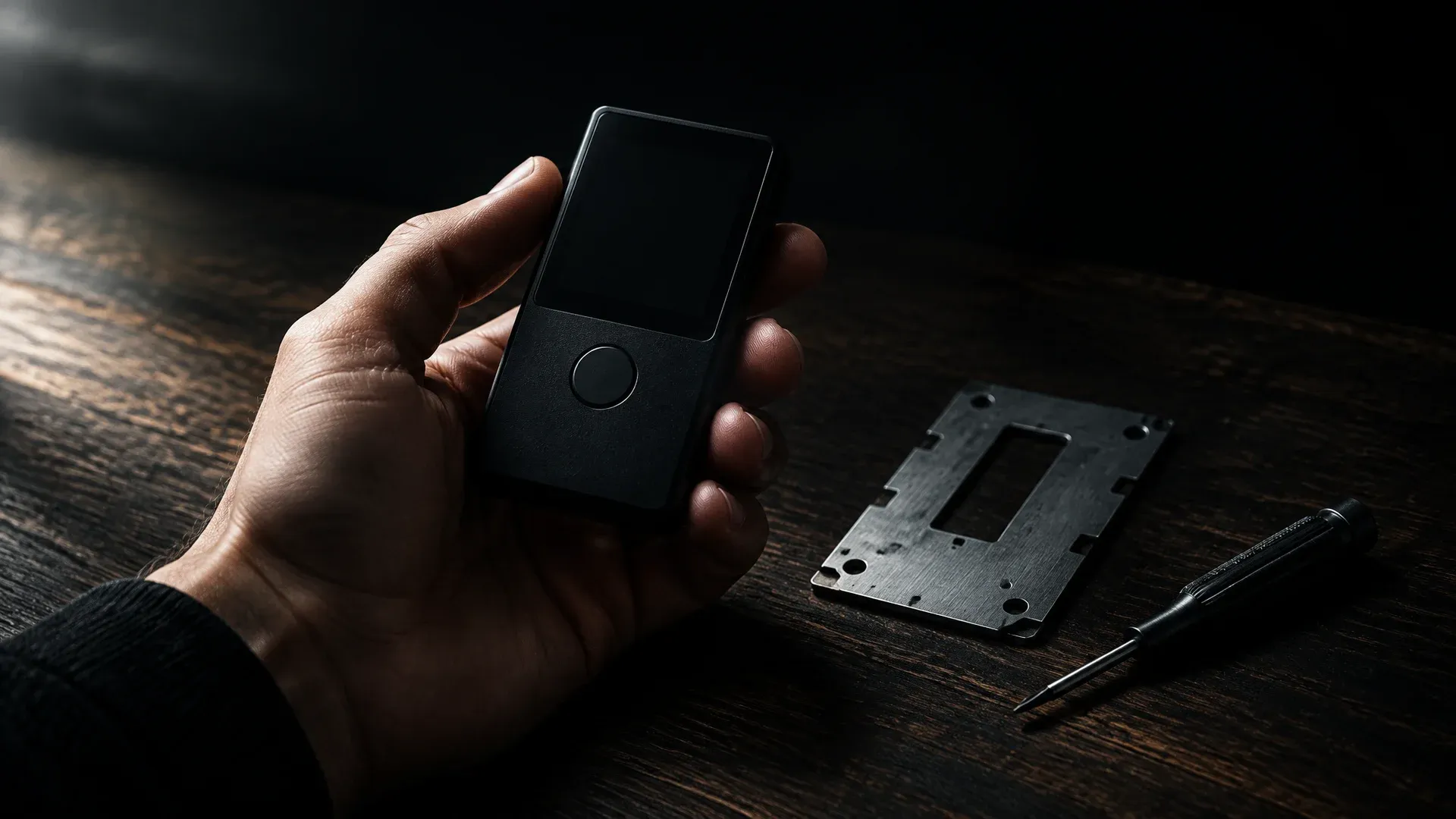
The second decision after buying: do the HBAR stay in the provider's account or move to a device of your own?
Custody: exchange account, software wallet or your own device
After the purchase the HBAR sit in the venue's account at first. That is the most convenient route and at the same time the one decided by others: the provider holds the keys, and you depend on its continued existence and its withdrawal processes. The second route is a software wallet on the phone or in the browser, for Hedera commonly HashPack, which according to the network page also supports staking HBAR directly. The third route is a device of your own: Ledger lists HBAR in its overview of supported networks, and the keys do not leave the device.
Which route fits depends on the amount and the holding period. For 100 euros meant to be sold again in four weeks, a device costing 70 euros is not a sensible outlay. For a holding meant to sit for a year, that reverses. The differences between devices, from recovery to ease of use, are in our hardware wallet comparison. And whichever route you choose: the recovery words never belong in a photo, never in a cloud and never in a messenger message.
Staking without a lock-up: what the documentation says
Staking means assigning your own units to a node of the network so that it carries more weight in the vote on valid transactions, and receiving a reward for it. At Hedera the process is unusual in one respect: the network's technical documentation states expressly that there is no lock-up period when an account is assigned to a node, and that the balance remains available at all times. You can therefore sell the units without first unassigning them and sitting out a waiting period.
Two caveats belong with that, and both come from the same source. First, the Council sets the reward rate and can change it; a return is therefore not promised. Second, rewards only accumulate for up to 365 days if no payout is triggered in the meantime. Leave an account untouched for years and the part beyond that is given away. For completeness: the documentation contradicts itself in its own FAQ section at this point, where it speaks of locked units. The section on basic concepts is the authoritative one, and in case of doubt check the figure in your wallet before relying on it.
44.33 of 50 billion HBAR are in circulation
The quantity has been capped at HBAR from the start: 50 billion units, and the network rules allow no more. Of those, 44.33 billion were in circulation on October 29, which is 88.7 percent. The remaining 5.67 billion, or 11.3 percent of the total, are not yet in the market.
That is the figure missing most often from buying guides, even though it bears directly on the price. Every unit that enters circulation later spreads the same market value across more pieces. A comparison makes the scale tangible: the 5.67 billion HBAR still outstanding correspond to a good 383 million euros at the October 29 price, while the three euro books we measured together traded just under 17 million HBAR in 24 hours. The pipeline is therefore a multiple of daily euro trading. When which portion is released is a question for the network's publications, not for the price.
One year's holding period and the 1,000-euro threshold
In Germany, crypto assets held privately count as other economic goods and therefore precisely not as investment capital. Section 23 of the German Income Tax Act on private disposal transactions is accordingly the governing provision. Sell your HBAR at a profit within one year of buying and that gain is taxed at your personal rate, not at the flat withholding rate. After one year has passed, the gain from the sale stays tax-free.
On top of that comes a limit that is often misunderstood. Section 23 paragraph 3 sentence 5 of the Income Tax Act reads literally: "Gains stay tax-free if the total gain achieved from private disposal transactions in the calendar year amounted to less than 1,000 euros." The decisive words are total gain and less than. It is a threshold, not an allowance: at 1,000 euros of gain the full amount is taxable, not just the part above the line. And it applies to all private disposal transactions of the year taken together, gold and other coins included.
Staking rewards do not run through this provision. Those earnings belong to income from services under Section 22 number 3 of the Income Tax Act, and there a separate, markedly lower limit applies: such income is not subject to income tax if it amounted to less than 256 euros in the calendar year. Anyone planning to stake therefore keeps two sets of books. Tools that keep the two cases apart and count the holding period per purchase are in our overview of crypto tax tools. That is no substitute for tax advice.
Our assessment: what argues for and against getting in
Our view, with the evidence alongside it: Hedera is one of the few networks whose usage costs are fixed in dollars and whose maximum supply is settled. Both remove two uncertainties that exist elsewhere, and both can be read on the network page. For a buyer who cares more about the technology and the cost side than about the price move, that is a defensible argument.
Against it stand three equally documented points. The price sits 61.8 percent below where it stood a year ago and 85.9 percent below the 2021 high, measured on October 29. Eleven percent of the total supply is not yet in circulation and can reach the market later. And decisions about the network, down to the reward rate, are taken in a body in which a private holder has no vote. We therefore speak neither for nor against a purchase, and a total loss remains possible with any crypto commitment. Which exchanges can show a supervisory permission is in our overview of regulated crypto exchanges, linked in the closing section.
Buying Hedera: without a euro pair you pay the fee twice
The sequence that costs least is also the dullest. Three steps are enough:
- Settle the provider and its authorisation. Look up the provider's legal entity in the ESMA register and check whether it is listed there with the services you intend to use. A pre-selection of supervised houses is at the regulated crypto exchanges.
- Buy through the euro pair, not through the detour. All five venues measured quote HBAR against the euro. An order resting in the book cost 0.40 percent at Kraken instead of 1.5 percent, which on 100 euros is around 16 HBAR more. Current tiers are in the comparison of crypto exchanges.
- Fix custody before the holding grows. Up to a small amount the account at the provider is enough; above that, a wallet of your own pays off. The differences between the programs are in the software wallet comparison.
(As of October 29, 2026. This article is not investment advice. Prices and fee structures change; check the terms with the provider before you buy.)