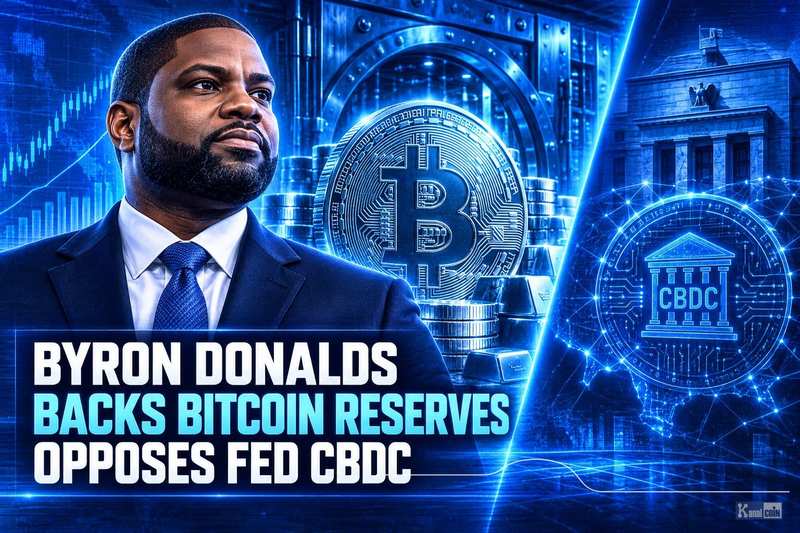
KEY POINTS Florida Congressman Byron Donalds has publicly backed the idea of the U.S. government holding Bitcoin as a reserve asset. Donalds opposes the issuance of a digital currency by the
KEY POINTS
- Florida Congressman Byron Donalds has publicly backed the idea of the U.S. government holding Bitcoin as a reserve asset.
- Donalds opposes the issuance of a digital currency by the Federal Reserve, a concept commonly referred to as a central bank digital currency (CBDC).
- His two-part stance highlights a policy divide in Washington between Bitcoin adoption and government-controlled digital money.
Florida Congressman Byron Donalds has staked out a two-part position on U.S. digital asset policy: he supports the idea of the government holding Bitcoin as a reserve asset, and he opposes the creation of a Federal Reserve-issued digital currency. The stance puts Donalds among a growing group of U.S. lawmakers who distinguish between holding decentralised assets and issuing state-controlled digital money, a distinction that carries real weight for crypto policy from Washington to the exchanges that serve Southeast Asian traders. For related coverage, see Event: Bitcoin Energy Summit 2024.
What Donalds Said About Bitcoin Reserves and a Fed Digital Currency
Donalds has expressed support for a government Bitcoin reserve, meaning the U.S. Treasury or a designated federal body would hold Bitcoin as part of its balance sheet, in a manner comparable to how governments hold gold or foreign currency reserves. This is a policy position Donalds advocates; it does not reflect any enacted law or existing government holding. For related coverage, see XRP Treasury SEC Approval: Capital Raise Explained.
On the other side of the debate, Donalds opposes a Federal Reserve-issued digital currency. The Federal Reserve defines a central bank digital currency as a digital form of central bank money that is widely available to the general public, in effect a government-issued digital dollar. Critics of CBDCs, including Donalds, argue that such a system would give the government unprecedented visibility and control over individual financial transactions.
The contrast between the two positions is deliberate. Supporting a Bitcoin reserve means the government holds an asset it does not control or issue; opposing a CBDC means rejecting a digital money system the government would both issue and administer. For Donalds, the former preserves financial independence while the latter undermines it.
Legislative backdrop
The debate over government Bitcoin reserves and CBDCs has moved through the U.S. Congress in several forms. House Bill 5403 from the 118th Congress is one legislative reference point in the broader effort to restrict or prohibit a retail CBDC in the United States, reflecting the same concern Donalds has voiced publicly. No standalone Bitcoin reserve legislation has been enacted at the federal level as of October 2026.
Two Different Government Roles in Digital Assets
The policy contrast Donalds draws maps onto a genuine structural difference. A government Bitcoin reserve treats Bitcoin as a store-of-value asset held on a public balance sheet, similar to how several central banks hold gold. The government acquires the asset but does not create, issue, or control it. Supporters argue this provides a hedge and demonstrates confidence in the asset's long-term value.
A central bank digital currency operates on an entirely different logic. In that model, the Federal Reserve or a designated authority would issue and manage a digital version of the U.S. dollar. Unlike Bitcoin, a CBDC is centralised by design, with the issuing authority setting the rules for how the currency can be used. Programmability features, such as expiry dates or spending restrictions, are technically possible in some CBDC designs, and that potential has fuelled bipartisan concern among U.S. lawmakers.
Reserve asset versus government-issued digital money
The distinction matters for how regulators and exchanges in Southeast Asia interpret U.S. policy signals. Platforms like those tracking Bitcoin's price movements already operate in regulatory environments where CBDC pilots are active, including Thailand, the Philippines, and Singapore. A U.S. congressional push toward Bitcoin reserves, alongside formal resistance to a Fed-issued digital dollar, sends a different message to regional regulators than blanket crypto hostility would.
If the U.S. were to formally establish a Bitcoin reserve, it would be among the largest sovereign holders of the asset globally. That prospect has a direct bearing on how exchanges such as Indodax in Indonesia or Coins.ph in the Philippines price risk and structure their institutional offerings, even though no such reserve exists today.
Policy Questions Still Unanswered
Donalds' stated position leaves open several significant questions. He has not publicly detailed how a government Bitcoin reserve would be structured, what size it should reach, which agency would custody the holdings, or how it would be funded. Without that specificity, the position remains a political signal rather than a legislative blueprint.
On the CBDC side, opposition is more common than detailed alternative proposals. The Federal Reserve has said it would not issue a CBDC without explicit authorisation from Congress, meaning any retail digital dollar remains years away from reality even if support existed. Regulatory milestones in other jurisdictions, such as Switzerland approving its first Bitcoin ETF, show that Western financial regulators are moving on digital asset rules, even as U.S. policy stays contested.
For Southeast Asian markets, the U.S. policy debate is a leading indicator rather than a direct mandate. Regional exchanges and regulators watch Washington closely, especially when U.S. lawmakers align or split on whether Bitcoin belongs on government balance sheets and whether state-issued digital currencies threaten financial privacy. Donalds' dual position, pro-reserve and anti-CBDC, represents one side of that debate clearly, but it will take more than a congressman's advocacy to shift U.S. policy in either direction.
Crypto advocates in the region who follow debates over Bitcoin's long-term viability as a reserve asset will note that endorsements from elected officials do not resolve questions about custody risk, volatility, or sovereign precedent. Whether Donalds' stance gains legislative traction, or remains a policy marker ahead of future budget and monetary debates, is a question that Southeast Asian exchanges, regulators, and investors will be watching closely.
Disclaimer: This article is for informational purposes only and does not constitute financial or investment advice. Cryptocurrency and digital asset markets carry significant risk. Always do your own research before making decisions.
Read original article on kanalcoin.com