Canton fell below the 8-cent mark on Sunday, November 15, 2026. According to CoinGecko, the coin, which trades under the ticker CC, cost $0.0799 at 8:48 a.m. German time, or €0.0725, down 5.5
Canton fell below the 8-cent mark on Sunday, November 15, 2026. According to CoinGecko, the coin, which trades under the ticker CC, cost $0.0799 at 8:48 a.m. German time, or €0.0725, down 5.5 percent from 24 hours earlier. The overnight low was $0.0750. As far as was known by the morning, there is no Canton-specific trigger: the coin is falling with the entire crypto market, which has been hit by rate fears and fund outflows since Friday. Anyone following the Canton Network price prediction now sees the price at its lowest since mid-December 2025.
This article puts the day's figures into context, maps the price levels below $0.08 and explains what open interest, the funding rate and the long/short ratio on the Canton perpetual are currently signalling. It also shows why leverage works just as fast on an eight-cent coin as it does on bitcoin.
Canton crash on November 15: price, daily range and volume
According to CoinGecko, the 24-hour high was $0.0856 and the low $0.0750, a gap of just over 14 percent. On the Kraken exchange, Canton closed Saturday at $0.07766, after $0.08552 on Friday, a daily loss of 9.2 percent. On Sunday morning the price recovered slightly to just under $0.080, after sliding as low as $0.07499 on Kraken overnight.
Volume rose sharply. On Kraken, about 21.3 million CC changed hands against the US dollar on November 14. Over the previous seven days, the average was just under 9.8 million CC a day. Saturday therefore brought 2.2 times the volume of an ordinary day, even though weekends usually see less trading. Rising volume alongside falling prices shows that real selling took place, rather than a handful of orders moving the price.
Market capitalization, the price multiplied by the number of coins in circulation, fell to about $3.20 billion, according to CoinGecko. Just over 40 billion CC are in circulation. The coin is down 14.0 percent over seven days, 26.3 percent over 30 days and 28.4 percent over one year.
When was Canton last this low?
The close on November 14 was the lowest since December 18, 2025, when Canton closed at $0.0757 on Kraken. The overnight low of $0.07499 also has a precedent from the same period: on December 19, 2025, the price fell as low as $0.07413 intraday. At the time, the coin was at the end of a weak phase that had bottomed on December 5, 2025, with a close of $0.0623. CoinGecko puts the all-time low at $0.0590, from December 6, 2025.
What followed was the steepest rally in the coin's short history. By February 2, 2026, the Kraken close had climbed to $0.188, and CoinGecko records the all-time high at $0.1942 on February 3. Canton now trades 58.8 percent below that record. Exactly one year ago, on November 15, 2025, the coin closed at $0.1133.
Why is Canton falling? The market sell-off also hits Wall Street's blockchain coin
Canton's decline is part of a broad sell-off. In the 24 hours to 8:48 a.m., bitcoin lost 4.7 percent according to CoinGecko and traded at around $63,900, while ether fell 6.0 percent to around $1,780. The crypto crash today usually hits smaller coins harder, because their markets are thinner and investors cut riskier positions first under stress. Our background piece gives a detailed answer to the question of why bitcoin is falling.
Trade media agree on three pressures. The first is the rate outlook. According to CME FedWatch, futures markets on November 14 priced an 88.5 percent probability that the US Federal Reserve will raise its policy rate by a quarter point at its December 8 and 9 meeting, as Bitcoin.com reports. Higher rates make credit more expensive and speculative assets less attractive.
The second pressure is fund outflows. According to data from Farside Investors, investors pulled about $1.07 billion from US spot bitcoin ETFs between November 9 and 13, and $398.9 million from ether funds, Coinpaper reports. The third is liquidity: the same outlet cites Coinbase Institutional's weekly report, which says the combined supply of the stablecoins USDT, USDC and DAI shrank by $11.5 billion within 30 days. Stablecoins are tokens pegged to the dollar that investors use to buy on crypto exchanges. When their supply shrinks, buying power is missing.
Sentiment is captured by the Fear and Greed Index from alternative.me, a gauge running from 0 for extreme fear to 100 for extreme greed. It stood at 10 points on November 15, after 13 the day before. We also summarise the day's reasons under why is crypto down.
Canton has one particular feature. Large financial institutions use the Canton Network to represent securities and other assets as tokens. Since October, it has carried the tokenization work of the US depository DTCC, which we covered in Canton carries the DTCC tokenization. That institutional use clearly does not protect the coin's price in a general sell-off. The reason lies in the model: institutions pay fees on the network but do not necessarily hold large CC positions that they would support in a crisis.
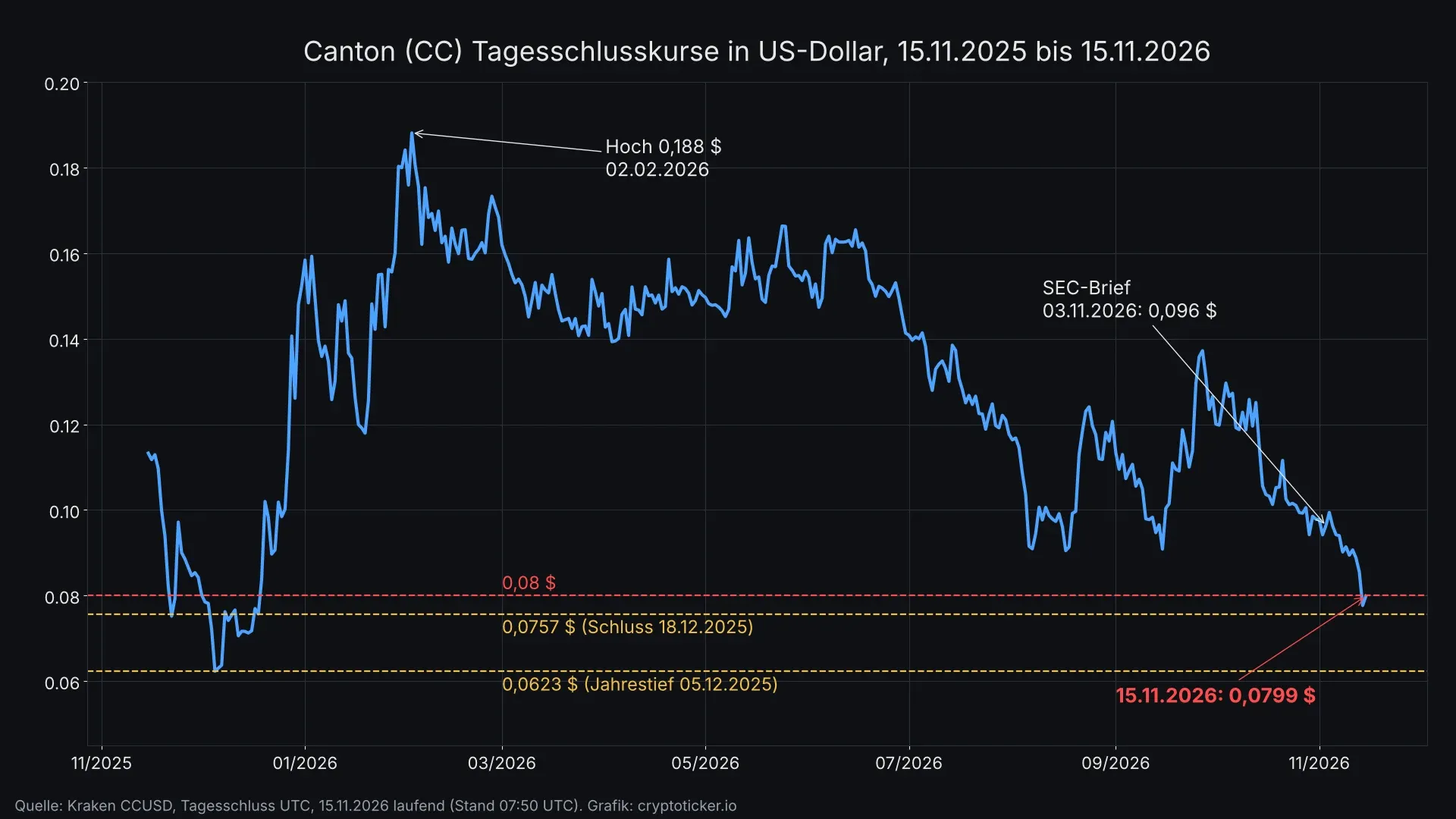
Canton's daily closes on Kraken over twelve months: the price has fallen almost back to where the December 2025 rally began.
Canton since the February high: from $0.188 to below $0.08
The chart shows Canton's daily closes on Kraken over the past twelve months. After the December 2025 low, the price tripled within eight weeks. From February to June it then oscillated between $0.14 and $0.17. Since July, the curve has shown a series of lower highs and lower lows, interrupted by an interim high at the end of September at just under $0.14. In November alone, the close fell from $0.0942 on November 2 to $0.0777 on Saturday.
Canton after the SEC letter: down 17 percent in twelve days
The timing stands out. On November 3, 2026, the Division of Corporation Finance at the US Securities and Exchange Commission stated in a so-called no-action letter that it regards Canton Coin as a digital commodity, as The Block reports. A no-action letter is a statement by agency staff that they will not recommend enforcement action under the conditions described; it is not a binding ruling on whether a token is a security. What that means for investors is covered in our piece on Canton Coin at the SEC. On the day of the letter, CC closed at $0.0964 on Kraken, and a day later at $0.0994. Since then the coin has lost 17 percent. Regulatory clarity has not shielded the price from the market slump.
25th place at risk: Canton versus Avalanche
With a market capitalization of $3.20 billion, Canton is just holding on to 25th place among the largest cryptocurrencies, according to CoinGecko. Avalanche follows directly behind with $3.19 billion, a gap of less than one percent. Avalanche, however, lost 10.8 percent over the same 24 hours, almost twice as much; more on that in our piece on the Avalanche crash. Among the 25 largest coins, Cardano, Dogecoin and Monero lost the most at 8:48 a.m., each slightly more than 8 percent, according to CoinGecko, while Litecoin shed 7.2 percent. At 5.5 percent, Canton sits in the middle of the losers, similar to NEAR Protocol at 5.9 percent.
Leverage on Canton: what 10x and 100x mean for an 8-cent coin
A low unit price misleads many investors. A coin priced at eight cents does not swing less in percentage terms than one priced at $60,000; if anything, the opposite is true. Leverage multiplies the effect of every price move on the capital committed, in both directions. With 10x leverage, a 10 percent price change moves the position by 100 percent. If Canton rises from $0.0799 to $0.0879, a 10x long position doubles the capital committed. If Canton falls from $0.0799 to $0.0719, that capital is wiped out. In practice, the exchange closes the position slightly earlier because it holds back a safety margin for fees and slippage.
At 100x, about 1 percent is enough. A long position opened at $0.0799 would already be gone at around $0.0791. The 24-hour high of $0.0856 and the low of $0.0750 were just over 12 percent apart. A long position opened at the high with leverage of about 8x or more would, on paper, not have survived the fall to the low. A short position works the other way round: it gains when the price falls and is liquidated when it rises. The rebound from the overnight low of $0.0750 to just under $0.080 amounts to just over 6 percent; a 20x short opened at the low would have been wiped out.
Stop-loss and position size in Canton trades
A stop-loss is an order that automatically closes a position once a set price is reached. It limits the loss before liquidation kicks in. Leveraged traders also size their positions so that a loss up to the stop-loss costs only a small part of the account; 1 to 2 percent is a figure often cited. For a coin like Canton, one point matters in particular: the futures market is small. In fast phases, a stop-loss can be filled well below the intended price because there are no buyers between two price levels. Our explainer on long and short in crypto sets out exactly what the two terms mean.
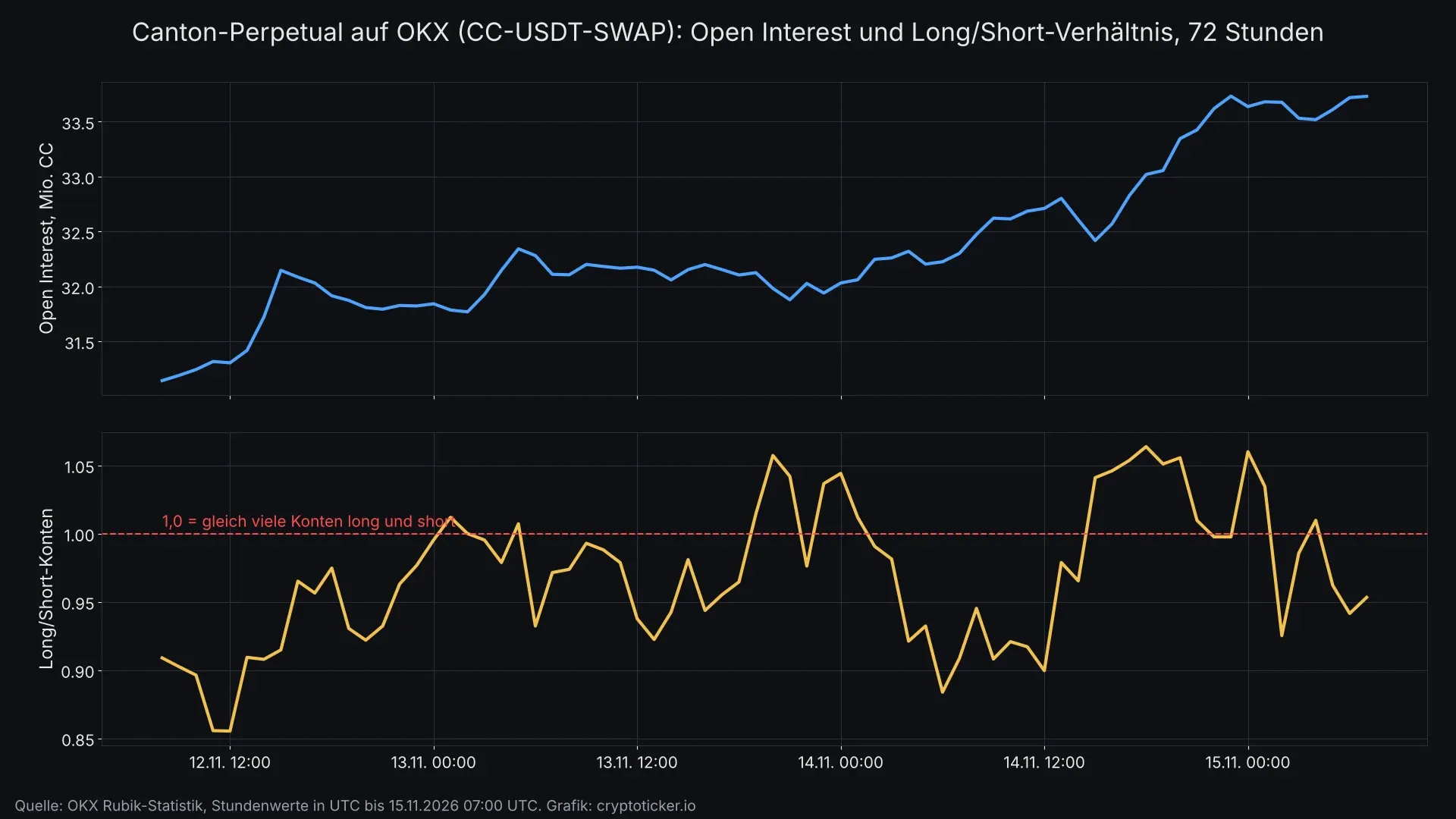
On the Canton perpetual on OKX, the number of open contracts grew while the price fell.
Canton open interest: more open bets despite falling prices
Open interest is the volume of all open futures contracts on a coin. When it rises, new bets are being added; when it falls, positions are being closed or forcibly unwound. Our piece what open interest is offers a detailed explanation. On the Canton perpetual on OKX, a futures contract with no expiry settled against the stablecoin USDT, open interest rose according to the exchange's hourly data from 31.1 million CC at 9 a.m. German time on November 12 to 33.7 million CC at 8 a.m. on November 15. That is an increase of just over 8 percent. In dollar terms, the value stayed almost unchanged at around $2.7 million, because the price fell over the same period.
Two conclusions follow. First, the slump in Canton did not trigger a large wave of forced closures on OKX; otherwise the number of open contracts would have fallen. Second, the futures market is small compared with the spot market. On Kraken alone, about $1.7 million worth of CC changed hands on Saturday, and according to CoinGecko total trading volume across all exchanges is about $20 million a day. Canton's price is therefore driven mainly by unleveraged buying and selling, unlike bitcoin or ether, where liquidations running into the billions set the pace. Our piece on the crypto liquidations shows how large the forced closures were across the market.
Long/short ratio and funding rate: traders are split
The long/short ratio of accounts shows how many accounts are betting on rising prices relative to falling ones. A value of 1.0 means the same number of accounts on each side. For Canton on OKX, it fluctuated between 0.86 and 1.06 over the past 72 hours. At 8 p.m. German time on Saturday evening it stood at 1.05, shortly before the price made its steepest move lower late that evening. At 8 a.m. on Sunday it stood at 0.95, so the short side was slightly in the majority.
The funding rate fits that picture. It is the payment that flows regularly between the long and short sides of perpetuals to keep the contract price close to the spot price. When it is positive, longs pay; when it is negative, shorts pay. For the current period to 1 p.m. German time, OKX showed minus 0.035 percent for Canton. Shorts are paying longs, a sign that more capital is betting on further declines than on a recovery.
Will Canton fall below $0.0757? The levels from the price history
The daily closes on Kraken produce three levels to the downside. The first is the overnight low of $0.07499. The second is the close of December 18, 2025, at $0.0757, the lowest close so far after the December low. If Canton closes below it, the coin will be at its lowest in almost a year. The third is the low of the weak phase on December 5, 2025, at $0.0623 on a closing basis; the all-time low according to CoinGecko is just below it at $0.0590.
To the upside, the first hurdle is $0.0855, where Canton closed on Friday. Above that comes the area around $0.09, where the price closed for several days from November 9 to 12. Such levels are not a forecast; they only show where the price last traded for some time, and therefore where many investors may have placed buy or sell orders. How far the overall market could still fall is examined in our piece on how low bitcoin can fall; the live bitcoin price is on our price page.
Trading Canton in Germany: MiCA exchanges, futures and CFDs
In Germany, there are three ways to buy or sell Canton or to bet on a move. The simplest is to buy through a crypto exchange licensed under the EU crypto regulation MiCA. MiCA stands for Markets in Crypto-Assets and has governed across the EU since the end of 2024 which providers may trade and hold crypto assets for clients. Kraken and OKX, for example, list CC for trading according to their own market data. Our comparison of the best crypto exchanges shows which platform charges which fees.
The second route is futures and perpetuals such as the OKX contract described above, which allow long and short trading with leverage. Such contracts are offered by centralized exchanges and by decentralized trading venues, which our perp DEX comparison lists. Check there whether a given venue offers a Canton contract before you open an account. The third route is CFDs, contracts for difference on the price, which CFD brokers such as XTB offer on cryptocurrencies. A CFD only tracks the price movement; you do not own any coins.
CFDs are complex instruments and come with a high risk of losing money rapidly due to leverage. A high percentage of retail investor accounts lose money when trading CFDs. You should consider whether you understand how CFDs work and whether you can afford to take the high risk of losing your money.
Sell or hold Canton? Two scenarios after the crash
This article cannot and will not make a recommendation. It does help, however, to frame the situation in conditions that can be checked.
In the first scenario, the broader market calms down. Bitcoin stabilizes, ETF outflows ease and Canton holds $0.0757 on a daily closing basis. The coin would then stay above the December 2025 low, and a recovery towards $0.0855, where the price still closed on Friday, would be possible. In that case, the case for Canton rests on its use by financial institutions, which we have covered, for example, in our piece on the integration with Ripple Custody.
In the second scenario, the sell-off continues, driven by further fund outflows or a sharper rate outlook ahead of the Fed's December meeting. If Canton closes below $0.0757, the December low of $0.0623 comes within reach. The negative funding rate shows that some traders are betting on exactly that. How investors in the bitcoin market handle the same question is described in our piece on whether to buy or sell bitcoin. What earlier downturns show is set out in our piece on the bitcoin bear market, and the conditions under which analysts expect a recovery in our piece on when bitcoin will rise again.
Whatever the scenario, anyone holding Canton with leverage should check their liquidation price against the levels above. Anyone holding without leverage loses money if prices keep falling, but is not forced out of the position.
Crypto crash of November 14 and 15: where Canton stands in the field
Canton is not alone this weekend. Our crypto news on the bitcoin slump gives an overview of Friday and Saturday. How the decline fits into conditions across other financial markets is shown in our overview of the financial crash. Our piece Litecoin price falls to $45 puts Saturday evening's drop in Litecoin into context.
For Canton, the situation cuts both ways. With the classification by SEC staff and the DTCC tokenization, the coin received two pieces of news this autumn that many investors had been waiting for. Both landed in a market that has been heading lower since October. Whether use by banks and custodians supports the price over the long term will only become clear once pressure from the broader market eases.
Canton price: below $0.0757 lies the December low
- Note the levels. The December 18, 2025, close of $0.0757 will decide the next move; below it lies the December low of $0.0623. Providers that list Canton are in our comparison of crypto exchanges.
- Recalculate your leverage. Leveraged traders should work out their own liquidation price and set a stop-loss. Our comparison of crypto brokers lists platforms for futures and CFDs.
- Choose a venue. For buying and selling without leverage, providers with a MiCA licence are suitable. The overview of MiCA-regulated exchanges shows which ones they are.
(As of November 15, 2026. This article is not investment advice. Prices and fee structures change; check the terms with the provider before you buy.)
