Cardano ADA News: What $ADA Recovery And Way Ahead Tells in 2026 ADA touched $0.1966 this week, its highest print since July 4, before settling near $0.1933, down 0.44% today. This Cardano AD
Cardano ADA News: What $ADA Recovery And Way Ahead Tells in 2026
ADA touched $0.1966 this week, its highest print since July 4, before settling near $0.1933, down 0.44% today. This Cardano ADA News update lands alongside a stranger detail: the network lost 7,070 non-empty wallets over the past two months, even as price climbed, per Santiment Intelligence.
Cardano ADA News: Why the Rally Happened This Week Across Markets
$ADA Market cap rose close to 25.03% over the past week, according to CoinMarketCap data, placing $ADA among the cleanest gainers in a choppy altcoin stretch. Current price stands at $0.196, up 0.45%.
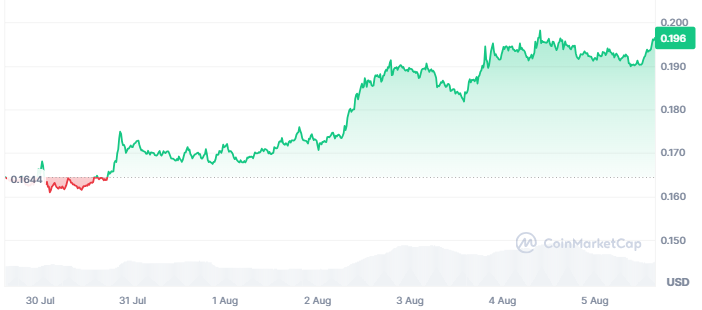
Current market snapshot, per live data:
Market cap: $7.05B, down 0.46% on the day
24-hour volume: $397.14M, down 45.74% from the prior day
Fully diluted valuation: $8.69B
Circulating supply: 36.5B ADA, against a 45B max supply
All-time high: $3.10 on September 2, 2021
All-time low: $0.01735 on October 2, 2017
A later CoinMarketCap reading showed the blockchain weekly gains cooling to 18.2%, with the monthly figure sitting near 5%.
In this Cardano ADA news today, large holders drove most of the move.
How the Whale Accumulation Pattern Works Behind This ADA Price Move
Large wallets, holding between 100 million and 1 billion $ADA, added more than 240 million $ADA in recent weeks, based on CoinCodex tracking. Smaller wallets moved the opposite direction, and non-empty wallet count dropped to 4.62 million, down 7,070 from two months earlier.
That split explains the price move. When smaller holders sell or step away, larger wallets absorb the supply, tightening free float and letting price rise even as total holder count falls.
This bounce followed a rough patch earlier in 2026. Analytics and NFT platform shutdowns, governance friction, and thin activity relative to market size had pushed ADA down toward the mid-$0.15 range before this recovery began.
Major Cardano Development Updates: The Ecosystem This Month
Development work has kept pace with Cardano ADA News on price action.
The Van Rossem hard fork, Protocol Version 11, went live on mainnet around July 18, 2026, It marked the first major upgrade driven fully by on-chain governance, covering DReps, stake pool operators, and the Constitutional Committee.
Recent progress across the ecosystem:
Ouroboros Leios public testnet, called Musashi Dojo, has run since June with steady updates to block certification and mempool design
Mithril continues advancing recursive circuit work and smaller certificate sizes
A Pyth integration now offers free one-year Pro API keys with no usage caps for institutional-grade price feeds
Project Catalyst opened a new pilot fund near 2.5 million $ADA, aimed at stablecoins, identity, and programmable token work
Broader efforts include LayerZero interoperability testing and continued node tooling updates tied to Plutus V4.
How Charles Hoskinson Views Cardano in 2026
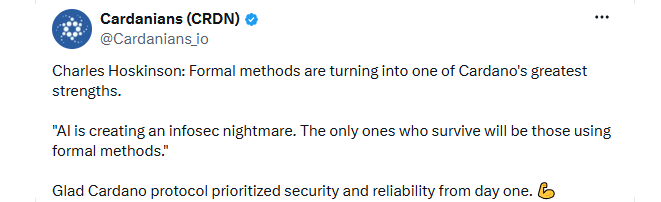
In a recent talk, Charles Hoskinson, Cardano founder, pointed to formal methods as one of the $ADA network's core strengths, arguing that artificial intelligence has created serious security risks industry-wide and that only protocols built on rigorous verification will hold up over time.
In an overall way, Hoskinson views the blockchain a long-term project built around security, decentralization, research, and real-world utility.
He continues to describe the platform as a third-generation blockchain designed to address the chain trilemma through its Oroboros proof-of-stake, Extended UTXO model.
At the same time, Hoskinson has acknowledged the challenges facing the ecosystem. Amid weak $ADA price performance from its peak, governance friction, and criticism from the wider crypto market, he said the chain needs to “change the approach.”
In a recent comment, he argued that Cardano’s biggest challenge is no longer technology but perception and branding.
What Comes Next on the Cardano Roadmap Toward Higher Throughput Levels
Scaling remains the central focus through Leios and the wider Dijkstra-era upgrades rollout. Leios adds endorser blocks and parallel validation. Throughput estimates range from several times current capacity up to 65 times, depending on configuration and rollout phase, as per Input Output research (ecosystem products).
Near-term roadmap steps:
Continued adversarial testing on the public testnet with ongoing parameter tuning
A move toward mainnet-ready release candidates backed by formal specification work
Initial Dijkstra-era hard fork phases targeted for late 2026
Conservative mainnet activation, followed by gradual capacity increases
To track the chain, the real test ahead is whether Leios and related upgrades convert into daily usage and deeper liquidity, since accumulation alone will not carry this move past its current ceiling without stronger fundamentals behind it.
Disclaimer: This article is for informational purposes only and does not constitute financial or investment advice. Crypto markets carry significant risk. Always do your own research before making any investment decisions.