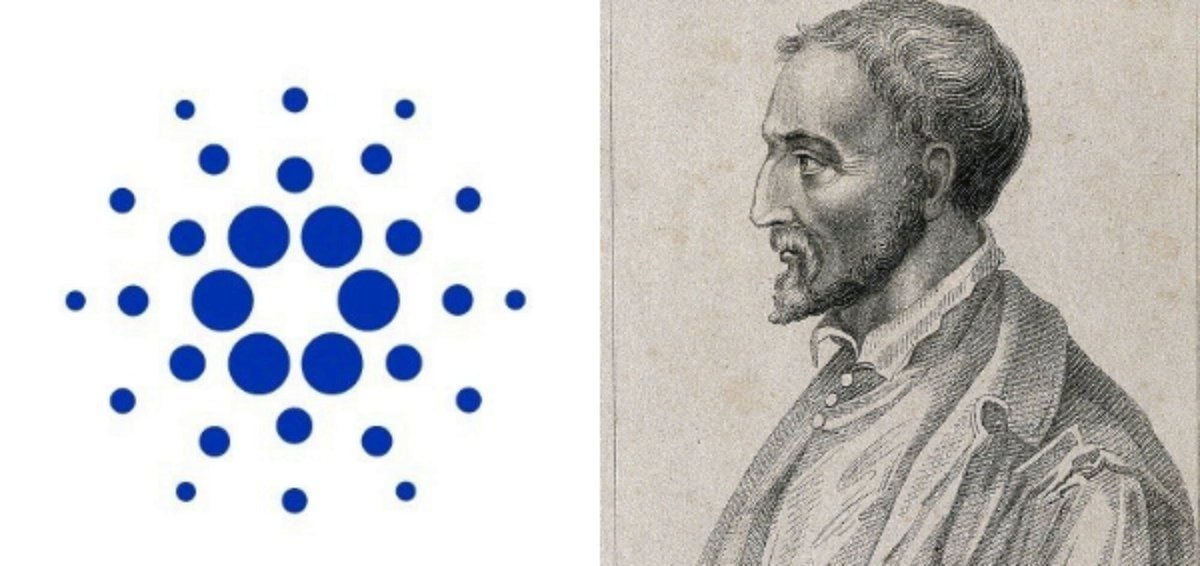
Cardano, the proof-of-stake blockchain, and its native coin $ADA take their names from two mathematicians born roughly 300 years apart. The naming theme also extends to the smallest unit of A
Cardano, the proof-of-stake blockchain, and its native coin $ADA take their names from two mathematicians born roughly 300 years apart. The naming theme also extends to the smallest unit of ADA and to the way the network's development stages are labeled.
Two names, two mathematicians
@Cardano is named after Gerolamo Cardano, a 16th-century Italian polymath who worked as a doctor and mathematician. The Italian physician, mathematician and scholar lived from 1501 to 1576. He also introduced the Cardan grille, a cryptographic writing tool.
The coin, $ADA, honors Ada Lovelace, the 19th-century English mathematician often described as the first computer programmer. Lovelace was born on December 10, 1815, in London.In 1843 she translated an article on Charles Babbage's invention and added extensive notes describing how the machine could be programmed.
The tribute carries through to the coin's denominations. ADA's sub-unit is the lovelace, and one ADA equals 1,000,000 lovelace. The structure mirrors Bitcoin's satoshi, the smallest unit of $BTC.
The theme in Cardano's roadmap
The naming convention continues in Cardano's development plan. The development phases are Byron, Shelley, Goguen, Basho and Voltaire, all named after poets except for Goguen, a computer scientist. Byron links back to Lovelace, as Lord Byron was her father. The Byron era is named after George Gordon Byron, the English poet, peer and politician.
Each phase maps to a set of features. Byron established the core technology, including the consensus mechanism and ADA. Shelley decentralized block production and introduced staking. Goguen enabled smart contracts and dApps, while Basho focused on scaling and optimization.Voltaire represents the culmination of these efforts, establishing decentralized governance.
Separate from the phases, Cardano also names its ledger eras, which are introduced through hard forks. Starting with Alonzo, eras are planned to be named after mathematicians and computer scientists in alphabetical order.Mary brought native tokens and multi-asset functionality to Cardano, while Alonzo introduced smart contract support. Babbage, named for the inventor whose machine Lovelace wrote about, follows Alonzo in that sequence.
The naming has drawn fresh attention as Cardano nears its ninth anniversary. The Cardano Foundation has revisited the naming origins of the network and its native token, tying them to mathematics and science.
Sources
Cardano Docs: Development phases and erasWikipedia: Cardano (blockchain platform)CoinMarketCap Academy: Lovelace definition