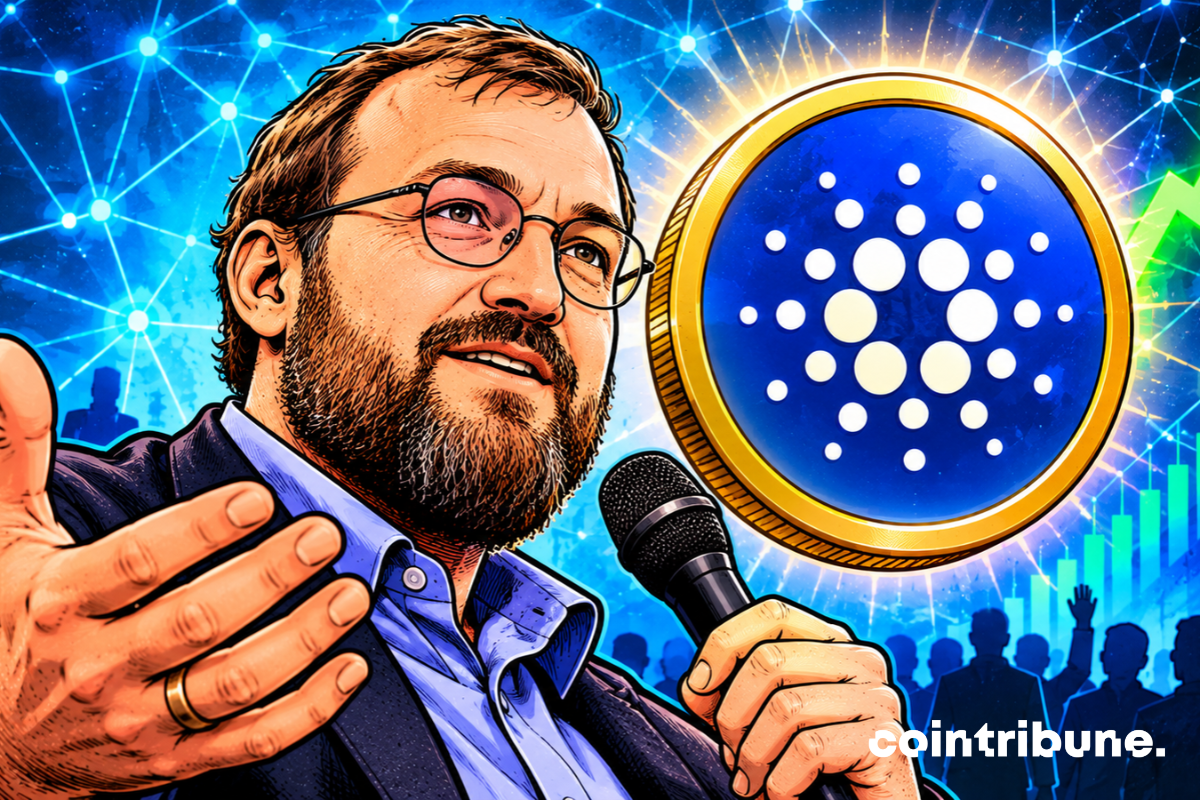
The founder of Cardano, Charles Hoskinson, claims to have completed all the work announced in his roadmap. During a recent live broadcast, he responded to criticism from investors unhappy wit
The founder of Cardano, Charles Hoskinson, claims to have completed all the work announced in his roadmap. During a recent live broadcast, he responded to criticism from investors unhappy with the sharp decline of the ADA token. While the cryptocurrency remains far from its 2021 all-time high, the debate now focuses on the founder’s responsibilities and the financial expectations of his community. Hoskinson nevertheless believes he has fulfilled his commitments.
In brief
- Charles Hoskinson claims to have completed all stages of Cardano’s roadmap.
- The founder rejects accusations that he had promised to surpass Bitcoin.
- The five development eras were completed with decentralized governance introduced in 2025.
- Hoskinson believes the network can now operate without his direct intervention.
- ADA has lost 86% since its peak of $1.21 reached at the end of 2024.
Charles Hoskinson defends Cardano’s record against investors
On Saturday, Charles Hoskinson defended Cardano’s progress during a live broadcast on YouTube. In particular, he responded to several interventions regarding his past statements and investors’ expectations. An internet user, using the pseudonym shevilkid1738, accused him of having promised that the project would surpass Bitcoin. The founder immediately disputed this claim, believing that no evidence confirmed such a promise.
I never promised that. I said I would really like that to happen, and I believe that Cardano is a better store of value than Bitcoin for various reasons.
Charles Hoskinson, founder of Cardano.
Hoskinson explained that he had simply expressed his wish to see Cardano become more important than Bitcoin. He also considers that his network has several interesting features as a store of value. However, he recalled that he never guaranteed a rise in the ADA price. According to him, mentioning a possibility does not mean promising a financial result to token holders.
More than an hour after this exchange, the same internet user presented another statement from the founder. He reminded him that he had thought Cardano would probably become the largest global cryptocurrency. Hoskinson then insisted on the difference between a personal conviction and a firm commitment. He also claimed to have accomplished everything that depended on him, especially concerning the decentralization of the network.
Your 1st cryptos with BinanceThis link uses an affiliate program.
A roadmap completed after five major stages
To justify his position, Charles Hoskinson relies on Cardano’s technical evolution since its launch. The project had organized its development around five major periods: Byron, Shelley, Goguen, Basho, and Voltaire. Each corresponded to specific objectives concerning the operation, capabilities, and governance of the blockchain. According to its founder, these different stages have now achieved the announced goals.
The first period, Byron, launched the network in September 2017. Then, Shelley introduced staking in July 2020, allowing holders to participate in the network’s operation. In September 2021, Goguen brought smart contracts thanks to the Alonzo hard fork. This development allowed developers to build applications directly on the blockchain and expand its technical possibilities.
The Basho period then focused on processing capacity and scaling. The Vasil upgrade marked this stage in September 2022. Then, the Chang hard fork launched Voltaire in September 2024, with the introduction of new governance mechanisms. Finally, January 2025 marked another significant advance with the Plomin hard fork, which strengthened the decision-making power of ADA holders.
This last upgrade gave token holders a real vote on the network’s future. It thus marked a transition to fully decentralized governance. Participants can now choose the ecosystem’s directions without depending directly on Hoskinson. For the founder, this evolution confirms that the project has reached the final stage of its initial roadmap.
Decentralization ends the central role of Cardano’s founder
During his intervention, Hoskinson also insisted on the loss of his direct power in the ecosystem. He believes the network now operates autonomously and can choose its own leaders. This organization no longer requires his approval for making important decisions. Therefore, he considers that his personal responsibility cannot remain the same as in the early years of the project.
The roadmap is complete. Everything I had announced as needing to be built has been built. Its value has quadrupled compared to Honda’s. Millions of people have used it and millions more continue to use it. It is autonomous and self-managed, capable of choosing its own leaders without my consent.
Charles Hoskinson, founder of Cardano.
This position provoked a new reaction from the internet user, who found it abnormal that a founder could disengage like this. He notably believed that investors still had legitimate expectations of the person who launched the project. Hoskinson then asked him when this obligation should end. He answered by recalling that the announced features had been developed and that millions of people had used the network.
The founder also presented the value created by the project as an element of his record. According to his statements, this value has been multiplied by four compared to Honda’s. He also pointed out that millions of users continue to participate in the ecosystem. For him, the blockchain’s autonomy now constitutes an essential result of his initial work.
Behind this confrontation, the decline of the ADA price occupies a central place. The cryptocurrency had reached $3.09 in 2021 before entering a long period of decline. In 2023, its price had dropped to about $0.25. It then rose by 384% to reach $1.21 at the end of 2024. Since this intermediate peak, the token has lost 86% of its value.
This evolution partly explains the tensions between Hoskinson and some investors. Despite Cardano’s technical advances, ADA holders also expect financial results. However, the founder believes this expectation cannot define the end of a network’s development. He thinks part of the community now confuses the project’s progress with the price evolution of its asset.
Hoskinson illustrated this opposition with several examples of purchase prices. An investor who bought tokens at $3 hopes to see them reach $5. Another, entered at $5, then expects a rise to $7. According to him, satisfying each new expectation would indefinitely postpone the end of commitments. He therefore rejects the idea that his work could depend solely on token holders’ financial gains.
The future will now depend on the ecosystem’s ability to operate without direct intervention from its founder. Decentralized governance will have to prove its effectiveness while investors continue to watch ADA‘s evolution. The next steps no longer depend solely on Hoskinson’s personal commitments but also on the community’s collective decisions. This transition could sustainably reshape the relationships between the founder and token holders.